
Zenodo Scraper: Datasets, Software & Research Output
Pricing
from $0.56 / 1,000 record scrapeds
Zenodo Scraper: Datasets, Software & Research Output
Scrape Zenodo records: datasets, software, publications and posters with DOI, licence, files, version history and public download stats. No login, no proxy, no browser.
Pricing
from $0.56 / 1,000 record scrapeds
Rating
0.0
(0)
Developer

Arman Hossain
Maintained by CommunityActor stats
0
Bookmarked
1
Total users
0
Monthly active users
17 days ago
Last modified
Categories
Share
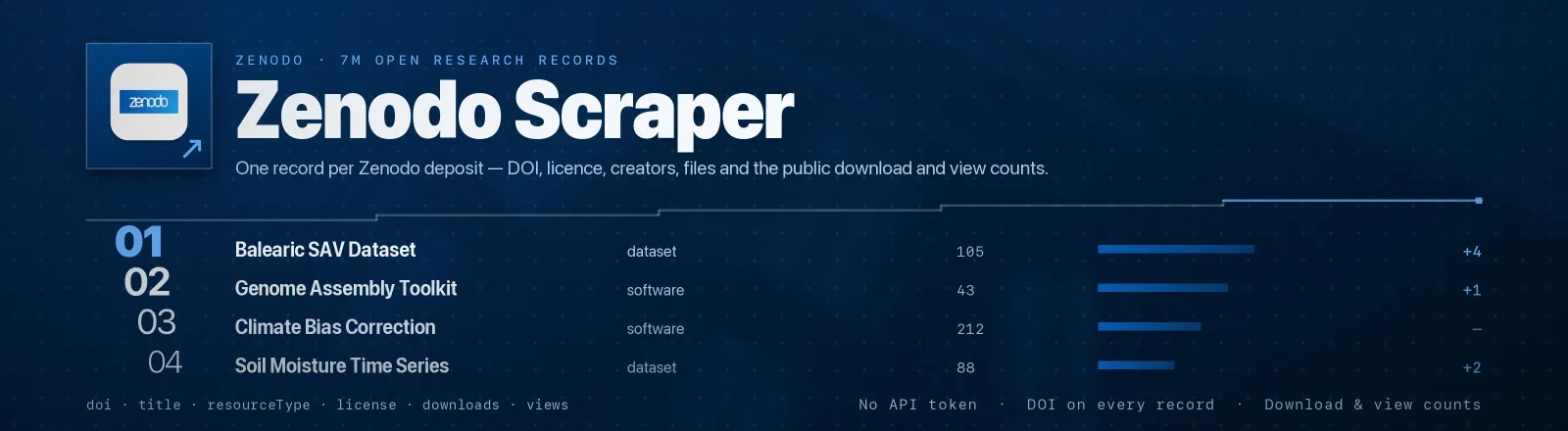
Zenodo Records Scraper searches Zenodo, CERN's open research repository, and returns one structured record per deposit, DOI, title, plain-text description, creators with ORCIDs, licence, keywords, communities, file listings with direct download URLs, version, related identifiers and the public download and view counts.
Zenodo runs a documented REST API over its entire catalogue of 7 million records. This Actor reads it directly: no browser, no proxies, no login, no API token.
Agent skill: SKILL.md
What you get
| Output field | Meaning |
|---|---|
recordId, doi | Zenodo record ID and the minted DOI |
title | Record title |
description | Abstract as clean plain text, HTML stripped, entities decoded |
creators | Authors with name, affiliation and orcid |
resourceType | dataset, software, publication, poster, image, … |
publicationDate | Publication date as YYYY-MM-DD |
license | SPDX-style licence id (cc-by-4.0, mit, …) |
keywords | Depositor-supplied keywords |
communities | Community slugs the record belongs to |
files | File name, byte size, checksum and direct download URL |
downloads, views | Public usage statistics, unusual for a repository to expose |
version | Version string, when the depositor set one |
relatedIdentifiers | Linked DOIs/URLs with their relation type (isSupplementTo, isPartOf, …) |
scrapedAt | Run timestamp |
A RUN_SUMMARY record in the key-value store holds per-run counts, the filters used, and any query that failed.
Common use cases
- Find open datasets for ML training. Filter to
dataset, sort through by download count, and pull the file URLs straight from the output. - Track research software releases. Filter to
softwareand watch a community or keyword on a schedule. - Monitor a lab's data publications. Search the lab name or watch its Zenodo community.
- RAG and knowledge-base ingestion. Clean plain-text abstracts with DOIs make good chunks and good citations.
- Bibliometrics. Download and view counts per record are exposed publicly, so impact analysis needs no extra source.
Quick start
Open datasets for a topic:
Everything a community has published, with file listings:
Two topics across two resource types, four independent searches:
Input
| Field | Type | Default | Notes |
|---|---|---|---|
searchQueries | array | [] | Full-text search terms. Quote a phrase to match it exactly. Empty = no text filter. |
resourceTypes | array | [] | dataset, software, publication, poster, presentation, image, video, lesson, physicalobject, other. Empty = all types. |
communities | array | [] | Community slugs or full zenodo.org/communities/<slug> URLs. Empty = all of Zenodo. |
includeFiles | boolean | true | Include file listings with sizes, checksums and download URLs. |
maxResults | integer | 500 | Total cap across all query combinations, split evenly. 0 = no limit. |
How the filters combine. Zenodo applies only the last value when a facet is repeated, so this Actor runs the cross product as separate searches: two queries × two types = four independent searches, each independently paginated and independently retried. That is why maxResults is split between combinations, and why one bad query cannot take down the others.
Output example
API example
JavaScript example
Limits and behaviour
- 25 records per page, and that is Zenodo's rule, not ours. Anonymous callers are capped at 25; the documented 100 needs an API token. This Actor stays token-free and pages at 25.
- 10 000-record result window. Zenodo rejects any request where
page × sizeexceeds 10 000. The Actor stops one page short and logs a warning telling you to narrow the query rather than letting the API 400. - Zenodo is slow. Filtered searches routinely take 20-30 s and answer 504 under load. Requests allow 90 s, and 429/5xx/504 are retried with exponential backoff, a 429 honours the
Retry-Afterheader rather than guessing. - Rate limit is ~30 requests/minute for anonymous callers, so a one-second pause sits between pages.
- Failures never abort the run. A query that fails is recorded in
RUN_SUMMARY.failuresand the remaining combinations continue. The Actor only throws if every combination fails. - Descriptions are decoded twice. Zenodo stores depositor-authored HTML, so entities are decoded before tags are stripped and again afterwards. The full Latin-1 entity block is handled, which matters for accented author names (
König→König) and units (°→°). - Public data only. No authentication, no personal data, no access-control bypass.
FAQ
Do I need a proxy? No. Proxy configuration is not required to run this Actor.
Do I need a Zenodo account or API token? No. You supply no credentials.
Why is files empty on some records? Those deposits are closed or restricted access. The metadata is public; the files are not.
Why did I get fewer records than maxResults? The budget is split evenly across query combinations, and a combination stops early when its result set is exhausted. RUN_SUMMARY reports the per-run totals.
Can I search by author or DOI? Yes, searchQueries is passed straight to Zenodo's search, so creators.name:"Smith" and doi:"10.5281/zenodo.16537543" both work.
What happens if Zenodo is unavailable? The query is retried with backoff, then recorded in RUN_SUMMARY.failures; the run continues with the remaining combinations.
Can I schedule it? Yes, it is designed for scheduled runs. Sort order is mostrecent, so a scheduled run sees new deposits first.
Can I integrate it with something else? Yes, Apify API, client libraries, webhooks, scheduled runs, dataset exports (JSON/CSV/Excel) or MCP. Output is structured JSON.


