

Douyin Index Scraper
Pricing
from $7.60 / 1,000 keyword series
Douyin Index Scraper
Get Douyin Index (抖音指数) data: daily interest series per keyword back to 2024, related words, available dates and regions. Export to JSON, CSV or Excel.
Pricing
from $7.60 / 1,000 keyword series
Rating
0.0
(0)
Developer

BlueskyScraper
Maintained by CommunityActor stats
0
Bookmarked
19
Total users
9
Monthly active users
3 days ago
Last modified
Categories
Features
Share
Douyin Index (抖音指数) and the Toutiao index as data: the daily composite interest series for a keyword back to 2019-01-01, an optional split into search / content / consumption index, related words, the available date range and the list of regions. No login, no browser — the data comes from an API.

Tested head-to-head on 6 November 2026
The same two keywords and a 30-day window went through this Actor and the two other Douyin Index Actors in the Store.
| This Actor | Others | |
|---|---|---|
| Price per keyword, Free plan | $0.01384 | $0.025–$0.03 |
| Daily series for every keyword | Yes | Yes |
| Time | 17 s | 20–23 s |
What you get
| Mode | What it returns |
|---|---|
trend (default) | One row per keyword: the full daily series (points[]), first/last date, count, peak, average, lag |
trend + fullHistory: true | The same row with everything the source has — from 2019-01-01 or from the day the keyword first appeared |
trend + includeIndexBreakdown: true | Adds indexBreakdown: search, content and consumption index for the window, the window before it and the change vs last year |
trend + flat: true | One row per point — handy for loading into a warehouse |
related | Content-related and search-related words with scores, rank, growth and the queries behind them |
dates | The latest date the publisher reports for each data type |
areas | Regions (with levels) and categories |
Coverage measured on 09 November 2026
- History starts on 2019-01-01. One call for 狗粮 (dog food) with the window
2018-01-01 … 2026-11-08returned 2 869 daily points from 2019-01-01, no gaps; every day before 2019 came back as 0, i.e. not covered. For 美食 (food) the series starts on 2021-01-01 — each keyword starts when the source began tracking it, and the row says so insourceCoverageStart/daysBeforeSourceCoverage. - Windows are comparable: the same dates requested in three different windows came back with identical values, so you can stitch a daily tail onto an old export.
- Toutiao works the same way (
appName: "toutiao"), from 2019-01-01 as well. It is a separate index —platformtells you which one a row belongs to. - One API call returns up to 5 keywords at once — that is why batching is the default.
- The last available day is normally yesterday; the row carries
lagDaysandisPartialLastPeriod. - Related words: 83 content-related + 91 search-related on the demo keyword (狗粮, dog food).
Example row (trend)
What this actor deliberately does not do
- The index is not people, posts or sales. It is a relative interest figure that the platform normalises. Do not compare two different windows as if they were absolute numbers.
- No invented data. A day without a value stays
nullwith a reason; a gap is counted inmissingPoints, never filled with a zero. - No history before 2019. The source starts on 2019-01-01 (proved by direct requests for 2018–2019; days before that come back as 0 and are dropped, not passed on as data).
- No glued indexes.
points[]is the daily composite index (综合指数). Search, content and consumption index are separate whole-window figures inindexBreakdown; they are never added up or mixed into the series. The change shareschangeVsPreviousPeriod/changeVsSamePeriodLastYearare published by Douyin Index on its own base and often differ from a plain ratio of the figures shown;changeVsPreviousPeriodComputedis that plain ratio (current / previous − 1). - Extra operations only when you ask. Related words and the index split each need their own switch.
- Related words need a Sunday. The source refuses any other end date, so the actor snaps the window back to the nearest Sunday and says so in
endDateRule. - No personal data. Only aggregate keyword interest — no creators, no viewers.
Input
| Field | Default | Meaning |
|---|---|---|
mode | trend | trend, related, dates or areas |
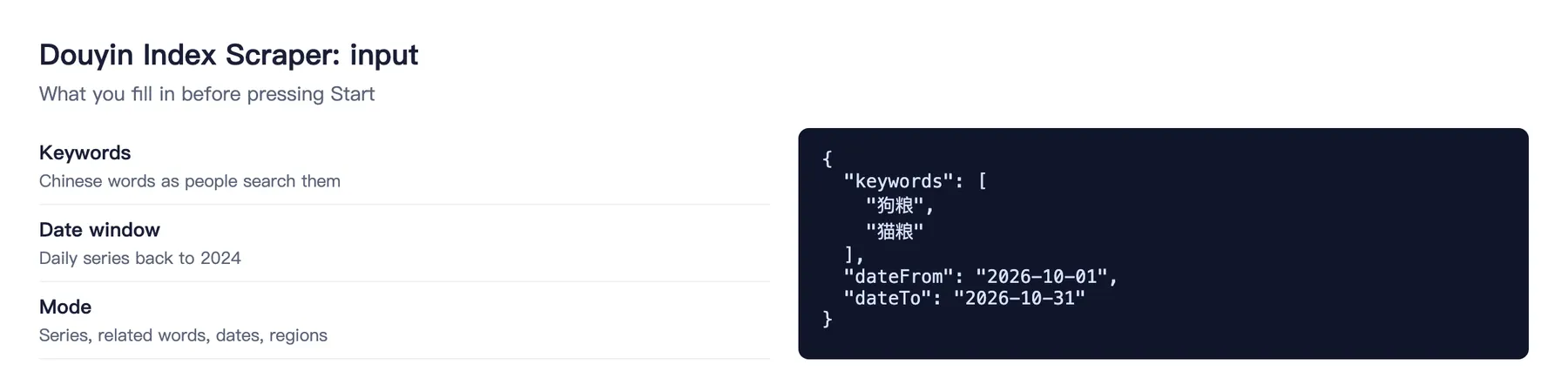
keywords | demo 狗粮 | Chinese keywords as people search them in Douyin |
dateFrom / dateTo | last 30 days | Window, YYYY-MM-DD; dateFrom: "max" = whole history |
fullHistory | false | Whole history from 2019-01-01, same price per keyword |
appName | douyin | douyin or toutiao |
region | empty | Optional region filter |
includeRelated | false | Add a related-words row per keyword |
includeIndexBreakdown | false | Add search / content / consumption index for the window |
flat | false | One row per point instead of one row per keyword |
maxKeywords | 20 | Upper bound on keywords |
Daily tail update
Load the whole history once with fullHistory: true, then schedule the Actor daily with the default 30-day window and replace the overlapping dates: the source publishes a day with a 1–2 day delay (lagDays), and the newest days are the only ones that can still change.
Price
Pay per event, no subscription.
| Event | Free | Bronze | Silver | Gold |
|---|---|---|---|---|
| Keyword series | $0.01384 | $0.01246 | $0.01107 | $0.0076 |
Index point (flat mode) | $0.00001 | $0.00001 | $0.00001 | $0.00001 |
| Related words | $0.003 | $0.0027 | $0.0024 | $0.0021 |
| Dates or regions lookup | $0.002 | $0.0018 | $0.0016 | $0.0014 |
| Run start | $0.009 | $0.009 | $0.009 | $0.009 |
Failed lookups and empty answers are not charged.
On the Apify Free plan a run returns up to 20 rows, because every row is bought from a paid source. Paid plans have no such limit.
FAQ
Do I need a login, cookies or my own proxy? No. Paste your input and press Start.
How do I use the data elsewhere? Export the dataset as JSON, CSV or Excel, schedule the Actor, or call it through the Apify API, n8n, Make and the Apify MCP server for AI agents.
What if there is no data for my input? You get a free row with type error or notice that explains why. Data rows are the only rows you pay for, plus the small run start fee.
Something looks wrong? Open an issue on the Issues tab with the run link. We read every one.


