

Quora Scraper — Questions, Answers, Profiles & Spaces
Pricing
from $15.00 / 1,000 answers
Quora Scraper — Questions, Answers, Profiles & Spaces
Scrape Quora questions, answers, search, profiles, Spaces and Topics without login. Full answer text and HTML, per-answer views and upvotes, AI-answer flag, author credentials and lead contacts.
Pricing
from $15.00 / 1,000 answers
Rating
0.0
(0)
Developer

Yuliia Kulakova
Maintained by CommunityActor stats
0
Bookmarked
2
Total users
1
Monthly active users
a month ago
Last modified
Categories
Share
Quora Scraper — questions, answers, profiles, spaces & topics, no login
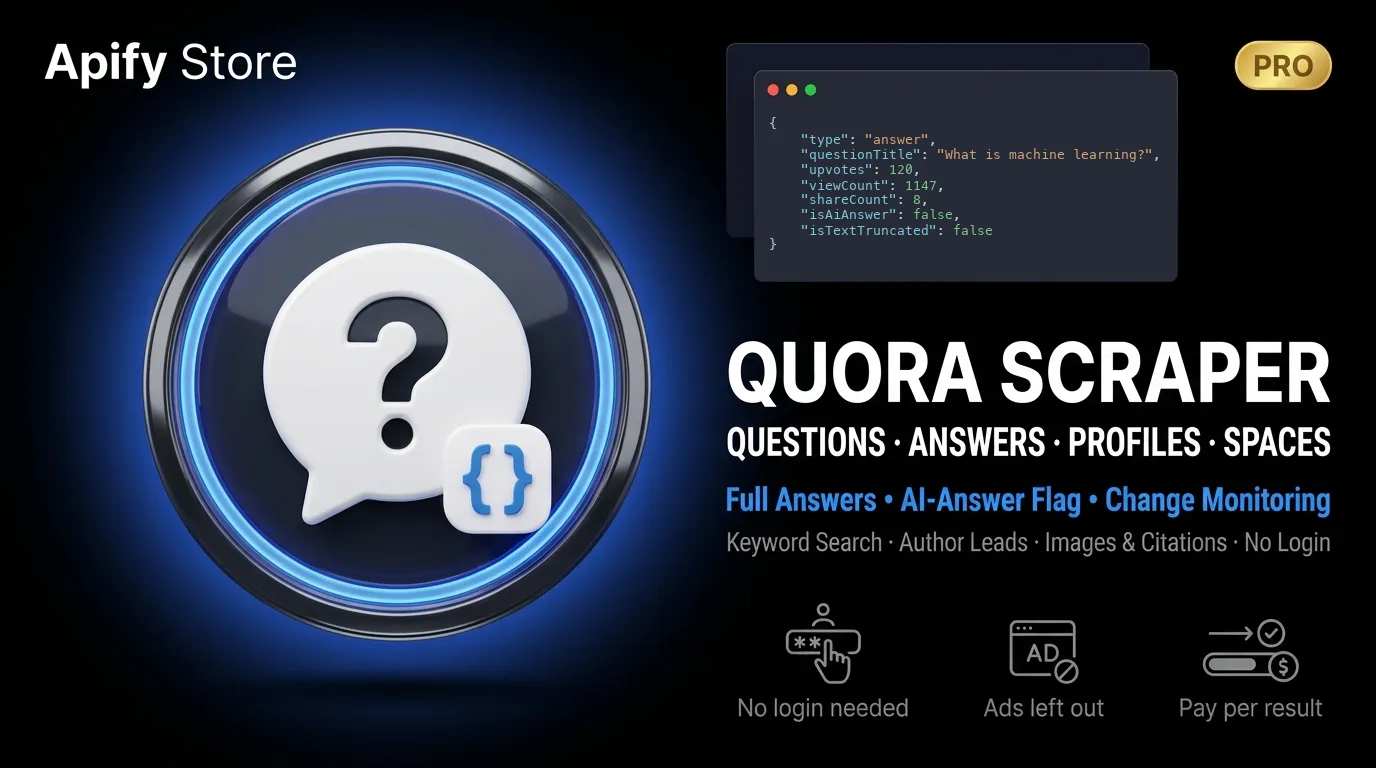
Scrape Quora questions and answers, run keyword searches, and pull profiles, Spaces and Topics — all from public pages, with no login, no cookies and nothing to set up.
One actor, four modes. Paste a mix of links and each one is recognised automatically, so questions, answers, profiles, Spaces and Topics can share a run.
- Question + answers — a question page → the question (title, answer and follower counts, topics) plus its top answers with full text and HTML, author, credential, upvotes, views, shares, comment counts and dates.
- Keyword search — a phrase → matching Quora pages → each one scraped like a pasted link.
- Profile — a user's credential and follower / answer / view stats, plus their answers and posts, with optional public contact details for lead generation.
- Space / Topic — a Space (
name.quora.com) or Topic (/topic/…) page plus its feed.
Who it's for: market and audience research, content and SEO mining, AI and NLP datasets, and expert or lead discovery — anywhere you need the real questions people ask and the answers that rank on Quora.
What this gives you that a plain text dump does not
- You can tell a human answer from a machine one. Quora now publishes answers written by its own
assistant alongside people's. Every answer row carries
isAiAnswer, so a research set, a training corpus or a sentiment study can keep the two apart instead of silently mixing them. - Engagement per answer, not just per question.
viewCount,upvotes,shareCountandcommentCountsit on each answer, and on question pagesposition/isTopAnswerrank the answers by upvotes — so you can see which answer carried the thread, not only that the thread was popular. - Formatting and citations survive. Next to plain
text, each answer comes ashtmlwith links intact, so the sources an author cited are still there after scraping. - Runs can watch for change.
onlyNewItemsskips what earlier runs already saved, andmonitorModewith awebhookUrlposts only what is new — a scheduled "what appeared since yesterday" needs no code. - Rows join back to your input. Quora renames and merges questions; every question row keeps the
link you asked for in
requestedUrl, next to the page it actually landed on. - Answers from equivalent questions are kept — and labelled. Quora merges duplicate questions and
shows their answers under "Originally Answered". Those rows carry
originallyAnsweredQuestionandoriginallyAnsweredUrl, so you get the answers a reader sees without mistaking them for answers written to this exact wording. - Ads are left out. Paid answers Quora mixes into question pages and feeds are never saved or billed.
- Nothing is quietly filled in. A field Quora does not show to signed-out visitors stays
nullinstead of being guessed, and a cut preview says so inisTextTruncated. When a question lists answers but Quora ships none of them to a signed-out visitor, the run says that in plain words instead of leaving you to guess whether the answers were lost. - An empty result is never a green run. If none of the requested pages could be read, the run fails with the reason instead of finishing "Succeeded" with an empty dataset.
- Your spending limit is respected. When a run reaches the maximum cost per run you set, it stops.
Key features
All of this works without an account or cookies:
- Answer text + HTML, with an honest preview flag — each answer as plain
textand as lightweighthtmlwith links preserved (internal links, external citations, formatting). Images in an answer come as full-sizeimages[]links and inline inhtml, so an image-only answer is never an empty row. A question page usually gives the whole answer; Quora occasionally serves only a preview of a long answer there too, and more often on profile and Space feeds — those rows carryisTextTruncated: trueso a fragment never passes for the full text. - Per-answer engagement —
viewCount,upvotes,shareCountandcommentCount, pluscreatedAtandupdatedAt. - Author block on every answer —
authorName,authorId,authorUrl,authorCredential(the credential line shown with that answer),authorImage,authorIsVerified, and the author's lifetimeauthorViewCountwhere Quora shows it. - AI-answer detection —
isAiAnswermarks answers written by Quora's assistant. - Question metadata —
topics[],answerCount,followerCountandcommentCount. - Profile stats —
followerCount,followingCount,answerCount,questionCount,postCount, lifetimeviewCount,lastMonthViews,credential,bioandisVerified. - Space & Topic pages — name, description, follower count and image, plus the questions and posts in their feed.
- Lead enrichment (optional) —
scrapeAuthorProfilesopens each answer author's profile and adds anauthorrow with thelinks[]from their Quora bio, anisLeadflag and aleadScore;extractAuthorContactsadds publicemails[]from the person's own website linked there — addresses on that site's domain or offered as its mail link, each checked for a mail server. In Profile modeextractAuthorContactsadds all of these to the profile row. - Incremental + monitoring —
onlyNewItemsskips items saved by earlier runs;monitorMode+webhookUrlPOST only newly seen items to your endpoint. - Flexible inputs —
startUrls(links),identifiers(bare slugs such asAdam-DAngelo) andsearchTerms. A pasted Quora search link runs as a keyword search. Common alternative field names (urls,usernames,queries,maxResults, …) are accepted too.
Input
Give links, identifiers or search terms — or any mix of them. Everything you enter is scraped in one run.
| Field | Type | Default | Description |
|---|---|---|---|
mode | enum | question | question / search / profile / space. Links are recognised automatically; the mode decides how bare identifiers are read. |
startUrls | array | [] | Quora links — question, answer, profile, Space (name.quora.com; old quora.com/q/name links are converted), Topic (/topic/…) or a Quora search link. In JSON: [{ "url": "…" }]. Alias urls (plain strings). |
identifiers | array | [] | Bare slugs / usernames (e.g. Adam-DAngelo in Profile mode, quorablog in Space mode), read per mode. Full links work here too. Aliases usernames / profiles. |
searchTerms | array | [] | Phrases to search for, one search per phrase. Aliases queries / searchQueries. |
searchType | enum | question | all / question / profile / space / topic — which kind of Quora page a search returns. question gives question pages with their answers. |
maxItems | integer | 100 | Maximum rows saved in the run (0 = no limit). Alias maxResults. |
maxAnswers | integer | 20 | Answers kept per question page; on a profile, answers and posts combined (0 = all that Quora shows). Alias maxAnswersPerQuestion. |
includeAnswers | boolean | true | Save answer rows. Off = a question page gives only the question, a profile only the profile. |
scrapeAuthorProfiles | boolean | false | On question pages, add one author row per answer author (billed as a profile). |
extractAuthorContacts | boolean | false | With author enrichment or in Profile mode: public e-mails from the website linked in the person's Quora bio. |
authorFilter | string | "" | Keep only answers whose author name or slug contains this text (case-insensitive). |
onlyNewItems | boolean | false | Skip items that earlier runs with this option on already saved. |
excludeEmptyFields | boolean | false | Leave empty fields out of each row. |
cookies | array | — | Optional, never required. See the FAQ. |
monitorMode | boolean | false | Like onlyNewItems, plus a POST of the new items to webhookUrl after the run. |
webhookUrl | string | "" | Where monitor mode sends its POST. |
proxyConfiguration | object | preset | Connection — already set up for Quora; nothing to change. |
Examples
Question + answers
Keyword search
Profile with public contact details
Answer authors as leads
Topic / Space
Daily monitor of new answers (run it on a schedule)
Output
One flat JSON row per item, tagged by type. All rows carry scrapedAt; rows found by a keyword search carry sourceQuery; answer rows from a profile carry fromProfile. Samples below are real output, trimmed for length.
Question (type: "question")
Fields: type, questionId, url, title, answerCount, followerCount, viewCount, commentCount, topics[], askedAt, updatedAt, scrapedAt, requestedUrl (+ sourceQuery from a keyword search). Questions listed in a Space or Topic feed may lack answer, follower and comment counts.
viewCountandaskedAtarenullfor signed-out visitors — Quora no longer shows them (see Limitations).
Answer (type: "answer")
Fields: type, answerId, url, text, html, images[], upvotes, viewCount, shareCount, commentCount, isAuthorAnon, isAiAnswer, createdAt, updatedAt, isTextTruncated, authorName, authorUrl, authorId, authorCredential, authorImage, authorIsVerified, authorViewCount, questionTitle, questionUrl, questionId, scrapedAt, originallyAnsweredQuestion, originallyAnsweredUrl, isTopAnswer, position (+ fromProfile in profile mode, sourceQuery from a keyword search). On question pages position and isTopAnswer rank the collected answers by upvotes — the question's own answers first; answers from profile and Space feeds carry no position, isTopAnswer or originallyAnswered… fields. originallyAnsweredQuestion / originallyAnsweredUrl name the question an answer was written for when Quora lists it under "Originally Answered", and are null otherwise.
Profile (type: "profile")
Fields: type, authorName, authorUrl, authorId, authorCredential, authorImage, authorIsVerified, authorFollowerCount, bio, credential, followerCount, followingCount, answerCount, questionCount, postCount, viewCount, lastMonthViews, isVerified, url, scrapedAt. With extractAuthorContacts the row also carries links[], emails[{email, role, source, mxFound}], isLead and leadScore.
Author (type: "author") — with scrapeAuthorProfiles
Fields: the profile fields above plus links[], isLead and leadScore; with extractAuthorContacts also emails[{email, role, source, mxFound}]. isLead is true when the person can be reached outside Quora: a personal website in their Quora bio or a public address. A bio that only cites reference sites does not count.
Post (type: "post") — from profiles and Spaces
Fields: type, postId, url, title, text, images[], isTextTruncated, upvotes, viewCount, commentCount, shareCount, createdAt, authorName, authorUrl, authorId, authorCredential, authorImage, authorIsVerified, spaceName, spaceUrl, scrapedAt.
Space (type: "space") and Topic (type: "topic")
Space fields: type, spaceId, url, name, description, followerCount, icon, scrapedAt.
Topic fields: type, topicId, url, name, description, followerCount, questionCount, image, scrapedAt.
Pricing
Pay per result. Every saved row is one billing event — a question, an answer, a profile (an enriched answer author counts as a profile), a Space or Topic, or a post — at the price shown on this actor's pricing panel. Public contact e-mails found for a person are a separate event, charged only when at least one address is found. A start fee applies per run, counted per GB of memory.
On top of the result price you pay the platform usage of your run (compute and data transfer), billed by Apify at its standard rates and shown on every run. In our test runs it came to about $4 per 1,000 rows on average — from about $1 on Space pages to about $9 on keyword searches, where many pages give only a question row.
- Duplicate rows inside a run are neither saved nor billed.
- Items with no content at all — for example a post that only re-shares another item — are neither saved nor billed.
onlyNewItemsskips what earlier runs already collected, so a scheduled run does not pay twice for the same answer.maxItemsand Apify's maximum cost per run both cap a run; it stops when either is reached.
Use cases
- Audience & topic research — pull the real questions people ask in a niche, their
topics[], follower and answer counts and the most upvoted answers to understand demand and language. - SEO & content mining — harvest question titles and full answer text/HTML (with links) to find content gaps, cited sources and questions worth targeting.
- AI and NLP datasets — question–answer pairs with engagement signals, with
isAiAnswerto keep machine-written answers out of human-only data. - Expert & lead discovery — rank contributors by views, verification and credentials; optionally add outbound links and public e-mails for outreach.
- Brand & topic monitoring — schedule
monitorModewith awebhookUrl(oronlyNewItems) to get pinged when new answers appear on a question or a Space, or when a competitor's profile publishes something new.
Honest limitations
These come from how Quora treats signed-out visitors — read them before you run.
- Only the top answers. Quora shows signed-out visitors the top answers of a question — usually about half a dozen — and scrolling loads related content, not more answers. A higher
maxAnswerscannot add more. - Some questions show no answers of their own. To a signed-out visitor Quora sometimes lists only answers from equivalent questions (saved and labelled, see above) or no answers at all. In the second case the question row is still saved and the run log names the question.
- A few fields are
nullfor signed-out visitors. QuestionviewCountandaskedAt, many Topicdescription/questionCountvalues, and answer, follower and comment counts on questions listed in a Space or Topic feed. Answer views, upvotes, shares and comment counts are available. - Some answers come as previews. Quora sometimes shows only the start of a long answer — most often on profiles and in Space feeds, occasionally on a question page. Those rows carry
isTextTruncated: true; a later run of the question page usually gives the whole text. - Keyword search covers what web search has indexed. Quora's own search is closed to signed-out visitors, so keyword search finds matching Quora pages through public web search. Very new pages may not show up yet, and results can differ between runs. Spaces are indexed sparsely, so a Space search usually returns only a few of them.
- Runs take time. Expect several seconds per page — a run of a few hundred rows takes minutes, not seconds.
- Topics vs Spaces. Topic feeds show less to signed-out visitors than Spaces; the Topic's own row is reliable, feed depth varies.
- Contact details depend on the person. Links come only from the person's Quora bio and e-mails only from their own website linked there; reference links such as encyclopedias, dictionaries or publishers are not visited. Many people link nothing — expect addresses for a minority of authors.
FAQ
Do I need to log in, add cookies or set anything up? No. Questions, answers, profiles, Spaces, Topics and search all work without an account, and the connection is already configured — add your links or phrases and start.
Why are viewCount and askedAt empty on questions?
Quora no longer shows question view counts or ask dates to signed-out visitors. Answer-level viewCount is unaffected.
What does the optional cookies field do?
It opens pages as your own signed-in Quora session, using cookies you export from your browser. Nothing described on this page needs it; it is provided as is, and your account is used at your own discretion.
Can I pass usernames or slugs instead of full links?
Yes — put bare slugs like Adam-DAngelo in identifiers; they are read according to mode. Full links work there too.
How many answers will I get per question? The top answers Quora shows a signed-out visitor — usually about half a dozen.
What happens if I start with an empty form? In Question mode the actor scrapes one example question so you can see the output format, and says so in the log.
Can I get contact details for lead generation?
Use scrapeAuthorProfiles (for answer authors) or Profile mode, together with extractAuthorContacts. Rows then carry links[] from the person's Quora bio, emails[] from the website linked there (each checked for a mail server), isLead and leadScore.
Is this allowed? The actor collects public data only and uses no login. Scraping public pages is broadly permissible but may conflict with Quora's Terms of Service, and any personal data (author names, links, e-mails) must be used in line with GDPR/CCPA. Compliance is the operator's responsibility.
Support & feedback
Something went wrong? Open an issue on the Actor's Issues tab and include the run ID and the input you used. I always do my best to find the cause, fix it and help you get the data you need.
Missing a field or an option? Issues are the right place for that too.
If this Actor was useful to you, please leave a rating or a short review on its Store page. It helps other people find it and keeps a small independent Actor visible.


![Quora Search Scraper · Keyword Questions & Answers [No Login] avatar](https://images.apifyusercontent.com/R63d4Fha1kbNa7Wb5EkXBXywGfBdHhDbUvjGw9ZWhGg/rs:fill:76:76/cb:1/aHR0cHM6Ly9hcGlmeS1pbWFnZS11cGxvYWRzLXByb2QuczMudXMtZWFzdC0xLmFtYXpvbmF3cy5jb20vakdtSW5ua0dIWXU3MDBuSTcvaEJqdUUzcXNKSDB1MjJEZ0ktZXpnaWYtMi0yNjU5M2NhZTgwLmpwZw.webp)


![Quora Scraper · Questions, Answers & Spaces [No Login] avatar](https://images.apifyusercontent.com/jcmeEFEdl2d_w5gWshcbtupsNp8tn7V6V5nKFiD1Dr0/rs:fill:76:76/cb:1/aHR0cHM6Ly9hcGlmeS1pbWFnZS11cGxvYWRzLXByb2QuczMudXMtZWFzdC0xLmFtYXpvbmF3cy5jb20vbmduOHZSRVNUa3NleVdFNnAtYWN0b3ItU2xsNnBCY0JIbEZuaG9QUmgtdjR0enRsajEyNi1RdW9yYS1Mb2dvLVJlZC1JY29uLVNvY2lhbC1NZWRpYS1QbGF0Zm9ybS03Njh4NzY4LndlYnA.webp)