

Marketplace Search Scanner: Amazon, eBay, Etsy
Pricing
from $2.40 / 1,000 keyword summaries
Marketplace Search Scanner: Amazon, eBay, Etsy
For any keyword, see the market on Amazon, eBay, Etsy, Walmart, Target, Best Buy, Home Depot and Lowe's: every listing with price, seller and reviews, plus price percentiles, seller concentration, review depth and new entrants since your last run. Only your Apify account needed.
Pricing
from $2.40 / 1,000 keyword summaries
Rating
0.0
(0)
Developer

CleanPull
Maintained by CommunityActor stats
0
Bookmarked
1
Total users
1
Monthly active users
2 days ago
Last modified
Categories
Features
Share
This marketplace search scanner does keyword market research on Amazon, eBay, Etsy, Walmart, Target, Best Buy, Home Depot and Lowe's: give it keywords and get every listing with price, seller, reviews, rating, ad flag and place, plus a summary per marketplace with price percentiles (min, p10, p25, median, p75, p90, max), seller concentration and review depth of the organic results, with the ads summarised apart. Schedule it with a watchlist and every run also says who entered the top since the last run, which sellers are new, who left, and whether the price band moved. Amazon works in 22 countries. Run it once, on a schedule or through the API. Only your Apify account is needed: no developer keys, no setup.
How to scan marketplace searches
- Open Marketplace Search Scanner on Apify and go to its input form.
- Enter search terms in Keywords, one per line, as shoppers type them.
- Pick the Marketplaces to search, the Amazon marketplaces (countries) and Results per search. Turn Amazon sponsored results off for organic results only.
- Start the run. Open the Keyword summaries view to read each marketplace's Median, P25 and P75 price, Sellers, Top 3 share and Avg reviews, and the Listings view for each result's Place, Price, Seller / brand and Reviews.
- To watch a market, give it a Watchlist name, turn on Changes only, save it as a task and schedule it weekly. The Changes view then lists new entrants and their new sellers, listings that left the top and price-band moves; each is confirmed on two runs in a row, so they appear from the third run.
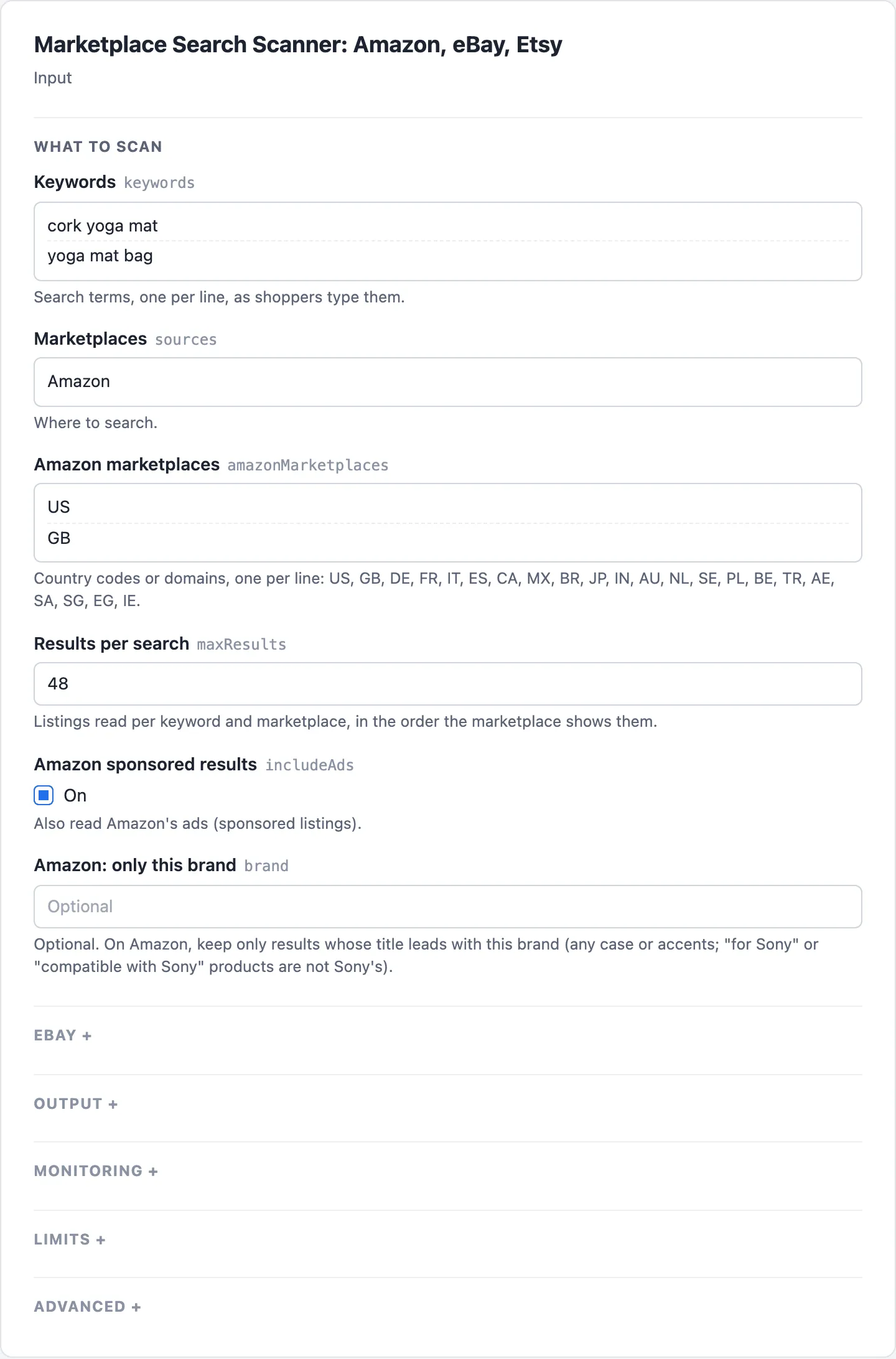
What the marketplace search scanner gives you
- "Is this niche worth entering?" See how many sellers share the top results, how deep their reviews go, how many listings have under 100 reviews, and where prices sit.
- "What should I charge?" Get the p25, median and p75 price for a keyword on each marketplace, in its own currency.
- "Who is new in my market?" Put your keywords in a watchlist and schedule it weekly. New entrants and new sellers in the top results come back as change rows.
- "Did prices move?" A change row reports when the median or a quartile moves past your threshold.
- "Compare Amazon, eBay, Etsy, Walmart, Target, Best Buy, Home Depot and Lowe's for one product idea." The same fields for every marketplace, one summary row each.
- "Feed market data to an AI agent or a spreadsheet." Compact JSON, a field picker, and a dataset view per row type.
Marketplace search sources
| Marketplace | How | Seller | Reviews | Ads |
|---|---|---|---|---|
| Amazon | The public search page, read as shoppers in that country see it (the same reader as CleanPull's Amazon Keyword Rank Tracker) | The brand, read from the title (Amazon search shows no seller) | The product's rating and review count | Sponsored results, marked and placed |
| eBay | The ebay.com search page, through CleanPull's marketplace data service (seconds); its dataset when a page cannot be read | The seller | The seller's feedback count and positive % | Not marked |
| Etsy | Etsy search, through CleanPull's marketplace data service | The shop name | The shop's rating and review count | Not marked |
| Walmart | The walmart.com search page, through CleanPull's marketplace data service (seconds); its dataset when a page cannot be read | The marketplace seller (or Walmart.com) | The product's rating and review count | Left out (organic results only) |
| Target | target.com search, through CleanPull's marketplace data service | Target.com or the partner seller | The product's rating and review count | Not marked |
| Best Buy | bestbuy.com search, through CleanPull's marketplace data service | Best Buy | The product's rating and review count | Not marked |
| Home Depot | The homedepot.com search page, through CleanPull's marketplace data service (one page: 12 or 24 results) | The Home Depot | The product's rating and review count | Left out (organic results only) |
| Lowe's | The lowes.com search page, through CleanPull's marketplace data service (one page: 24 results) | Lowe's (empty for a marketplace partner's item) | The product's rating and review count | Left out (organic results only) |
- The marketplace data service is a third-party web data provider. CleanPull holds the account and its key, which never appears in your input, logs or results.
- Each result it returns is a provider record on your bill, up to Results per search for each keyword and marketplace.
- Search pages take seconds; the dataset takes 1 to 5 minutes per search, whatever the depth. Walmart and eBay are read from their search page (15 to 60 seconds a page, more pages for more results) and fall back to the dataset for a keyword whose page cannot be read, with a warning in the log saying why. Etsy, Target and Best Buy come from the dataset; a run starts every such search at once, so 10 keywords take about as long as one.
- Home Depot and Lowe's are read from their search page only, one page per keyword: Home Depot shows 12 or 24 results a page (many keywords open a category page Home Depot picks), Lowe's 24. A page that cannot be read is a failed search with the reason, free, and is read again on the next run.
- Results come in the order the marketplace's search shows them, and that order is the place (
position). Search pages and the dataset give the organic results only: Walmart, Home Depot and Lowe's pages mark their ads, and they are left out (sponsoredfalse on every result); the dataset and eBay's page do not mark ads, sosponsoredis null there.
Marketplace search data accuracy
- A block is never an empty result. Amazon pages come through a proxy ladder (direct, then datacenter, then residential); an amazon.com search refused on every tier is read through the data service's page reader, billed as standard Amazon pages (never the home-network add-on). Once the first two such searches are both refused, the rest go to the page reader straight away. If a later page cannot be read there, the pages already read are delivered and the row's notes say the read is partial. On the other marketplaces, a search the site refused is a failure, not an empty market. A search that cannot be read is listed in the run summary with the reason, never billed.
- Ads need a real shopper's view. In the US, Amazon shows ads only to home-network visitors, so searches with ads use residential addresses. A first page without ads is read once more at our cost.
- New entrants are really new.
- A listing counts as new only if no earlier run saw it anywhere in the results read in the last 60 days, and it is still in the top on the next run.
- Why: Amazon shows each visitor a slightly different result set, and reads through home-network addresses vary most. In tests, two reads a minute apart differed by 1 to 4 listings in the top.
- A listing that just moved up from below does not count either. New entrants are counted in the top half of the results read, so the rest is a buffer.
- Amazon's ads rotate on every visit and are never counted.
- Gone means gone twice. A listing counts as having left the top only after 2 runs in a row without it.
- Price bands move only past a threshold (10% by default):
- in the same currency;
- in the same direction on 2 runs in a row;
- against a baseline that holds until a move is reported, so slow drift still adds up to one.
- Ads are kept apart. Ads are placed by bids, not by the market:
- price, seller and review figures are of the organic results only;
- the ads get their own count, price range and top advertisers (
ads); - a product shown as an ad and as an organic result is two listing rows.
- Auctions are not prices. An eBay auction's current bid is listed, but it is left out of the price figures (
notFixedPricecounts these). eBay fixed price only leaves auctions out of the listings. - Currencies are never mixed. Price figures use each marketplace's main currency, and listings in other currencies are counted apart.
- A service problem stops only its marketplaces. If the marketplace data service is unavailable or asks us to slow down, its marketplaces stop for the run with the reason (they are read again on the next run), and Amazon goes on. Requests to it are capped and spaced, so its limits are never reached.
- eBay sellers in a watchlist's memory. eBay seller usernames are kept only as salted hashes in the watch's memory, which is enough to tell a new seller from one seen before; an eBay listing that left the top is reported without its seller. Watchlists made before this are converted on their next run, keeping who was seen.
Marketplace search scanner input
| Field | Key | What it does |
|---|---|---|
| Keywords | keywords | Search terms, one per line |
| Marketplaces | sources | amazon, ebay, etsy, walmart, target, bestbuy, homedepot, lowes (Amazon by default) |
| Amazon marketplaces | amazonMarketplaces | US, GB, DE, FR, JP… (one search per keyword and marketplace; empty: US) |
| Results per search | maxResults | Listings per search (48 by default; up to 200) |
| Amazon sponsored results | includeAds | Amazon sponsored results (on by default; residential add-on in the US) |
| Amazon: only this brand | brand | Amazon: keep only results of this brand (optional; see below) |
| eBay fixed price only | ebayFixedPriceOnly | Buy-it-now listings only, no auctions |
| One row per listing | listingRows | One row per listing (on by default); off for summaries only |
| Watchlist name | watchlistName | Runs with the same name compare against each other (default default) |
| Changes only | changesOnly | Return only change rows (and the listings of new entrants); the first run of a watchlist returns its summaries |
| Watch the top | newEntrantTop | How deep new entrants and listings that left are counted (top 24 by default, at most half the results read) |
| Smallest price-band move (%) | priceMoveMinPercent | The smallest move of the median or a quartile that counts as a price-band move (10 by default) |
| Max cost per run (USD) | maxRunCostUsd | A search starts only when what the run has charged plus the most that search could cost stays within it (for schedules) |
| Max rows | maxItems | Stop after this many rows |
| Only these fields | fields | Keep only these fields in each row |
| Proxy | proxyConfiguration | Amazon only, optional; the actor picks proxies itself |
| History store | stateStoreName | The key-value store that keeps each watchlist (default: its own store, cleanpull-marketplace-scanner); pick one when you run with a scoped API token |
Example inputs
A niche check on Amazon US and UK:
The same keyword on every marketplace:
A weekly Amazon watchlist that returns only changes (new entrants, new sellers, listings that left the top, price-band moves), capped at $0.50 a run:
Marketplace search scanner output
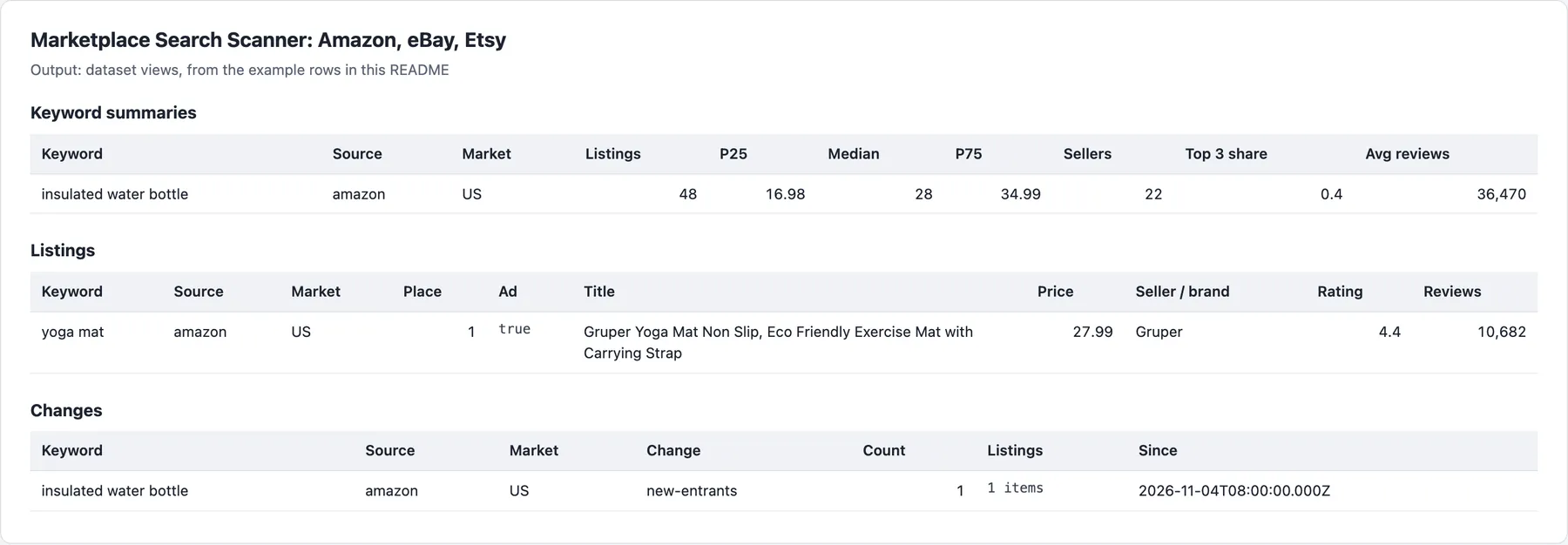
Three kinds of rows (recordType), shown in the Keyword summaries, Listings and Changes views.
Example rows
keyword-summary, one per keyword and marketplace:
A real row (first run of a watchlist; later runs fill newEntrants, newSellers, droppedOut and priceBandMove):
Two more fields on every summary:
-
brandandotherBrandsDropped(Amazon with Amazon: only this brand set;nullotherwise): the brand asked for, and how many results read were of other brands and left out of every figure and listing row. A result counts as the brand's when the brand leads its title (among its first 4 words, any case or accents), and not after "for", "para", "compatible" and the like, which mark a product made to fit the brand. Pages read and their cost are the same; only listing rows of other brands are no longer delivered. A brand filter keeps its own watch. Example: "Sony WH-1000XM5" on amazon.es with Amazon: only this brand set to "Sony" keeps the Sony headphones and leaves out Bose, soundcore and Anker results and "para Sony" ear pads. -
salesFloor(Amazon;nullfor other marketplaces): the sum of the top 10 organic results' "bought in past month" badges, each at the bottom of its bucket, and that floor times their price. Real row, "yoga mat" in the US:{"unitsPerMonthMin": 36600,"revenuePerMonthMin": 933914,"listingsCounted": 10,"listingsWithBadge": 10,"currency": "USD","basis": "The sum of Amazon's \"bought in past month\" badges over the top 10 organic results (…). A floor, not an estimate of actual sales: (…)"}It is a floor, never an estimate of actual sales: a result without a badge counts 0, and "10K+" can be far more than 10,000.
-
marketplaceFees: the marketplace's published list rates for selling fees, US sellers, most categories, so a margin can be read after fees:typicalFeePercent,fixedFeePerOrder, thecomponents(eBay final value and per-order fee; Etsy transaction, payment processing and listing fee; Walmart and Amazon referral fee),basis(what is left out: ads, fulfilment, other categories),sourcesandasOf. Amazon's FBA fee depends on size and weight: the Amazon Product Scraper gives it per product.nullfor Target, Best Buy, Home Depot, Lowe's and Amazon outside the US.
listing, one per result:
Other fields depend on the marketplace:
- Amazon:
organicRank,sponsoredRank,badges,boughtPastMonth. - eBay:
listingFormat,sellerFeedbackPercent,quantityAvailable,quantitySold,itemLocation,inStock. - Etsy:
listedAt,itemReviews,discountPercent,starSeller,freeShipping,inStock. - Walmart, Target, Best Buy:
upc,inStock; Targetpromotion, Best Buymodel. Walmart read from its page:priceMax(the top of a price range),upcnull. - Home Depot, Lowe's:
model; Home DepotstoreSku; Lowe'sitemNumber,marketplace(a partner's item),priceMax.
What a search page leaves out (Walmart and eBay read from the page, against the dataset):
- Walmart: no
upc(the page shows none);conditionLabelis "New" or empty, and other conditions come from the title's words. - eBay: the seller's feedback count is rounded as the page shows it ("1.7K" is 1,700); no
quantityAvailableorinStock; a card without condition words (common in vintage categories) hasconditionfrom the title, elseunknown. - Both: a keyword that fell back to the dataset has the dataset's fields; the run's log says which.
Condition and pack size, on every listing:
condition:new,renewed(refurbished, reconditioned, Walmart's Restored),used,open-boxorunknown.unknownis never counted as new.conditionBasissays where it came from:label: eBay's or Walmart's condition field, whose own words are inconditionLabel("Pre-owned", "Restored").title: a condition word in the title, such as "(Renewed)", "Refurbished", "Open Box", "Pre-Owned" or "Used - Good". Titles are read in English, Spanish, German, French, Italian, Dutch, Portuguese, Polish, Swedish and Japanese, for every Amazon marketplace.listing: an Amazon, Target or Best Buy catalog listing. These stores list items new and put any other condition in the title.none: nothing states it. This is Etsy without a condition word, since Etsy sells handmade and vintage items. A label that is not new wins over the title, and a condition word in the title wins over the store's convention. Before version 0.3, eBay and Walmart rows carried the marketplace's own words incondition("Pre-owned"). Those words are now inconditionLabel, andconditiontakes the same five values on every marketplace.
packCount: the units the title says are sold together ("2-Pack", "Pack of 4", "Set of 3", "x2", "Twin Pack", "3er Pack", "lot de 2", "2本セット"). It isnullwhen the title gives no count. Pieces of one item ("10-Piece Cookware Set") and contents ("100 Count", "64 oz") are not packs.
Like-for-like price figures. priceMin…priceMax stay as before, over every organic fixed-price listing. Next to them:
singleNewPricegives the same figures over single-unit, new listings only (packCountnull or 1,conditionnew). It counts what it left out, asexcludedMultiPack,excludedOtherCondition(renewed, used or open box) andexcludedUnknownCondition, and states its rule inbasis.conditionCountsandmultiPackcount the organic listings.
Change rows and run summary
change, at most one row per kind and search:
new-entrants, with the listings;new-sellers;dropped-out, confirmed on a second run;price-band, with the moves and the old and new band.
An example new-entrants row (illustrative values; one entrant shown):
The run's final status message summarises the key numbers in plain text after "Done: N results.": per keyword the price p25/median/p75, sellers and top-3 share, median reviews, ads and Amazon's sales floor, then the single-unit new band, HHI, review depth and fee rate where there is room, ending "More in the dataset." when not everything fits.
Dataset views: Keyword summaries, Listings and Changes. RUN_SUMMARY in the key-value store gives:
- the outcome:
COMPLETE,PARTIAL,NO_CHANGES,EMPTYorFAILED; - counts per marketplace and the charges;
- the marketplace data service's calls, records and error rows;
pageReads(search page requests, retries included) anddatasetRecords(records the data service delivered); the final status ends with them and the rows delivered;- every search that could not be made, with the reason.
Marketplace search speed and settings
No eBay or Etsy developer keys
eBay, Etsy, Walmart, Target, Best Buy, Home Depot and Lowe's come through CleanPull's marketplace data service. Inputs from version 0.1 that still carry keys run as they are; the keys are ignored.
Etsy, Target and Best Buy take a few minutes
The dataset reads each search fresh, which takes 1 to 5 minutes whatever the depth. All the searches of a run start together, so more keywords add little time. Amazon and the search pages are read meanwhile. Walmart and eBay take seconds unless a page cannot be read. Best Buy's search page carries only its sponsored products, and its results load in the browser afterwards, so Best Buy is read from the dataset too.
Home Depot and Lowe's search pages
They are read from their search page, one page per keyword (Home Depot 12 or 24 results, Lowe's 24). The dataset's crawler was refused on both in every test, so there is no fallback: a page that cannot be read is a failed search, free, read again on the next run. In tests, Lowe's pages took 40 to 75 seconds and some needed a second try; Home Depot's took 20 to 40.
Amazon seller is the brand
Amazon's search results show no seller. The brand that leads the title is the closest public signal, so the rows say sellerSource: "title-brand". For buy-box sellers, use Amazon Product Scraper on the ASINs.
Cleanest settings for a US watchlist
Turn off Amazon sponsored results:
- Amazon shows US ads only to home-network visitors, and those reads come from addresses all over the US.
- Amazon shows each of them a slightly different result set. In tests, several of the top 24 differed between runs.
- With ads off, pages come from one server address. Two runs compared cleanly: no false new entrants, nothing falsely gone, no false price moves.
- Snapshots with ads are fine as they are.
Pricing
| Event | Free | Bronze | Silver | Gold and above |
|---|---|---|---|---|
| Keyword summary (one per keyword and marketplace) | $3.00 / 1,000 | $3.00 / 1,000 | $2.70 | $2.40 |
| Listing row | $0.50 / 1,000 | $0.50 / 1,000 | $0.45 | $0.40 |
| Provider record (each result from eBay, Etsy, Walmart, Target, Best Buy, Home Depot, Lowe's) | $6.00 / 1,000 | $3.00 / 1,000 | $2.70 | $2.40 |
| Provider search (one per marketplace and run: all the run's keywords on it, 1 to 5 minutes) | $30.00 / 1,000 | $15.00 / 1,000 | $15.00 | $15.00 |
| Amazon search page | $2.00 / 1,000 | $2.00 / 1,000 | $1.80 | $1.60 |
| Amazon page from home-network addresses (add-on: ads in the US, every other country) | $12.00 / 1,000 | $12.00 / 1,000 | $12.00 | $12.00 |
| Change row (new entrants, new sellers, dropped out, price band) | $1.00 / 1,000 | $1.00 / 1,000 | $0.90 | $0.80 |
- Not billed: a search that fails or is blocked, re-reads made to find ads, and results the service could not read.
- Provider records and provider searches are billed with the search's summary, like Amazon pages. A run of 10 keywords on eBay at 48 results is one provider search ($0.015 on Bronze), 480 provider records ($1.44 on Bronze), 10 summaries and 480 listing rows; on the Free plan the provider search and records cost twice as much.
- Search pages are billed the same way: a provider record per organic result delivered (ads are left out, never more than Results per search) and one provider search per marketplace and run, whether a keyword was read from its page or fell back to the dataset. A Home Depot or Lowe's search whose page cannot be read is not billed.
- Max cost per run (USD) counts a provider search fee for every keyword, since a keyword can be its own search.
- Changes only: the first run of a watchlist returns its summaries as the baseline. After that, an unchanged search delivers nothing, and only its Amazon pages, or its provider records and provider search, are billed.
- Max cost per run (USD): a search starts only when its worst case still fits, so scheduled runs stay within it.
Limits
- eBay is ebay.com (US) only. Prices are in the listing's currency, mostly USD.
- Home Depot and Lowe's: one search page per keyword, with no dataset fallback.
- Amazon search shows no seller; the brand that leads the title stands in (
sellerSource: "title-brand"). - Best Buy's keyword match is looser than the others: Best Buy's own search ranks related accessories high (a "usb c cable" search led with a charging dock). Use precise keywords.
- Ads are kept as rows on Amazon only; Walmart, Home Depot and Lowe's pages mark their ads and they are left out, and the dataset and eBay's page do not mark them (
sponsorednull). - The sales floor is a floor (
salesFloor, Amazon only), never an estimate of actual sales. - Nothing found: when the whole run delivers nothing because no search could be made (no reader for that source and marketplace, input naming nothing searchable), it succeeds with one free
recordType: "unreadable"row per search giving thereason; nothing is charged. When other searches delivered, such a search is listed inRUN_SUMMARYwith the reason instead. A run near its time limit stops starting searches, delivers what it read and lists the rest inRUN_SUMMARY(as free rows only when it delivered nothing). A run whose every search was refused still fails.
FAQ
How much does marketplace market research cost per keyword per run?
One Amazon US keyword at 48 results with Amazon sponsored results off, read on one page, costs $0.029 on the Free and Bronze plans: $0.002 for the page, $0.003 for the summary and $0.024 for 48 listing rows; with One row per listing off, $0.005. With ads on, each US page adds the $0.012 home-network add-on, and so does every page outside the US; Amazon pages with 16 results need 3 pages for 48. One eBay, Etsy, Walmart, Target, Best Buy, Home Depot or Lowe's keyword at 48 results adds $0.144 in provider records on Bronze ($0.288 on Free), plus one provider search per marketplace and run ($0.015 on Bronze, $0.03 on Free). A search that fails or is blocked is never charged, and higher Apify plans pay less (see Pricing above).
On a watchlist with Changes only, the first run bills the summaries as the baseline. After that, a week when a search is unchanged costs only its reads: $0.002 per Amazon page in the US with ads off (plus the add-on where it applies) on the Free and Bronze plans, or its provider records and the provider search on the other marketplaces ($0.003 per record and $0.015 per search on Bronze, $0.006 and $0.03 on Free). A week with changes adds $0.001 per change row and $0.0005 per new entrant's listing row. Max cost per run (USD) stops a run before a search whose worst case would pass it, and Max rows caps the rows.
How often should I run a marketplace watchlist?
Weekly suits most markets, daily for fast ones. A new entrant (and its new seller) is confirmed on the run after it first appears, a listing has left the top only after 2 runs in a row without it, and a price-band move must pass Smallest price-band move (%) in the same direction on 2 runs in a row, so one-off differences between reads are not reported. The first run is the baseline, so changes appear from the third run. For the cleanest US watchlist, turn off Amazon sponsored results (see above).
What is the difference between the price band and single-unit new prices?
priceMin to priceMax (with priceP25, priceMedian and priceP75) cover every organic fixed-price listing in the marketplace's main currency. singleNewPrice gives the same figures over single-unit, new listings only (packCount null or 1, condition new), counting what it left out. Ads are never in either: they have their own figures in ads.
Why is a price, seller or figure missing?
- Ads:
sponsoredis null where the source does not mark ads (the dataset and eBay's page), and ads are left out on Walmart, Home Depot and Lowe's. - Auctions: an eBay auction's bid is listed but left out of the price figures (
notFixedPricecounts these). - Other currencies: listings in another currency are counted apart from the price figures.
- Sales floor and fees:
salesFlooris Amazon only;marketplaceFeesisnullfor Target, Best Buy, Home Depot, Lowe's and Amazon outside the US. - Changes:
newEntrants,newSellers,droppedOutandpriceBandMoveare confirmed on two runs in a row after the baseline, so they are filled from a watchlist's third run. - Walmart from its page: no
upc. eBay from its page: noquantityAvailableorinStock.
Which marketplaces and countries does it support?
Amazon in 22 countries (US, GB, DE, FR, IT, ES, CA, MX, BR, JP, IN, AU, NL, SE, PL, BE, TR, AE, SA, SG, EG, IE), and in the US eBay (ebay.com), Etsy, Walmart, Target, Best Buy, Home Depot and Lowe's.
Can I use the marketplace search scanner through the API?
Yes. Start runs through the Apify API or an API client, and read the dataset through its Keyword summaries, Listings and Changes views, or the RUN_SUMMARY record with the outcome, counts, charges and every search that could not be made. Only these fields (fields) trims each row to the keys you need.
Does it work with Google Sheets, Make, Zapier or Claude?
Yes. Apify's integrations send each run's results to Google Sheets, Make, Zapier, webhooks and other tools, and a schedule keeps them updated. From Claude, the MarketMage plugin sizes up a keyword's market across these marketplaces, or watches it for new entrants and price-band moves, in a chat.
Is it allowed to scrape marketplace search results?
The actor reads public marketplace search results as a signed-out visitor sees them: no login, no account and no customer data. Seller names are the shop or brand names the marketplaces show; eBay seller usernames are kept in a watchlist's memory only as salted hashes. How you use the data, and following the laws and terms that apply to you, is your responsibility. This is not legal advice.
Related actors
Other CleanPull actors for marketplace:
- Amazon Product Scraper: Amazon price, Buy Box, every seller's offer and Best Sellers Rank by ASIN.
- Walmart Scraper: Walmart products, prices, UPC, sellers and stock.
- Target Scraper: Target products, prices and units in stock at stores near a ZIP code.
- Supplier Price Finder: wholesale cost, MOQ and landed cost for a product idea across supplier sites.
Use it from Claude
The MarketMage plugin runs these actors from a Claude chat.
Found it useful? A rating on the Store helps others find it.
Changelog
- 0.3.16, status summary (2026-11-06): the final status message now summarises each keyword's key numbers after "Done: N results." (price band, sellers and top-3 share, median reviews, ads, sales floor; then the like-for-like band, HHI, review depth and fee rate), so a reader can often skip the dataset read. The counts in it leave out zeros. Prices and events unchanged.
- 0.3.x, brand filter and amazon.es counts (2026-11-04): new optional input
brand: on Amazon, results of other brands are left out, and the summary says how many (brand,otherBrandsDropped). Fix: review counts written with "mil" (a thousand, as amazon.es shows "(4,0 mil)") were read as millions (a 3 Nov amazon.es summary showed a median of 40,000,000 reviews); counts with spaces between digit groups (amazon.fr) are read whole. An amazon.es ad's "Anuncio patrocinado" lead-in (and its French, German, Italian, Dutch, Swedish and Polish forms) is no longer part of its title, so it is no longer read as the advertiser's brand. Prices and events unchanged. - 0.3.x, fix (2026-11-02): a Walmart result its page lists with
price: 0and no price lines (seen on a $300 to $600 TV search) now has no price (priceandcurrencynull) instead of a $0 listing row (the price summary already left it out). Prices and events unchanged. - 0.3.x, fewer reads (2026-10-30): with
ebayFixedPriceOnly, eBay is asked for Buy It Now listings only, so its pages are no longer filled with auctions that were read and billed as provider records only to be left out (your bill for such searches drops; any auction eBay still shows is left out as before). A watch saved before with that setting starts a new baseline once. A search page that comes back without result data is read once more before the keyword goes to the dataset.RUN_SUMMARYgainspageReadsanddatasetRecords; the final status says how many were read for the rows delivered. Prices and events unchanged. - 0.3.x, fix (2026-10-30): large Amazon results pages (amazon.de and others now send pages close to the home-network size limit) no longer fail the search: a page over the limit is read whole through the fallback instead, billed as before. Failure messages now say when a page was over the size limit rather than refused by Amazon.


