

Europe PMC Literature Search: Articles & Preprints
Pricing
from $1.26 / 1,000 publications
Europe PMC Literature Search: Articles & Preprints
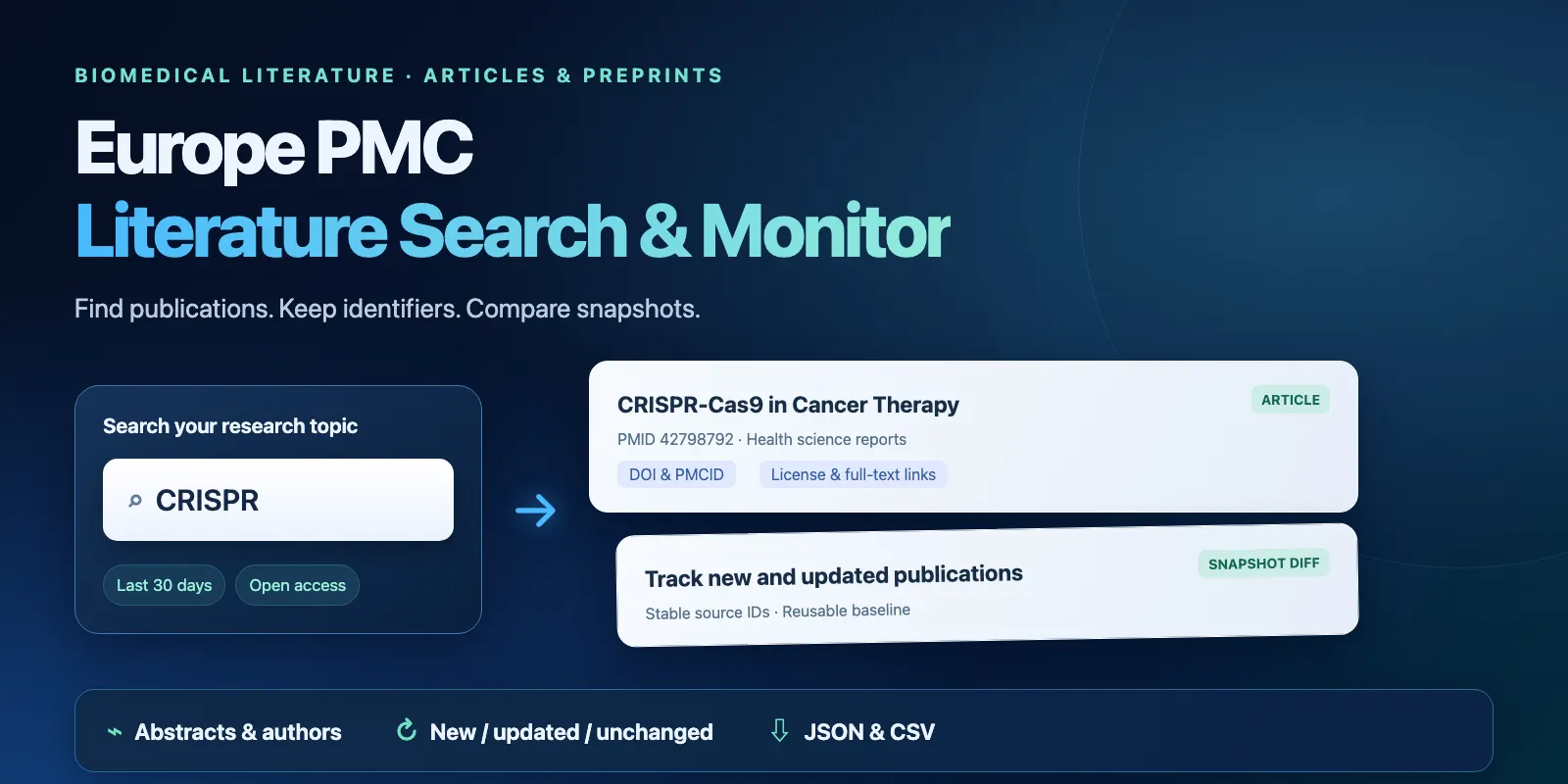
Search Europe PMC articles and preprints with dates and open-access filters. Export identifiers, abstracts, licenses and full-text links, or compare snapshots to find new and updated publications.
Pricing
from $1.26 / 1,000 publications
Rating
0.0
(0)
Developer

Cliqto Media
Maintained by CommunityActor stats
0
Bookmarked
2
Total users
1
Monthly active users
2 days ago
Last modified
Categories
Features
Share
Search Europe PMC for biomedical articles and preprints and get one Dataset row per publication: identifiers (PMID, PMCID, DOI), title, authors, journal, dates, abstract, license and full-text links. Pass a previous snapshot to find new or updated records. No Europe PMC API key or login is needed; a typical 25-record search takes a few seconds and costs $0.085 on the FREE tier.
What it does · Quick start · Use cases · Input · Output · Monitoring · Pricing · Limits and data rights · API and AI agents · Troubleshooting · FAQ · Support
What it does
The Actor sends your query to the public Europe PMC REST search, adds your date, source and open-access filters, and returns matching publications newest first. Each row is one Europe PMC record (source:id), with source metadata kept as is. A key-value store record SNAPSHOT lists the known identities and content fingerprints, so the next run can mark rows as new, updated or unchanged.
Good fit
- Literature surveillance: new papers or preprints on a topic in the last N days.
- Building a citation list or spreadsheet with DOI, PMID, PMCID, license and links.
- Checking which records are open access and under which license before reuse.
- Recurring monitoring of one query with a saved snapshot.
Not a fit / limits
- Full text download: the Actor returns full-text links but does not fetch articles.
- More than 500 records per run, or a complete history of a topic.
- DOI-based deduplication: the same article in MED and PMC stays as two rows.
- Medical conclusions, ranking by quality or relevance scoring.
Quick start
- Open the Input tab. The form is prefilled with the CRISPR example below.
- Click Start.
- Open Publications in the Dataset. Check
title,pmcid,pubDateandlicense. Full-text links (fullTextUrls) and the other fields are in the full JSON, CSV or Excel export. - Open Run summary to check counts, source matches and limits.
Expected result: 25 open-access publications first published in the last 30 UTC days, including today. The newest records are often fresh PubMed Central entries: they usually have pmcid and license, while doi, pmid and abstractText can still be null because the source has not added them yet.
Use cases
| Buyer job | Input path | Output entity | Key fields | Next step |
|---|---|---|---|---|
| New research on a topic | query + lastDays | Publication | title, pubDate, doi, sourceUrl | Export CSV or read via API |
| Open-access reuse check | query + openAccessOnly: true | Publication | isOpenAccess, license, fullTextUrls | Check license before reuse |
| Preprint tracking | source: "PPR" | Publication | isPreprint, title, firstIndexDate | Export or monitor |
| Fixed review period | dateFrom + dateTo | Publication | pmid, doi, pubTypes, abstractText | Screening spreadsheet |
| Repeat monitoring | previousSnapshot + onlyNew | Publication with change type | changeType, fingerprint, citedByCount | Save new SNAPSHOT |
Input
| Field | Type | Required | Default / prefill | Allowed values | Effect |
|---|---|---|---|---|---|
query | string | yes | prefill CRISPR | 1–2,000 characters, plain text or Europe PMC search syntax | Search text, e.g. CRISPR, TITLE:"base editing", AUTH:"Doudna J". Blank text is rejected before source access. |
lastDays | integer | no | none; prefill 30 | 1–3650 | Rolling window of first publication dates in UTC days, including today. Do not combine with dateFrom/dateTo. |
dateFrom | string | no | none | YYYY-MM-DD | Inclusive start of first publication date. |
dateTo | string | no | none | YYYY-MM-DD, on or after dateFrom | Inclusive end of first publication date. |
openAccessOnly | boolean | no | false; prefill true | true / false | Adds OPEN_ACCESS:Y. Open access does not mean every reuse is allowed. |
source | string | no | ALL | ALL, MED (PubMed), PMC (PubMed Central), PPR (preprints) | Limits the Europe PMC source. ALL also includes other Europe PMC source types. |
maxResults | integer | no | 25 | 1–500 | Number of unique records to inspect. Pagination stops here even if onlyNew emits fewer rows. |
previousSnapshot | object | no | none | The complete SNAPSHOT JSON (up to 5,000 records) from an earlier run with the same query and filters | Enables new / updated / unchanged classification. Do not paste Dataset rows. |
onlyNew | boolean | no | false | true / false | With a baseline, emit only records that are new to it. Updated records are not emitted and keep their old fingerprint in SNAPSHOT. Without a baseline every record is new. |
The query and added filters are joined with AND. Results are sorted by first publication date, newest first. Invalid input (blank query, lastDays together with dates, dateFrom after dateTo, a malformed snapshot) fails as INVALID_INPUT with no charge.
More examples:
Ten newest CRISPR preprints; isPreprint is true and journal may be null.
Up to 100 records for a fixed review period. Explicit dates keep the window stable between runs.
Output
Each Dataset item is one publication. The Publications view shows titles, source, dates, authors, identifiers, access, license and change type. The Monitoring view shows identity, change type, citation count, preprint flag and fetch time. JSON export includes all fields.
| Field | Type | Can be null? | Meaning |
|---|---|---|---|
key | string | no | Stable source:id key, e.g. PMC:PMC9467582. |
id, source | string | no | Original Europe PMC identifier and source (MED, PMC, PPR, …). |
pmid, pmcid, doi | string | yes | PubMed, PubMed Central and DOI identifiers. null when the source has none yet. |
title | string | no | Source title. |
authors | array of strings | no (can be empty) | Author names. |
authorString | string | yes | Author display text from the source. |
journal | string | yes | Journal title. Preprints may have none. |
pubYear | integer | yes | Source publication year. |
pubDate, firstIndexDate | string (YYYY-MM-DD) | yes | First publication date and first indexing date. |
pubTypes | array of strings | no (can be empty) | Publication type labels, e.g. Journal Article, Preprint. |
abstractText | string | yes | Abstract when provided. Can contain HTML markup; not full text. |
isPreprint | boolean | no | True for PPR or a Preprint publication type. |
isOpenAccess | boolean | yes | Source open-access flag; null when the source does not say. |
license | string | yes | Article license, e.g. cc by. null means unknown, not a default CC-BY grant. |
citedByCount | integer | yes | Source citation count. 0 and null mean different things. |
fullTextUrls | array of objects | no (can be empty) | Links with url, site, availability, documentStyle. Some require a subscription. Not fetched by the Actor. |
provider | string | no | Always Europe PMC. |
sourceUrl | string | no | Europe PMC record page. |
fetchedAt | string (ISO time) | no | When this run read the record. |
sourceUpdatedAt | string | yes | Source dateOfRevision; not the fetch or indexing time. |
changeType | string | no | new, updated or unchanged. Citation count changes count as updates. |
fingerprint | string | no | SHA-256 of normalized content, used for comparison. |
Example row from the Quick start input (abstractText was null; two of four links trimmed):
Key-value store records:
RUN_SUMMARY: status, inspected and emitted counts, source matches, requests, change counts and limits.skippedMalformedcounts source records skipped because they lacked an ID, source or title or had unexpected field types; the other rows of that page are kept. A page with no usable record stops the run withPROVIDER_SCHEMA_DRIFT.SNAPSHOT: identity and fingerprint list for the nextpreviousSnapshot: records seen in this run plus earlier baseline records not seen this time, up to 5,000.incompleteistruewhen the run stopped early; such a snapshot is still safe to reuse, because it holds only rows that were delivered (or already known).
| Situation | What you get | Run status |
|---|---|---|
| Normal search | Rows in the Dataset, RUN_SUMMARY status COMPLETE; limitReached: true if more matches existed | SUCCEEDED |
| Valid search with no matches | Empty Dataset, status NOT_FOUND | SUCCEEDED |
| Monitoring with nothing new | Zero emitted rows with onlyNew: true; RUN_SUMMARY shows the unchanged count | SUCCEEDED |
| Your maximum cost per run was reached | Rows that fit the limit, status PARTIAL, reason: "CHARGE_LIMIT" | SUCCEEDED |
| Source stopped after some rows | Rows so far, status PARTIAL with the stop code in reason (see below) | FAILED |
| Source failure before any row | No rows, status ERROR with the stop code in reason | FAILED |
| Rejected input | No rows, status INVALID_INPUT | FAILED |
Stop codes: PROVIDER_* (Europe PMC answered with an error, timed out, was unavailable or returned unexpected data), SOURCE_DEADLINE (the 180-second source time budget ran out), REQUEST_LIMIT (25 source requests used), RETRY_AFTER_EXCEEDS_BUDGET (the source asked to wait more than 10 seconds), TOTAL_RESPONSE_BYTES_LIMIT / RESPONSE_TOO_LARGE (response size limits), CANCELLED (you aborted the run).
Monitoring
- Run your query and save the complete
SNAPSHOTJSON. - Paste it into
previousSnapshotfor the next run. Keep the same query, source and date strategy. - Leave
onlyNew: falseto see new, updated and unchanged rows, or set it to true to emit new records only. - Save the new
SNAPSHOTfor the next comparison.
A rolling lastDays window may advance without changing snapshot scope. Changing the query, filters or explicit dates requires a fresh baseline. Changing maxResults is allowed, but records outside the prior selection count as new. A record absent from the next selection is not marked deleted: it stays in the new snapshot unchanged, so it is not reported again as new when it reappears. The snapshot keeps up to 5,000 records; when full, the records not seen for the longest time drop off first. A snapshot from a stopped run (incomplete: true) is safe to use: rows that were not delivered are not in it and will count as new next time. The Actor does not create schedules or webhooks; you choose when to run it.
Pricing
Pay-per-event: one $0.04 run-start event after valid input, plus one publication event for each emitted row. Snapshot-only and skipped unchanged rows are not charged. Invalid input is rejected before the start event.
| Store tier | Per publication | 25 rows, including start |
|---|---|---|
| FREE | $0.0018 | $0.0850 |
| BRONZE | $0.0017 | $0.0825 |
| SILVER | $0.0016 | $0.0800 |
| GOLD and above | $0.0015 | $0.0775 |
On FREE, 100 emitted rows cost $0.22 and 500 cost $0.94, including start. A valid empty or unchanged-only run costs $0.04. The start event is also charged when the source fails after valid input (ERROR); a PARTIAL run pays the start and the rows it emitted. Your maximum cost per run can stop work early: the run then ends SUCCEEDED with status PARTIAL and reason CHARGE_LIMIT, keeping the rows that fit. At the minimum of $0.04 no rows fit, so allow at least $0.04 plus the per-row price for the rows you need. Apify controls actual billing; see the Pricing tab for your tier.
Limits and data rights
- Maximum 500 unique inspected records per run. A 500-record run usually takes under a minute (about 10 seconds in our tests); with slow source responses it can stop as
PARTIALat the internal deadline. - Source requests are sequential, at least one second apart, each with a 15-second timeout. Source work has a 180-second deadline, a 25-request cap including retries, a 12 MiB limit per response and an 8 MiB total response limit. Two source timeouts stop the run. Memory is 256 MB.
- The source can add or update records later, and publication date is not index date. For systematic reviews, verify your search strategy and export criteria. This Actor returns data, not medical conclusions or recommendations.
Europe PMC data access covers metadata, abstracts and full text under different rights. Free or open access does not mean every use is allowed: check the record license and publisher terms before reusing abstracts or following full-text links. The license field is the article license, not an abstract-specific legal guarantee. This Actor is independent of Europe PMC.
API and AI agents
Run the Actor with the same JSON input through the Apify API. Keep your Apify token private. Read the default Dataset items and the RUN_SUMMARY and SNAPSHOT records from the finished run. Apify exports JSON, CSV and Excel and can run the Actor on your own schedule.
Use with AI agents (MCP)
- MCP server with only this Actor:
https://mcp.apify.com?tools=cliqtomedia/europe-pmc-literature-search(authenticate with Apify). - Smallest useful input:
{"query":"CRISPR","lastDays":30,"maxResults":25}. - Key output fields:
title(paper title),doi/pmid/pmcid(identifiers, may benull),pubDate(first publication date),license(article license ornull),changeType(new,updated,unchanged). - A 25-record call takes a few seconds and costs $0.085 on FREE; 500 records usually take under a minute and cost $0.94. Keep
maxResultsat 500 or less and the query under 2,000 characters.
Troubleshooting
- No rows, status
NOT_FOUND. The search is valid but nothing matched. Widen the dates, changesourceor simplify the query. PROVIDER_REJECTED_QUERY. Europe PMC did not accept the query syntax. Check quotes and field names such asTITLE:orAUTH:.PROVIDER_RATE_LIMIT,PROVIDER_TIMEOUTorPROVIDER_UNAVAILABLE. The source was slow or unavailable. Retry later, or lowermaxResults.PARTIALwithCHARGE_LIMIT. Your maximum cost per run was reached. Raise it (start event plus per-row price) or lowermaxResults.SOURCE_DEADLINEorREQUEST_LIMIT. The source was slow for a large run. LowermaxResultsor split the date range.- Snapshot error. Use the complete
SNAPSHOTfrom a run with the same query and filters, with at most 5,000 records. sourceUrldoes not open from a script. Europe PMC pages can block automated clients; open the link in a browser or use the identifiers.
FAQ
Do I need a Europe PMC account or API key?
No. The Actor uses the public Europe PMC REST search without login.
Why are doi and abstractText empty for some rows?
The newest records are often added before the source has a DOI, PMID or abstract. The Actor keeps null instead of guessing. Records published some time ago more often have these fields filled.
Does open access mean I can reuse the text?
Not always. Check license and the publisher terms. A null license is unknown.
Can I get every article on a topic?
No. One run inspects up to 500 records, newest first. Use date windows to split larger reviews.
Support
Use the Actor's Issues tab on Apify. Include the run ID, the expected result and a non-sensitive input example. Never share tokens or cookies.


