

ChatGPT Search Answers via OpenAI API: Citations & Sources
Pricing
$40.00 / 1,000 answers
ChatGPT Search Answers via OpenAI API: Citations & Sources
Ask the model behind ChatGPT any list of questions with live web search, through OpenAI's official API, and get each answer with its citations, the pages it read and the searches it ran. No OpenAI account or key needed. Failed answers are never charged.
Pricing
$40.00 / 1,000 answers
Rating
0.0
(0)
Developer

Kendall Sorenson
Maintained by CommunityActor stats
0
Bookmarked
2
Total users
1
Monthly active users
8 days ago
Last modified
Features
Share
ChatGPT Search Answers: the answer, its citations and its sources
Ask any list of questions and get back what the model behind ChatGPT answers after searching the web: the full answer, every page it cited, the pages it read without citing, and the searches it ran.
It uses OpenAI's official API with live web search. You don't need an OpenAI account or API key, and there are no cookies, logins or browser automation to break.
Try it: the form is filled with two prompts. That is 2 answers, $0.08.
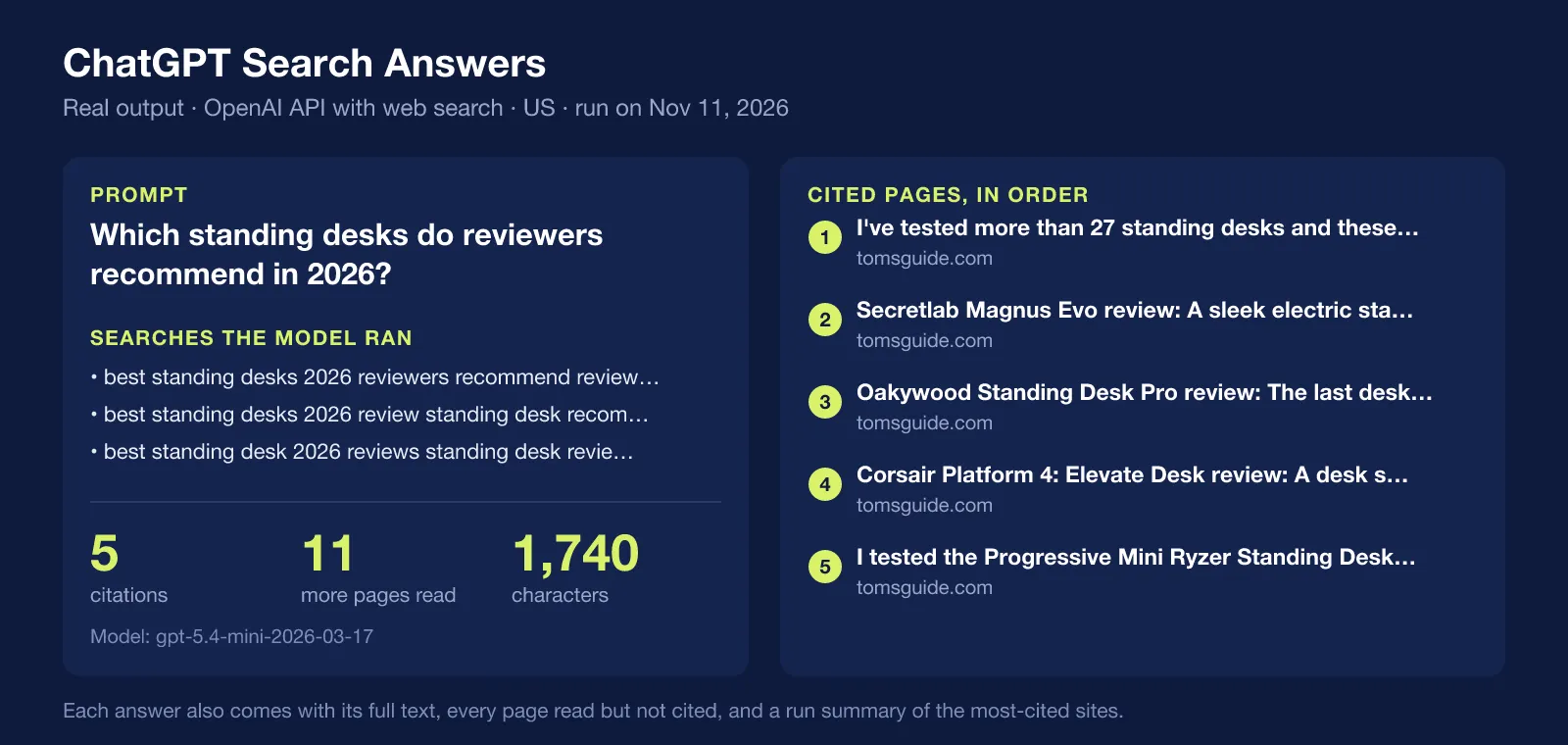
A real answer from a run on November 11, 2026.
Failed answers are never charged. You pay only for answers that were produced and saved.
What this is, and what it is not
This Actor calls OpenAI's API, using a current GPT model with the web search tool. It is the closest official equivalent of a ChatGPT search answer, and it is stable and repeatable.
It is not a recording of the ChatGPT app. Answers in the app can differ, because the app adds its own instructions, memory and personalisation. If you need to know how AI models answer a question and which sites they rely on, this gives you that reliably. If you need a screenshot of exactly what one person saw in the app, this is not that.
What you get for each answer
- The full answer in Markdown
- Citations: each page cited in the answer, in order, with URL, title and website. Tracking parameters are removed so the same page counts once.
- Pages read but not cited: what the model opened during its search and left out
- The searches it ran: the actual queries the model sent to the web
- The exact model version, country and time
A summary of the whole run
Each run also adds one free summary row: how many answers cited at least one page, the average number of citations, and the websites cited by the most answers. Ask 50 questions about your market and you can see at a glance which sites the model leans on.
Ask the same question more than once
AI answers vary from one request to the next. Set Answers per prompt to 3 or 5 to see how stable an answer is and which sources keep coming back.
Input
| Field | What it does |
|---|---|
| Prompts | One question per line, up to 1,000 characters each |
| Country for web search | Two-letter code such as US, GB or DE. The search behaves as if the user were there |
| Answer language | Optional, for example German |
| Answers per prompt | 1 to 10 |
| Always search the web | On by default, so every answer can cite sources |
| Search depth | Low, medium or high. Same price |
| Include pages read but not cited | On by default |
| Maximum answers | Stops the run after this many |
Example input:
Output
A real answer row from a run on November 11, 2026, with the answer text and lists shortened:
Results export to JSON, CSV or Excel.
How much does it cost?
You pay per answer, with no monthly fee:
| Event | Price |
|---|---|
| Answer (with citations, sources and searches) | $0.04 |
| Run summary row | Free |
| Answers that fail | Free |
Worked examples:
- 25 questions, one answer each: $1.00
- 50 questions, 3 answers each: $6.00
The price covers the AI model and the web search for each answer. Search depth does not change it.
Apify Free plan: 3 answers per run
Every answer costs real money to produce, so accounts on the Apify Free plan are limited to 3 answers per run as a trial. Runs on any paid Apify plan have no trial limit. If a run is cut short by this limit, the log and status message say so, and you are charged only for the answers you received.
Use it from AI agents (MCP)
The Actor works as a tool for AI assistants through Apify's MCP server:
The only field an agent has to set is prompts. Every output field has a description, and citations come back as structured URL, title and domain, ready to check or compare.
Code example
FAQ
Which model answers the questions?
A current small GPT model from OpenAI, chosen automatically, with OpenAI's hosted web search tool. The exact model version is recorded in every row.
Is this the same answer I would get in the ChatGPT app?
Not exactly. See "What this is, and what it is not" above. The API answer comes from the same family of models with web search, but the app can add personal context that the API does not have.
Why do two runs of the same prompt give different answers?
AI models don't give identical answers every time, and the web changes. Use Answers per prompt to see the spread instead of trusting one answer.
Are the answers always correct?
No. These are AI-generated answers and can be wrong or out of date. The citations are there so you can check them.
Do you store my prompts?
Prompts are sent to OpenAI to produce the answers, with OpenAI's storage of responses turned off for these requests. Your prompts and results stay in your own Apify account like any other run.
What can't I use this for?
Don't send prompts that break OpenAI's usage policies. This Actor is for questions and research, not for generating harmful content.
Want brand tracking instead of raw answers?
If your goal is to know whether AI recommends your brand, or which sites it cites in your market over time, the two trackers below do that analysis for you.
Related tools
- AI Visibility Tracker: whether ChatGPT, Gemini and Perplexity recommend your brand, with rank and share of voice.
- AI Citation Tracker: which websites AI answers cite in your market, and where competitors are cited instead of you.
- Google Autocomplete Scraper: find the questions people actually ask, then run them through this Actor.
Found a problem or want a field added? Open an Issue on this Actor's page.


