

Google Autocomplete & Suggest Scraper: Keyword Ideas
Pricing
$0.50 / 1,000 keyword ideas
Google Autocomplete & Suggest Scraper: Keyword Ideas
Google Autocomplete (Google Suggest) scraper: turn one seed keyword into hundreds of real search suggestions from Google, YouTube, Google Shopping, Bing and DuckDuckGo. Finds the questions people ask, comparisons and long-tail keywords, labelled by type. Any country and language.
Pricing
$0.50 / 1,000 keyword ideas
Rating
0.0
(0)
Developer

Kendall Sorenson
Maintained by CommunityActor stats
0
Bookmarked
2
Total users
1
Monthly active users
9 days ago
Last modified
Features
Share
Google Autocomplete Scraper: keyword ideas and the questions people ask
Turn one seed keyword into hundreds of real search phrases. This Actor types your keyword into autocomplete the way a person would, with question words, comparisons, prepositions and every letter from a to z, and collects every suggestion that comes back.
It reads Google Search, YouTube, Google Shopping, Bing and DuckDuckGo, in any country and language. Every idea is labelled by type, so you can pull out just the questions, or just the comparisons, in one click.
Try it: the form is filled with standing desk on Google Search. That returns about 460 keyword ideas, about $0.23.
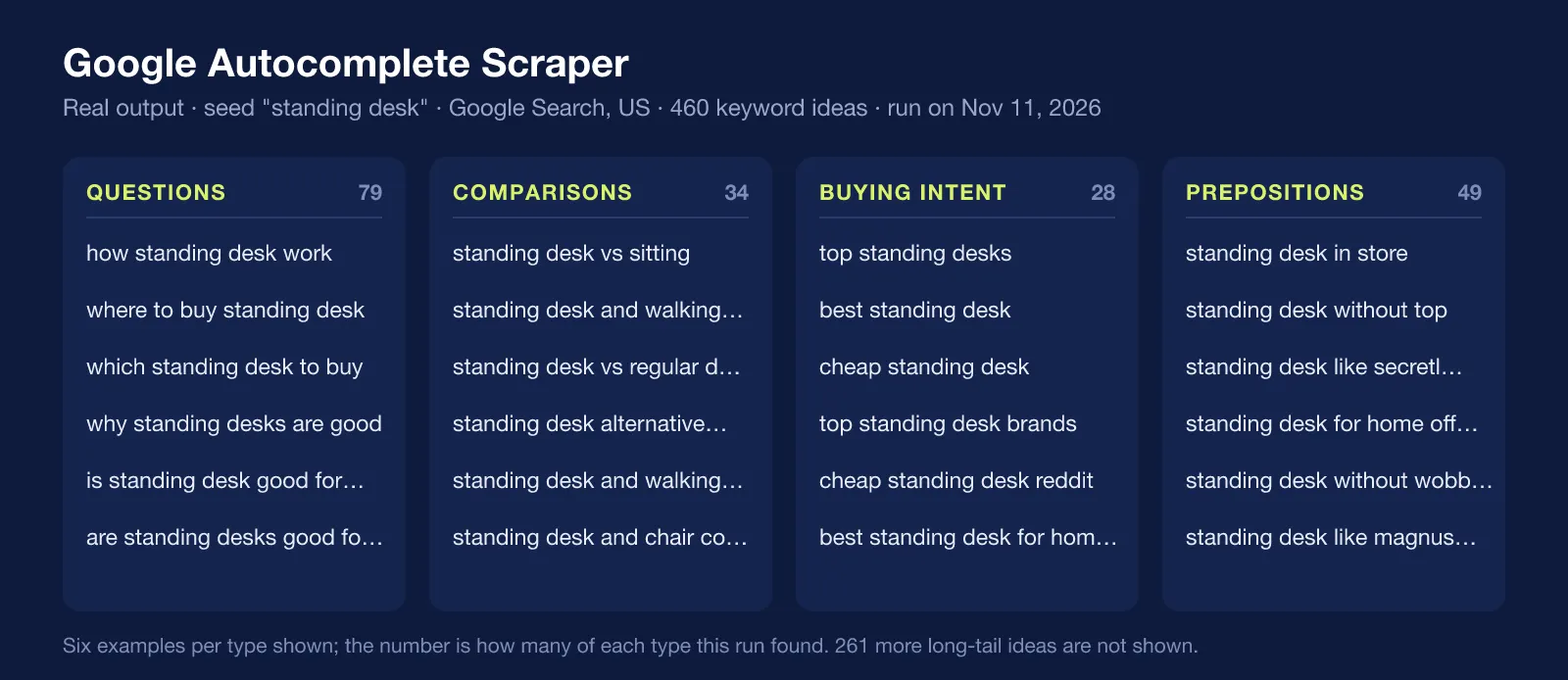
Real results from a run on November 11, 2026.
What you get
In a run on November 11, 2026, the seed standing desk returned 460 ideas from Google alone and 1,013 distinct ideas across Google, YouTube and Bing. Some of them:
| Type | Real examples |
|---|---|
| Questions | are standing desks good for you · which standing desk to buy · where to buy standing desk |
| Comparisons | standing desk vs sitting · standing desk vs regular desk · standing desk and walking pad |
| Buying intent | best standing desk for home office · cheap standing desk · top standing desk brands |
| Prepositions | standing desk for home office · standing desk without wobble · standing desk like secretlab |
| Long-tail | standing desk mat · standing desk riser · standing desk ikea |
For each idea you get:
- The keyword and the seed it came from
- Its type: question, comparison, buying-intent, preposition, long-tail, related or base
- Which search engine suggested it
- Its position in the autocomplete list (1 is the top suggestion)
- The exact text that was typed to produce it
- Word count, for filtering to long-tail phrases
Labels follow what the suggestion actually says. Typing standing desk or also returns standing desk organizer; that is filed under long-tail, not comparison.
A summary row for each seed
Each seed also gets one free summary row: how many distinct ideas were found, counts by source and by type, a sample of questions, and the ideas that more than one search engine suggested. Those overlaps are usually the strongest topics.
No search volumes, on purpose
Autocomplete tells you what people search for, not how often. This Actor does not invent volume numbers. To see whether interest in an idea is rising or falling, run it through the Google Trends Scraper.
Input
| Field | What it does |
|---|---|
| Seed keywords | One keyword or phrase per line |
| Where to get suggestions | Google Search, YouTube, Google Shopping, Bing, DuckDuckGo. Each returns its own ideas |
| Country and language | Two-letter codes, for example us and en, or de and de |
| Ways to expand each seed | Questions, prepositions, comparisons, a to z, 0 to 9 |
| Go one level deeper | Looks up the first N suggestions themselves to find longer phrases |
| Questions only | Keep only ideas phrased as questions |
| Must contain / must not contain | Keep or drop ideas by word |
| Minimum number of words | Set to 3 or 4 for long-tail phrases only |
Question words and prepositions are built in for English, Spanish, German, French, Portuguese and Italian. Other languages still work for the a to z expansion.
Example input:
Output
A real row from a run on November 11, 2026:
The summary row from the same run (lists shortened):
Results export to JSON, CSV or Excel.
How much does it cost to scrape Google Autocomplete?
You pay per keyword idea returned, with no monthly fee:
| Event | Price |
|---|---|
| Keyword idea | $0.0005 |
| Seed summary row | Free |
| Lookups that return nothing or fail | Free |
Worked examples on the Free plan:
- One seed on Google Search, about 460 ideas: $0.23
- One seed, questions only, about 80 ideas: $0.04
- 10 seeds on Google and YouTube, about 8,000 ideas: $4.00
An idea suggested by two search engines appears once per engine and is charged once per engine. Filters apply before charging, so narrowing to questions or long-tail phrases lowers the cost.
Use it from AI agents (MCP)
The Actor works as a tool for AI assistants through Apify's MCP server:
The only field an agent has to set is seeds. Every output field has a description, and the ideaType label lets an agent ask for "the questions people ask about X" and filter the result without guessing.
Code example
FAQ
Where do the suggestions come from?
From each search engine's public autocomplete service, the one behind the suggestions you see while typing in a search box. No login or browser automation is involved.
Are these the same suggestions I would see?
Close, but not always identical. Autocomplete depends on country, language and time, and a signed-in person also gets personal suggestions. This Actor asks as an anonymous visitor in the country and language you choose.
Why is there no search volume or difficulty score?
Because autocomplete doesn't provide them, and reliable volume data comes from sources whose terms don't allow reselling it this way. The position in the list is the only ranking signal autocomplete gives, and it is included.
How many ideas will I get?
It depends on the seed. A broad two-word seed typically returns 300 to 500 ideas per search engine with the default settings. Narrow or rare seeds return fewer.
Do I need a proxy?
Usually not. The Actor paces its lookups and retries with a pause if a search engine asks it to slow down. A proxy option is there for very large runs.
Is it legal to scrape autocomplete suggestions?
Suggestions are public, aggregated phrases with no personal information. You are responsible for how you use the results and for following the terms that apply to you. If you are unsure, ask a lawyer.
Related tools
- Google Trends Scraper: check whether a keyword idea is rising or falling.
- Google Ads Transparency Center Scraper: see which ads competitors run for those keywords.
- AI Visibility Tracker: whether ChatGPT, Gemini and Perplexity recommend your brand for the questions you found.
Found a problem or want another search engine added? Open an Issue on this Actor's page.


