

FifthRow Verified Cited Answers
Pricing
from $140.00 / 1,000 verified cited answers
FifthRow Verified Cited Answers
FifthRow Answers turns any question into a sourced brief, then verifies the brief against the full text of every page it cites. It searches current evidence, grounds the response, and returns an inspectable result with sources, citations, and quality evaluation.
Pricing
from $140.00 / 1,000 verified cited answers
Rating
0.0
(0)
Developer

FifthRow
Maintained by CommunityActor stats
0
Bookmarked
3
Total users
1
Monthly active users
16 days ago
Last modified
Categories
Share
FifthRow Verified Cited Answers: research briefs checked against their sources
FifthRow Verified Cited Answers turns any question into a sourced brief, then verifies the brief against the full text of every page it cites. You get inline citations, the list of sources read, and a hallucination score for the answer. Use it when a plausible answer is not enough and you need one you can defend.
A model can only be checked against a source it has actually read. So every run fetches and reads each cited page in full, then tests the answer against that text. That is why a run costs $0.14 and why the score means something.
How a run works
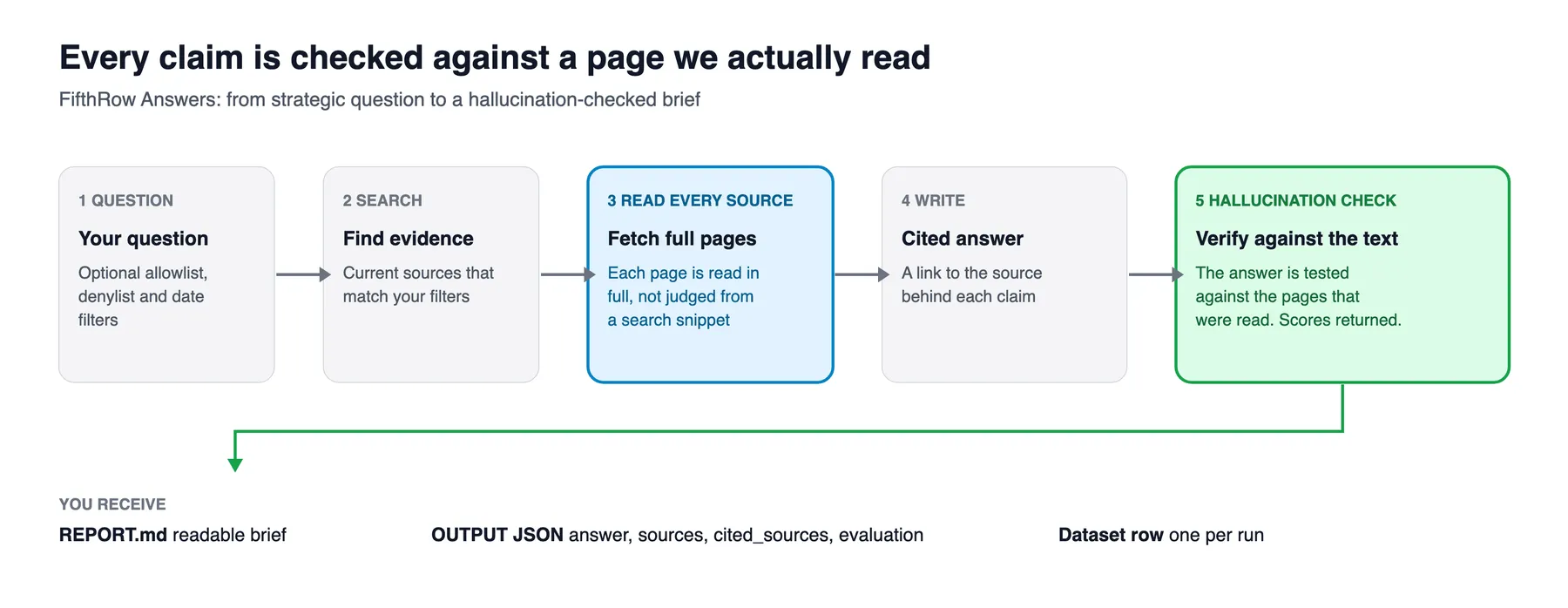
- Question in. You send one strategic question, with optional domain allow and deny lists and date filters.
- Evidence search. FifthRow searches current sources that match your filters.
- Every source read in full. Each page that can support the answer is fetched and read, not judged from a search snippet.
- Answer with a citation on every claim. The brief is written with inline links to the pages behind each statement.
- Hallucination check. The answer is evaluated against the text that was actually read. Relevance and hallucination scores are returned with it.
- Output. A readable
REPORT.md, structured JSON, and one dataset row.
What you get back
| Output | Where | Use |
|---|---|---|
REPORT.md | Key-value store | Brief to read and share |
OUTPUT (JSON) | Key-value store | id, status, and result with query, answer, sources, citations, search sources, and evaluation |
| Dataset row | Dataset | Same JSON object as OUTPUT: id, status, and detailed result |
sources lists every page that was read. cited_sources lists the ones the answer relies on. The gap between the two shows what was checked and set aside.
Example: a real brief with sources and evaluation
Question
Answer (unedited output)
The primary competitors to The RealReal in the U.S. and global luxury resale market include Vestiaire Collective, Fashionphile, Rebag, Tradesy, Poshmark, Grailed, Luxury Garage Sale, Chrono24, Sotheby's, and eBay The RealReal Strategy and Business Model - UmbrexThe RealReal Competitors: Complete List - Distill Intelligence.
Direct Luxury Resale Specialists
These platforms compete directly for authenticated pre-owned supply and luxury buyers, often specializing in handbags, watches, and accessories:
- Vestiaire Collective: A major global luxury resale marketplace with strong presence in Europe and cross-border reach; one of The RealReal's clearest category peers The RealReal Strategy and Business Model - UmbrexBattle Of Luxury Resale Business Models: The RealReal Vs. Reflaunt.
- Fashionphile: U.S.-focused authenticated resale player best known for handbags, accessories, and watches; competes directly for premium supply The RealReal Strategy and Business Model - UmbrexThe RealReal Competitors: Complete List - Distill Intelligence.
- Rebag: Luxury resale specialist concentrated in handbags, accessories, and watches, with a stronger emphasis on instant offers and trade-in experiences The RealReal Strategy and Business Model - UmbrexThe RealReal Competitors: Complete List - Distill Intelligence.
- Tradesy: Acquired by Vestiaire Collective, it is a key U.S. luxury resale platform; Farfetch's pre-owned section also intersects here The RealReal Strategy and Business Model - UmbrexLuxury Resale Market Research Report 2034 - Dataintelo.
- Luxury Garage Sale: Curated designer consignment service offering high-end luxury goods The RealReal Competitors: Complete List - Distill Intelligence.
Category-Specific or Premium Substitutes
These platforms focus on specific luxury categories or high-value collectibles:
- Chrono24: Specialist marketplace for luxury pre-owned watches; matters most in the watch category rather than across all of The RealReal's assortment The RealReal Strategy and Business Model - UmbrexThe RealReal Competitors: Complete List - Distill Intelligence.
- Sotheby's and Christie's: Auction houses for high-end watches, jewelry, handbags, art, and collectible luxury items; compete in very high-value segments The RealReal Strategy and Business Model - Umbrex.
- Grailed: Community marketplace for curated menswear and luxury streetwear The RealReal Competitors: Complete List - Distill Intelligence.
Broader Resale and Marketplace Substitutes
These platforms are broader, less curated, or social-driven but still serve as substitutes for apparel and accessory resale:
- Poshmark: Social commerce marketplace for buying and selling fashion; acquired by Naver in 2023 for ~$1.2B and expanding into luxury authentication The RealReal Competitors: Complete List - Distill IntelligenceLuxury Resale Market Research Report 2034 - Dataintelo.
- eBay: Large marketplace with authentication programs in some categories; competes for price discovery The RealReal Strategy and Business Model - Umbrex.
- thredUP: Managed resale platform with lower-price, less luxury-focused profile; relevant more for closet cleanout than high-end hard luxury The RealReal Strategy and Business Model - Umbrex.
- StockX: Strong in sneakers, streetwear, and collectible categories; overlaps where luxury and collectible fashion converge The RealReal Strategy and Business Model - Umbrex.
Key Market Context
- The RealReal is the most prominent dedicated luxury resale platform in North America, operating a consignment model with in-home pickup and physical authentication locations Luxury Resale Market Research Report 2034 - Dataintelo.
- The global secondhand luxury market was valued at ~$32B in 2021, growing five times faster than the primary market Battle Of Luxury Resale Business Models: The RealReal Vs. Reflaunt.
- Vestiaire Collective is the global leader in peer-to-peer luxury resale across 80+ countries and now owns Tradesy Luxury Resale Market Research Report 2034 - Dataintelo.
- The top five players (including The RealReal, Vestiaire Collective, Farfetch, Poshmark, and Richemont) collectively account for ~42% of global market revenue as of 2025 Luxury Resale Market Research Report 2034 - Dataintelo.
The RealReal's closest competitive set is made up of platforms that compete for authenticated pre-owned supply, with traditional retailers acting as indirect competitors The RealReal Strategy and Business Model - Umbrex.
Sources read (7)
- https://umbrex.com/resources/company-profiles/the-realreal/ (cited)
- https://www.forbes.com/sites/pamdanziger/2022/10/07/battle-of-luxury-resale-business-models-the-realreal-vs-reflaunts-resale-as-a-service/ (cited)
- https://www.distillintelligence.com/competitors/the-realreal (cited)
- https://dataintelo.com/report/global-luxury-resale-market (cited)
- https://www.facebook.com/TheRealRealPage/posts/the-worlds-most-trusted-and-beloved-source-for-authenticated-luxury-resale/1447062914127677/ (read, not cited)
- https://circularfashionnews.substack.com/p/the-state-of-luxury-resale-how-new (read, not cited)
- https://www.tiktok.com/@therealreal/video/7622834758938053902 (read, not cited)
Evaluation
Who it is for
- Analysts and consultants who need a first draft they can defend, with every claim one click from its source.
- AI agents and workflows that need a checked answer as a tool call, with a score they can gate on.
- Teams in regulated or high-stakes work where an unsourced answer cannot be used.
How it compares
| SERP scraper | RAG web browser | FifthRow Verified Cited Answers | |
|---|---|---|---|
| Returns | Search results | Page text | A written brief |
| Reads full pages | Sometimes | Yes | Yes, every cited page |
| Citation on each claim | No | No | Yes |
| Checks the answer against sources | No | No | Yes, with a score |
| Best for | Lists of results | Feeding your own LLM | Answers you must be able to prove |
Input
| Field | Required | Description |
|---|---|---|
query | Yes | The strategic question |
search_domain_allowlist | No | Up to 20 domains to search |
search_domain_denylist | No | Up to 20 domains to exclude |
search_after_date_filter | No | Only sources after this date |
search_before_date_filter | No | Only sources before this date |
The FifthRow API key is configured on the Actor. You only provide the question and constraints.
Pricing
$0.14 per run. The price covers searching, fetching and reading every cited page in full, writing the cited brief, and running the hallucination check. Reading full pages is the costly step, and it is what makes the check possible.
| Runs | Cost |
|---|---|
| 10 | $1.40 |
| 100 | $14 |
| 1,000 | $140 |
Use it from an agent
Call it through the Apify API or the Apify MCP server.
FAQ
How is the answer checked?
The answer is evaluated against the pages that were read. The evaluation object returns relevance and hallucination scores.
What is the difference between sources and cited_sources?
sources are all pages read. cited_sources are the pages the answer relies on.
Can I limit where the evidence comes from? Yes. Use the allowlist for trusted domains, the denylist to exclude others, and the date filters to keep evidence current.
What if the evidence is thin? The brief says so. When sources do not cover a question directly, the answer states the closest evidence it found and where the gap is.
What happens if a run fails? The run stops with a FifthRow error. Report issues in the Issues tab.
Structured result contract
The default dataset item and the OUTPUT key-value record are the same JSON object. Both return id, status, and result. result contains query, answer, sources, cited_sources, search_sources, result_status, failure_kind, and evaluation.
evaluation.hallucination.score is a source-support score, not a count of hallucinations. 1 means every evaluated claim was supported by the full text of the sources read; 0 means none were supported. Use evaluation.hallucination_count for the number of unsupported claims.


