
LinkedIn Activity Time Scraper: Profile Last Active, No Login
Pricing
from $3.40 / 1,000 profiles
LinkedIn Activity Time Scraper: Profile Last Active, No Login
When was a LinkedIn profile last active? One row a profile: the exact time of its newest post, repost, reaction or article, days since, an active/dormant verdict, 7/30/90-day counts, company, location, followers. LinkedIn recent activity rows (posts, reactions) on request. No login. Misses free.
Pricing
from $3.40 / 1,000 profiles
Rating
0.0
(0)
Developer

Hyperbach
Maintained by CommunityActor stats
0
Bookmarked
2
Total users
1
Monthly active users
4 days ago
Last modified
Categories
Features
Share
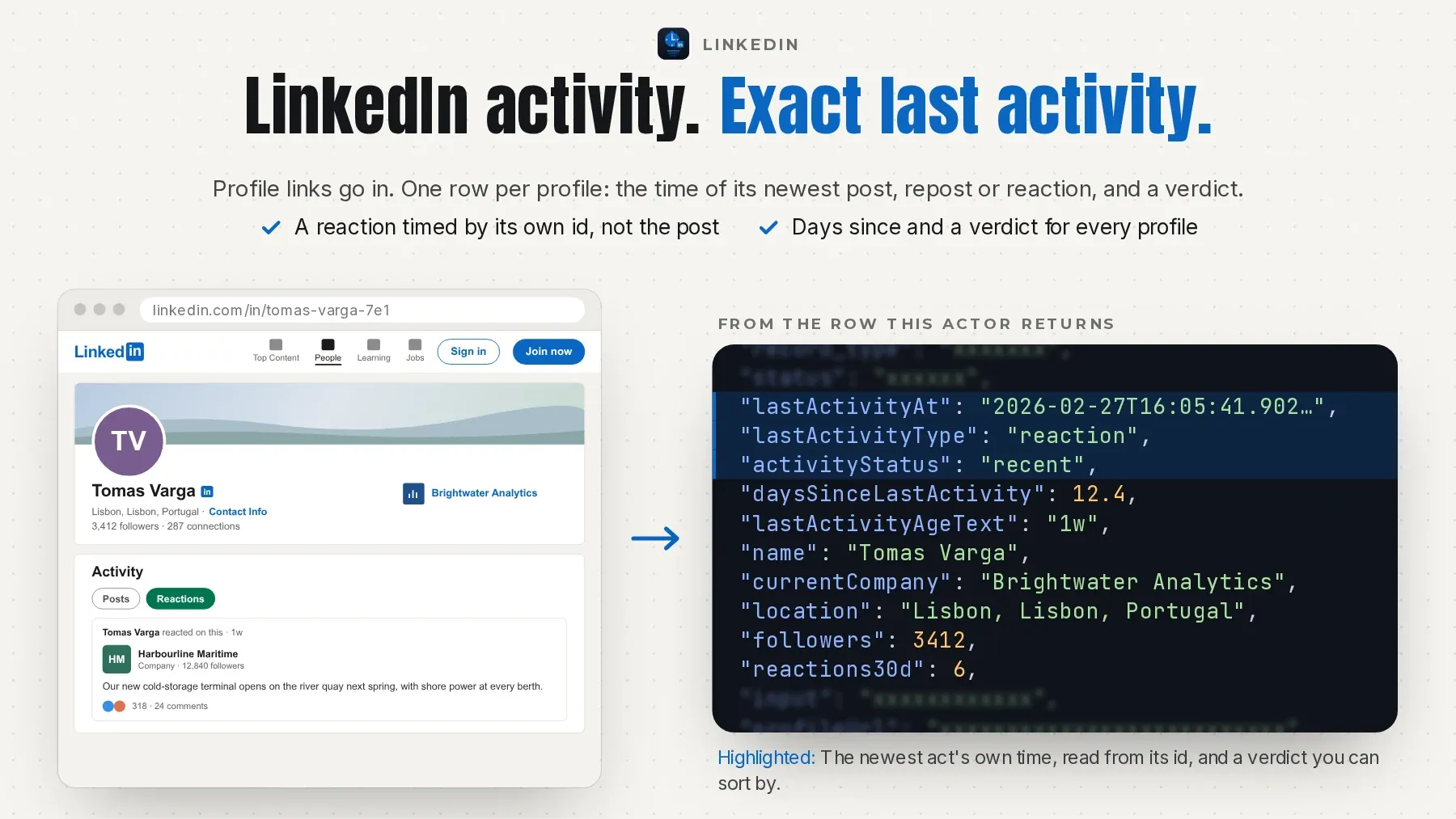
When was a LinkedIn profile last active? Profile links or usernames in, one row per profile out: the exact time of its newest public activity (a post, a repost, a reaction or an article, to the millisecond, from the activity's own id), what it was, the days since, an active / recent / quiet / dormant verdict, the posts, reposts and reactions of the last 7, 30 and 90 days, and the profile's name, company, location, followers and connections. Turn on one more switch for a row per activity: the reacted or posted post's link, author, text, reactions, comments and media. A missing, private or empty profile is a free row, never charged. No login, no LinkedIn account, no cookie, proxies handled for you.
From $6.80 per 1,000 rows (profile) on the Free plan, $5.78 on Starter; every row and add-on is priced under Pricing below. A run start is $0.00045. The default input returns about 5 rows for about $0.03445. A missing profile, a profile LinkedIn holds back from logged-out readers, a profile with no public activity, a company or post link and a value that names no profile are free rows.
How it compares
- 22 times faster than harvestapi's LinkedIn Profile Reactions Scraper, with more data: 5 profiles in 4.1 s, against 92 s; 51 fields per profile, against 9. It is 3 times cheaper: $1.75 per 1,000 profiles, against our $4.85.
- 6 times cheaper than david15999's LinkedIn Activity Index, with more data: $4.85 per 1,000 profiles, against $30.01; 51 fields per profile, against 17. It is faster: 5 profiles in 2.1 s, against our 4.1 s.
- 13 times faster and cheaper than automation-lab's LinkedIn Profile Activity Time Scraper, with more data: 5 profiles in 4.1 s, against 52 s; $4.85 per 1,000 profiles, against $8.18; 51 fields per profile, against 10.
- 9 times faster and 6 times cheaper than saasydb's LinkedPulse, with more data: 5 profiles in 4.1 s, against 36 s; $4.85 per 1,000 profiles, against $30.01; 51 fields per profile, against 19.
Measured on 2026-11-19. Each line compares one job, run by both scrapers at the same time. Prices are per 1,000 profiles: Apify Actors at the Scale plan's prices.
Tested head-to-head on 2026-11-19
The job: When were five public LinkedIn profiles last active (the input schema's example: five profile links). Every Actor ran on it the same day from the same harness; every run's cost is at the Scale plan's prices: a rival's charged events at its price for that plan, this Actor's at its list price. Fields counts the filled fields of a typical row. Each rival reads the same five profile links and gives one row a profile: harvestapi/linkedin-profile-reactions is the most used profile-activity actor (its newest reaction a profile), david15999, automation-lab and saasydb the other actors that give a profile's last activity. The most used last-activity checker takes one link a run and is not in the table. Re-measured monthly.
| Actor | Rows | First row | Run time | Cost | Fields | Failures |
|---|---|---|---|---|---|---|
| this Actor | 5 | 2.6 s | 4.1 s | $0.024 | 51 | none |
harvestapi/linkedin-profile-reactions | 5 | 18 s | 92 s | $0.009 | 9 | none |
david15999/linkedin-activity-index-linkedscore | 5 | 1.6 s | 2.1 s | $0.15 | 17 | none |
automation-lab/linkedin-profile-recent-activity-time | 5 | 9.1 s | 52 s | $0.041 | 10 | none |
saasydb/linkedpulse-linkedin-activity-intelligence | 5 | 9.6 s | 36 s | $0.15 | 19 | none |
Why this LinkedIn activity checker
- The real last activity, to the millisecond. Every card on a LinkedIn profile carries the activity's own id, and the id is its creation time. A reaction is timed by the reaction's own id, not by the post it reacted to; a repost by the repost's own id. The newest of them is the profile's last activity. On the 8 reactions of two profiles we compared with a logged-in reactions scraper, the time was equal to the millisecond on 8 of 8 (one of them on 73 reads of the page).
- Not the age of one card. A popular checker returns the age text of the profile's first post card ("6d"), which is a post's age, not the time of the profile's newest act: on 3 of 4 profiles we paired, the profile had been active hours or days later (one reacted 48 minutes before the read; on another the checker said "6d" while the newest activity's card read "18h"). Here the newest activity's own card age is a column of its own (
lastActivityAgeText, the post's age on that card) beside the exact time. - A verdict and counts you can sort by.
daysSinceLastActivity,activityStatus(active, recent, quiet, dormant),isActive,activityScore, and posts, reposts and reactions in 7, 30 and 90 days, every one computed from the activity's own times. The counts are the page's view (LinkedIn shows a logged-out reader up to 9 posts and 9 reactions, plus the profile's own articles and posts listed in the page's record), and every row says so. - A profile that hides its activity is still read. Some profiles hide the Activity section; their page still lists their own posts and articles with exact dates, so the row gives their last post (
activitySourcejson-ld) and says the reactions are not shown, instead of a false "no activity". - Every profile gets its row, and typed rows are free. A link LinkedIn answers "Profile Not Found" (read on two connections), a profile held back from logged-out readers, a profile with no public activity, a company or post link and a value that names no profile each get a free row that says why. One profile's failure never ends the run: a refused page is read again on a fresh connection.
- No login, ever. The profile page is read as a logged-out visitor sees it: no cookie, no account to lose, nothing of yours sent to LinkedIn.
- Fast. One page a profile, 8 profiles at once, no browser. On build 0.1.4 (10 runs of 2026-11-19, 04:09-04:32 UTC, 256 MB): a one-profile run took 5.1 seconds of run time to its row (the median of 3 runs, 4.1-5.9 s); five profiles with their activities gave 52 rows in 3.9-7.2 seconds (555 rows a minute, start-up included, the median of 3 runs); 20 profiles alone took 7.2-8.1 seconds (3 runs); the comparison run below read the five example profiles in 4.1 seconds.
Who it's for
- Sales and recruiting teams — a lead or candidate list sorted by who was active this week, so outreach goes to people who will see it; the reactions show what they engage with.
- Marketers and community managers — which influencers, partners or customers still post and react, with their newest posts and their engagement.
- Researchers and analysts — the activity of a panel of profiles over time from scheduled runs, each activity with its exact time and the post it touched.
- Developers and data teams — a CRM enrichment step: links in, typed rows keyed by the member id out, a free row for every profile LinkedIn does not show, the leader's input name read as it is.
Quick start
When were these profiles last active?
Every activity the profile's page shows, with the posts
Only the reactions of the last 30 days
Switching from bestscrapers/linkedin-detect-activity-time?
Your input works as it is. Each name in the left column is read as this Actor's own field and the run log says so (read <theirs> as <ours>); a name marked not read is ignored with a note. A value in the other Actor's shape, an object list or its own date form, is read too.
| bestscrapers/linkedin-detect-activity-time | this Actor | what to know |
|---|---|---|
linkedin_url | profiles | Read as one profile link (any LinkedIn host or form, or a username); give several in profiles. |
What differs:
- The leader takes one link a run; this Actor takes a list, and the leader's
linkedin_urlis read as one of them. - The leader's value is the age text of the profile's first post card (
recent_activity_time, e.g. "1mo"), which is the age of that post. This Actor gives the exact time of the newest activity from the activity's own id (lastActivityAt), and the leader's kind of value aslastActivityAgeText. - Each row also carries the verdict, the 7 / 30 / 90-day counts and the profile's identity, and with
includeActivitiesthe activities themselves.
Output
One row per profile (and, when you ask, one row per activity):
| field | meaning |
|---|---|
record_type | profile: one row per profile you gave; activity: one row per activity (with includeActivities). |
status | ok (charged), or why the input gave no charged row: no_public_activity, not_found, not_available, not_a_profile, invalid_input, duplicate, failed, not_read (free). |
input | The value you gave that this row answers. |
profileUrl | The profile's canonical link (https://www.linkedin.com/in/…). |
publicId | The profile's username (the part after /in/). |
memberId | LinkedIn's numeric member id of the profile. |
name | The profile's name. |
currentCompany | The current company shown on the profile's top card. |
currentCompanyUrl | The current company's LinkedIn page. |
school | The school shown on the profile's top card. |
schoolUrl | The school's LinkedIn page. |
location | The profile's location as LinkedIn shows it. |
followers | The profile's followers: exact where the page's record has the number, else the top card's rounded figure (followersExact false). |
followersExact | True when followers is LinkedIn's exact count, false when it is the rounded top-card figure ("63K"). |
followersText | The top card's followers text as shown ("63K followers"). |
connections | The connections number (500 for "500+"). |
connectionsText | The connections text as shown ("500+ connections"). |
photoUrl | The profile photo's link, when the profile shows one. |
aboutSnippet | The first part of the About section as LinkedIn shows it to logged-out readers (about 85 characters, ending "…"). |
hasAbout | The profile has an About section. |
hasExperience | The profile shows an Experience section. |
hasEducation | The profile shows an Education section. |
hasPhoto | The profile has a photo. |
lastActivityAt | When the profile's newest public activity happened (UTC, to the millisecond, from the activity's own id). |
lastActivityTimestamp | The same time in epoch milliseconds. |
lastActivityType | What the newest activity was: post, repost, reaction or article. |
lastActivityId | The newest activity's own id (a reaction's and a repost's own, not the post's). |
lastActivityUrn | The newest activity's urn (urn:li:activity:…). |
lastActivityUrl | The newest activity's link: the post for a post, the activity's own feed link for a reaction or a repost. |
lastActivityPhrase | LinkedIn's phrase on the newest activity's card ("liked this", "reacted on this", "reposted this"). |
lastActivityAgeText | LinkedIn's age text on the newest activity's card ("2w"): the age of the post on that card, not of the act. A card-age checker returns the same kind of text from the profile's first post card. |
lastPostAt | The newest own post or article (UTC). |
lastRepostAt | The newest repost (UTC). |
lastReactionAt | The newest reaction (UTC), timed by the reaction's own id. |
daysSinceLastActivity | Days from the newest activity to the run, to 0.1 day. |
activityStatus | active (7 days or less since the newest activity), recent (30), quiet (90), dormant (more), none (no public activity). |
isActive | True when the newest activity is 30 days old or less. |
activityScore | 0-100: 60 × max(0, 1 − days ÷ 90) + 40 × min(1, activities in 30 days ÷ 10). |
posts7d | Own posts and articles in the last 7 days (the page's view, a floor). |
posts30d | Own posts and articles in the last 30 days (a floor). |
posts90d | Own posts and articles in the last 90 days (a floor). |
reposts7d | Reposts in the last 7 days (a floor; null when the profile hides its Activity section). |
reposts30d | Reposts in the last 30 days (a floor). |
reposts90d | Reposts in the last 90 days (a floor). |
reactions7d | Reactions in the last 7 days (a floor; null when the profile hides its Activity section). |
reactions30d | Reactions in the last 30 days (a floor). |
reactions90d | Reactions in the last 90 days (a floor). |
activitiesShown | The activities the profile's page shows a logged-out reader (posts, reposts, reactions, articles). |
activitiesDelivered | With includeActivities: the activity rows of this profile that went out after your filters and caps. |
activitySource | panels (the page's Activity section) or json-ld (the profile hides the section: its own posts and articles from the page's record). |
reactionsShown | False when the profile hides its Activity section: its reactions and reposts are not shown. |
countsNote | What the counts are: the page's view, a floor. |
activityType | On an activity row: post, repost, reaction or article. |
activityId | The activity's own id (a reaction's own id, not the post's). |
activityUrn | The activity's urn. |
activityUrl | The activity's link: the post for a post, the activity's own feed link for a reaction or a repost. |
activityAt | When the activity happened (UTC, to the millisecond, from its own id). |
activityTimestamp | The same time in epoch milliseconds. |
activityPhrase | LinkedIn's phrase on the card ("liked this", "reacted on this", "reposted this"). |
reactionKind | On a reaction: like, or other (love, celebrate, support, insightful or funny). |
postId | The id of the post the activity is about. |
postUrn | The post's urn. |
postUrl | The post's link. |
postedAt | When the post was created (UTC, from its own id). |
postAgeText | LinkedIn's age text of the post ("15h", "2w"). |
postAuthorName | The post's author. |
postAuthorUrl | The author's LinkedIn page. |
postAuthorPublicId | The author's username or the company's slug. |
postAuthorType | person, company or school. |
postText | The post's text as the card shows it. |
postReactions | The post's total reactions. |
postComments | The post's comments count (0 when the card shows reactions and no comments). |
postTopReactionTypes | The up to three reaction types LinkedIn shows (LIKE, PRAISE, EMPATHY, INTEREST, APPRECIATION, ENTERTAINMENT), no counts. |
postImages | The post's images. |
postHasVideo | The post has a video. |
postHasDocument | The post has a document (a carousel). |
postArticleUrl | The LinkedIn article the post shares. |
postAuthorFollowers | With authorDetails: the author's followers (exact for a company). |
postAuthorLocation | With authorDetails: a person's location or a company's headquarters. |
postAuthorCompany | With authorDetails: a person author's current company. |
postAuthorIndustry | With authorDetails: a company author's industry. |
postAuthorSize | With authorDetails: a company author's size ("10,001+ employees"). |
postAuthorDetailsStatus | With authorDetails: served (a person's, a company's or a school's page), not_found, not_offered (the card names no author page), cut (the run's time limit came before the page) or failed. |
note | Why a row has its status, or a remark on it (a limit above the page's view). |
scraped_at | When this row was read (UTC). |
Example record:
Pricing
Pay for the profiles and activities a run delivers, plus one run start. No platform usage is billed to you, and the price falls with your Apify plan.
| event | unit | Free | Starter | Scale | Business |
|---|---|---|---|---|---|
Profile (profile) | per 1,000 | $6.80 | $5.78 | $4.76 | $3.40 |
Activity (activity) | per 1,000 | $0.85 | $0.7225 | $0.595 | $0.425 |
Run start (start) | per run | $0.00045 | $0.00045 | $0.00045 | $0.00045 |
A profile row is $6.80 per 1,000 on the Free plan ($0.0068 a profile) and $5.78 on Starter, with everything it carries: the newest activity's exact time, what it was, the days since, the verdict, the 7/30/90-day counts and the identity. With includeActivities each post, repost, reaction or article delivered is $0.85 per 1,000 ($0.00085 a row). Each run that delivers a charged row pays the run start, $0.00045 once.
So the example (five profiles) costs $0.03445 on the Free plan and $0.02935 on Starter; 100 profiles $0.68045 and $0.57845; 10 profiles with every activity their pages show (185 activity rows on one of our runs) $0.2257 and $0.1919125. Free: a profile LinkedIn does not have, a profile it holds back from logged-out readers, a profile with no public activity, a company, school or post link, a value that names no profile, a second link or username of a member the run already read, an activity your filters leave out, an input left unread at a cap, and a run that delivered no charged row (no run start either). A run that stops early (a timeout, an abort, the charge limit) is charged for the rows it delivered.
Before the first request the log names the prices at your plan and what the run can cost: "at most" under the bounds the run holds (one row a profile, maxActivitiesPerProfile, maxItems with the profile rows first) and your charge limit; activities with no cap have no row bound, so the line names "about" over the page's spread (8 to 24 activity rows a profile on 10 profiles of ours). Enterprise plans have their own rates: the Actor's Pricing tab shows the price for your plan.
Usage patterns
- Profiles —
profilestakes LinkedIn profile links in any form (www or a country host such as au.linkedin.com, with or without a trailing slash, parameters or a sub-path like/details/…or/recent-activity/…, a link wrapped in a redirect) or bare usernames (williamhgates). Every form is read as the one canonical linkhttps://www.linkedin.com/in/<username>, so two forms of one profile are read once, and two usernames of one member give one charged row and a freeduplicate. A company, school or post link, an old/pub/link, a member-id link (/in/ACoAA…) and a value that names no profile give a free row that says why. - What a profile row is —
record_type=profile,status=ok: a served profile (charged).lastActivityAtis the newest of every activity the page shows, each timed by its own id: a post, a repost (the repost's own time), a reaction (the reaction's own time, not the post's) or an article (its publication time).lastActivityType,lastActivityId,lastActivityUrlandlastActivityPhrase("liked this", "reacted on this", "reposted this") say what it was;lastPostAt,lastRepostAtandlastReactionAtgive each kind's newest.daysSinceLastActivitycounts from the run's own clock;activityStatusis active (7 days or less), recent (30), quiet (90) or dormant;isActiveis 30 days or less;activityScore= 60 × max(0, 1 − days ÷ 90) + 40 × min(1, activities in 30 days ÷ 10). The window counts andactivitiesShownare the page's view, a floor (countsNote). A free profile row'sstatussays why it has no charged row. - Activity rows — With
includeActivitieseach post, repost, reaction and article the page shows is a row of its own (record_type=activity, charged), newest first, with the profile's identity on it:activityType, its ownactivityId,activityAtandactivityPhrase,reactionKindon a reaction (like, orotherfor love, celebrate, support, insightful and funny: LinkedIn shows a logged-out reader "reacted on this" and not which), and the post it is about:postUrl,postId,postedAt(the post's own creation time),postAgeText(LinkedIn's age text, the post's), the author (postAuthorName,postAuthorUrl,postAuthorTypeperson, company or school),postText,postReactions,postComments,postTopReactionTypes,postImages,postHasVideo,postHasDocumentandpostArticleUrl.activityTypes,reactionKind,activityDateFrom/activityDateTo,postKeywordsandmaxActivitiesPerProfilechoose these rows; the profile row always reads the whole page, and it says how many activity rows went out (activitiesDelivered). - Options —
authorDetailsreads each distinct post author's page once a run and adds a person's followers, location and current company, or a company's exact followers, industry, size and headquarters (postAuthorDetailsStatussays served, not_found, not_offered when the card names no author page, cut when the run's time limit came first, or failed); a school's page is read like a company's.maxItemscaps the charged rows of the whole run, profile and activity rows together.maxConcurrencysets the profiles read at once (8 by default).
Input configuration
| field | type | default | what it does |
|---|---|---|---|
profiles | array | [] | Profile links or usernames, one a line: https://www.linkedin.com/in/ajjames, linkedin.com/in/satyanadella/, a country host (au.linkedin.com/in/…), a link with ?trk=… or a sub-path, or a bare username (williamhgates). Each profile is read once; a company, school or post link, an old /pub/ link or a value that names no profile gives a free row that says why. |
includeActivities | boolean | false | Off: one row a profile (its newest activity, the verdict and the counts). On: also one row for each post, repost and reaction the profile's page shows (up to 9 posts and 9 reactions logged out, plus the profile's own articles listed in the page's record), with the activity's exact time, the post's link, author, text, reactions, comments and media. Each activity row is charged as its own row. |
activityTypes | array | [] | Only these kinds of activity rows; empty = every kind. Posts include the profile's articles. The profile row always reads the whole page. Comments a profile made are not shown to logged-out readers. |
reactionKind | any / like / other | "any" | Which reaction rows to keep. LinkedIn shows a logged-out reader "liked this" (a like) or "reacted on this" (any other reaction: love, celebrate, support, insightful, funny), not which one. |
activityDateFrom | string | "" | Only activity rows at or after this time: a date (2026-11-01, UTC), a time (2026-11-01T08:00:00Z) or a span before now (30 days, 2 weeks, 12 hours). Empty = no lower bound. |
activityDateTo | string | "" | Only activity rows at or before this time: a date (the whole day, UTC), a time or a span before now. Empty = up to now. |
maxActivitiesPerProfile | integer | 0 | The newest N activity rows of each profile after the filters; 0 = every activity the page shows. A number above what the page shows is said on the profile row. |
postKeywords | array | [] | Keep an activity row only when its post's text holds one of these words (any case). Empty = no word filter. |
authorDetails | boolean | false | On: one more page per distinct post author of the run (a person's followers, location and current company; a company's exact followers, industry, size and headquarters) onto the activity rows. No extra charge; the run takes longer. |
maxItems | integer | 0 | The most charged rows of the whole run (profile rows and activity rows together); 0 = no cap beyond your charge limit. Typed rows (not found, private, no activity) are free and do not count. |
maxConcurrency | integer | 8 | Profiles read at the same time, each on its own connection. |
feedback | string | A note to the people who maintain this Actor: what you needed and did not get. For example a missing field, a wrong or empty result, or the Actor you switch from or to, and why. The run does not read it: the rows and the charges stay the same. A person reads every note. |
Errors
A run does not fail because of your input. When an input cannot be used — a date that is not a date, an id in the wrong form, two settings that contradict each other — the run ends Succeeded, charges nothing, and says what to change:
- the status message starts with
INPUT REJECTED; - the dataset holds one row,
{"error": true, "code": "…", "message": "…"}, and no results; - the key-value store record
ERRORholds the same object.
From code, check error on the first row before reading results.
A profile that gives no charged row is not an error: the dataset holds its free row (its status and note say why) and nothing is charged. A run that ends Failed is a fault on our side, never your input; it charges nothing, and we are alerted.
FAQ
Why only 9 posts and 9 reactions?
LinkedIn shows a logged-out reader the newest posts and reactions of a profile on its page, up to 9 of each, and lists the profile's own articles (and on some pages its own posts) in the page's record, which come as rows too (activitiesShown counts them all: 23 on one profile, 8 posts, 7 reactions and 8 articles). The activity pages behind them are for signed-in members. This Actor never logs in, so the counts are the page's view, a floor, and every row says so. The newest activity is exact: it is always among the cards the page shows.
Does it give the comments a profile made, the reaction type, badges or reactions on comments?
No. LinkedIn shows a logged-out reader a profile's posts, reposts and reactions, not its comments; a reaction as "liked this" or "reacted on this", not which reaction (rows say like or other); no badges (Top Voice, Creator) and no reactions on comments. All of these need a signed-in member. activityTypes therefore offers posts, reposts and reactions only.
Can it watch profiles for new activity?
Yes, with a schedule: save a task with your profiles, includeActivities on and activityDateFrom "1 day", and run it daily. Each run keeps only the activity of the last day, each by its own exact time, and each profile row still gives the newest activity and the verdict.
Why is there no headline?
LinkedIn does not show an ordinary profile's headline or job titles to logged-out readers (they are blank or masked); the row carries the current company and the school from the profile's top card instead.
Which status is which?
ok (charged), no_public_activity (the page shows no post, repost, reaction or article; the row keeps the profile's name and company), not_found (LinkedIn answered "Profile Not Found" on two connections), not_available (LinkedIn held the page back from logged-out readers on three connections, residential included: private, restricted or held back for now), not_a_profile (a company, school or post link), invalid_input (a value that names no profile, an old /pub/ link, a member-id link), duplicate (another link of a member the run already read), failed (no connection could read the page), not_read (left at maxItems, the charge limit or the run's time limit). Only ok rows are charged.
Does it need a LinkedIn account, cookies or an API key?
No. Everything is read logged out with a plain HTTP client; no member cookie is accepted and none is used.
Do I need Apify Proxy or my own proxy?
No. The Actor uses its own connections, at no extra cost to you.
Integration
JavaScript
Python
CLI
REST
AI agents and MCP
Apify's MCP server offers this Actor as a tool to Claude, Cursor, VS Code and any other MCP client. Connect https://mcp.apify.com?tools=hyperbach/linkedin-scraper and ask, for example: "Find out when these LinkedIn profiles were last active and whether they still post or react". The agent fills the input from the table above and reads the rows from the run's dataset. A field under the name another Actor gives it is read as this Actor's own: linkedin_url, linkedinUrl, linkedinUrls, profileUrls as profiles; max_results, maxResults, limit, maxRows as maxItems; maxItemsPerProfile, maxPosts, maxReactions, max_reactions as maxActivitiesPerProfile; findActivityFrom, reactedFrom, dateFrom, startDate as activityDateFrom (and more). An agent or a person can add feedback to any run and say what was needed and not delivered: a missing field, a wrong or empty result, the Actor switched from or to, and why. The run returns the same rows at the same price, and a person reads every note.
n8n, Make and Zapier
The Apify node in n8n, the Apify app in Make and the Apify integration in Zapier run this Actor on a schedule or from a trigger and read its dataset. A webhook on the run's end (Integrations on the Actor page) sends the rows on to your own endpoint. Nothing to install on our side.
Support
Disagree with a charge? Write to apify@hyperbach.com with the run ID. We will ask Apify to compensate you, and the charge comes back to your Apify account as platform credit.
Did it do the job? A short review on the Store, at any rating, helps the next buyer choose.
See also
- LinkedIn Jobs Scraper — LinkedIn job listings for keywords and a location, with the applicants count, the salary block and the company's facts.
- LinkedIn Ad Library Scraper — every ad a company runs on LinkedIn, with the full detail page: payer, impressions by country and the targeting the advertiser chose.
- LinkedIn Profile Scraper & People Search — LinkedIn profiles logged out, by link or people search: name, headline, location, about, followers, connections, companies and schools.
- LinkedIn Posts Scraper — LinkedIn posts logged out, by profile, company or post link or by search words: text, author, date, reactions, comments and media.
This page is generated from the Actor's schemas and a live sample — it cannot describe a field the Actor does not have.


