

Skool Community Scraper: Prices, Owners & Member Counts
Pricing
from $0.42 / 1,000 communities
Skool Community Scraper: Prices, Owners & Member Counts
Scrape Skool communities by keyword, category or URL: name and URL, description and about copy, member and online counts, posts and courses, free or paid with the price and tiers, the owner's public name and social links, custom links and media. Several searches per run, a max per search. No login.
Pricing
from $0.42 / 1,000 communities
Rating
0.0
(0)
Developer
Hyperbach
Maintained by CommunityActor stats
0
Bookmarked
2
Total users
1
Monthly active users
a day ago
Last modified
Categories
Features
Share
Skool communities, logged out: search terms, categories and a price filter (Skool's public discovery search), discovery URLs or community URLs in, one row per community out — its name and URL, the description and the about page's copy, the member and online counts, admins, posts, courses and modules, public or private, the rating and reviews count, free, paid or freemium with the price, its interval, the free trial and the tiers with their benefits, the owner's public name, handle, bio and social links, the custom links, the logo, cover, images and videos — several searches in one run, a max per search. One free search row per input carries a completeness verdict: COMPLETE (Skool's own end of the list), CAPPED (your limit), TRUNCATED (Skool's own limit of 1,000 communities a search) or PARTIAL. No login, no cookies, no browser, proxies handled for you.
$0.95 per 1,000 community rows on the Free plan, $0.80 on Starter. A run start is $0.0011. The default input returns about 50 rows for about $0.0486. A value that names nothing is a free row that says why.
Why this Skool scraper
- Several searches in one run. Search terms, Skool's nine categories (alone, or each term inside each category) and Skool's own price filter (free, or paid with a free trial), or discovery URLs from your browser with every filter you set there, or community URLs and names. Each search gets its own cap (
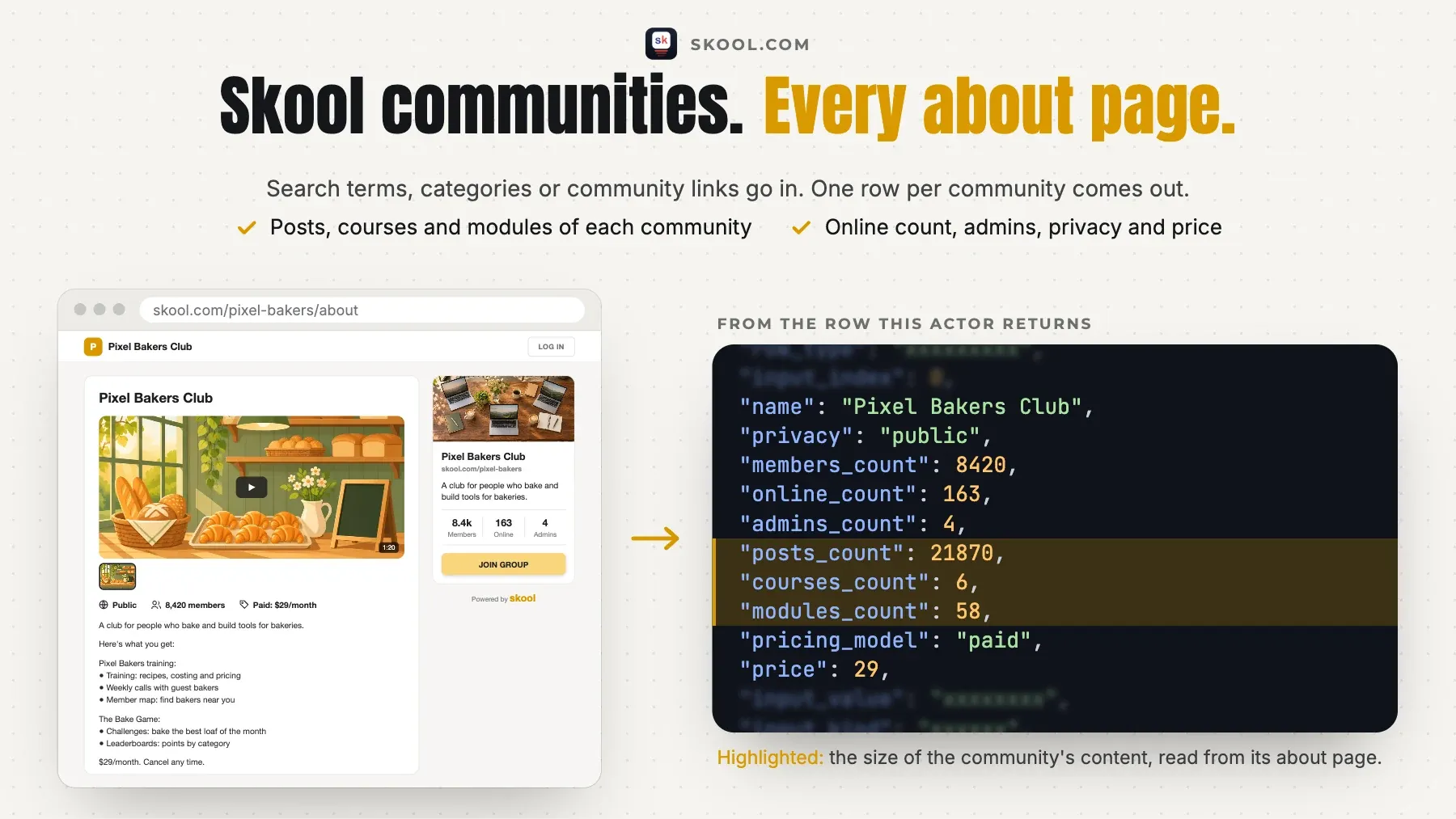
maxItemsPerSearch), and the run's cap sits on top (maxItems). An empty input reads Skool's default discovery list. - The about page on every row. Skool's search list shows the name, the description, the members and the price; this actor reads each community's about page as well, at no extra charge: the online count, admins, posts, courses and modules, public or private, the tiers with their benefits and billing periods, the free tier's benefits, the about copy, the owner's public profile and links, the custom links, the images and videos.
- Prices you can compare.
pricing_modelsays free, paid or freemium (a free tier beside paid tiers);priceis the amount Skool shows (its lowest paid tier) with thecurrencyand theprice_interval(month, year or one-time), andfree_trialsays whether a trial is offered. - Deep searches, checked. 30 communities a page in Skool's own order, page after page, to the end of the list by Skool's own count. Skool lists 1,000 communities of a search at most (34 pages, measured 2026-10-31); the free
searchrow says so (TRUNCATED) and names the filters Skool applied. A community a later page or another search repeats is delivered and charged once. - Honest runs. A community Skool does not know is a free
not_foundrow, checked twice; a URL that is not Skool's a freeinvalidrow; a community that hides its owner says so (owner_hidden) and gets no owner fields. No e-mail is guessed. Every input gets a row.
Who it's for
- Agencies and freelancers — every Skool community of a niche with its size, its price and its owner's public profile and links, to find the owners worth pitching.
- Course creators and community owners — what the communities of a niche charge, which tiers and benefits they sell, how large and how active they are, and how their about pages are written.
- Analysts and investors — the Skool ecosystem by category: member counts, free against paid, price points and the communities that grow, read again every week.
Quick start
The first 100 communities for one keyword
Free communities of two categories
Communities by URL or name
Output
One row per community (and one free search row per input):
| field | meaning |
|---|---|
row_type | community (one community, charged) or search (the input's row with the walk's verdict; free). |
input_index | The 1-based position of the input this row answers: the searches first (terms, categories or their pairs; Skool's default list when the input is empty), then startUrls. |
input_value | The input as you gave it: the term, the category, term · category, or the URL. |
input_kind | Which input it came from: search_term, category, search_term+category, default (an empty input: Skool's default list) or url (startUrls). |
search_url | The search (or the community's about page) on Skool, as a URL you can open. |
status | A search row: ok, not_found, invalid, duplicate, failed or not_read (see the FAQ). A community row: ok. |
status_detail | Why a search row is not ok, in a sentence. |
scraped_at | When the row was read (ISO 8601, UTC). |
position | The community's place on the search's list (1 = first), in Skool's order; null for a community read by URL. |
page | The discovery page the community was on (30 communities a page); null for a community read by URL. |
community_id | Skool's id of the community (32 hex characters). |
slug | The community's name in its URL (skool.com/<slug>). |
url | The community's page on Skool. |
name | The community's display name. |
description | The community's short description, as its owner wrote it. |
about_text | The about page's copy (its landing text), as its owner wrote it. |
members_count | Members of the community, as Skool counts them. |
online_count | Members online when the row was read (the about page). |
admins_count | Admins of the community (the about page). |
posts_count | Posts in the community (the about page). |
courses_count | Courses in the community's classroom (the about page). |
modules_count | Modules (lessons) of those courses (the about page). |
privacy | public (anyone can read the posts) or private (members only); the about page is public either way. |
rating | The community's average review rating (1-5), when it has reviews. |
reviews_count | How many reviews the community has. |
pricing_model | free, paid, or freemium (paid tiers beside a free tier with its own benefits). |
is_paid | True when the community shows a price. |
price | The price Skool shows for the community (its lowest paid tier), in currency; null for a free community. |
currency | The price's currency (ISO code, USD). |
price_interval | What the price buys: month, year or one_time. |
free_trial | True when the community offers a free trial. |
free_benefits | The benefits of the free tier of a freemium community, as listed on its about page. |
price_tiers | The community's tiers: each tier (standard, premium, vip …), its billing periods (monthly, annual, one_time) and its benefits. The tiers' own amounts are not shown to a visitor who is not logged in. |
owner_hidden | True when the community hides its owner on its about page; the owner fields are then null. |
owner_name | The owner's public name on Skool. |
owner_handle | The owner's Skool handle. |
owner_url | The owner's public profile on Skool (skool.com/@<handle>). |
owner_bio | The owner's public bio on Skool. |
owner_location | The location the owner gives on Skool. |
owner_instagram | The Instagram link on the owner's Skool profile. |
owner_youtube | The YouTube link on the owner's Skool profile. |
owner_x | The X (Twitter) link on the owner's Skool profile. |
owner_linkedin | The LinkedIn link on the owner's Skool profile. |
owner_facebook | The Facebook link on the owner's Skool profile. |
owner_website | The website link on the owner's Skool profile. |
custom_links | The community's own public links (label, url), as its page lists them. |
logo_url | The community's logo. |
cover_url | The community's cover image. |
brand_color | The community's brand colour (hex). |
media_images | The images of the about page's gallery. |
media_videos | The external videos of the about page (YouTube, Loom … links). |
hosted_videos_count | How many videos of the about page Skool hosts itself (their player links are per viewer and are not given). |
post_categories | The categories of the community's posts (a public community's feed sections). |
classroom_visible | True when the community shows its classroom tab. |
calendar_visible | True when the community shows its calendar tab. |
created_at | When the community was created on Skool (ISO 8601, UTC). |
updated_at | When Skool last updated the community's record (it moves with activity; ISO 8601, UTC). |
details_status | read when the about page was read; not_found or failed when only the search card's fields are on the row. |
communities_count | A search row: Skool's own count of the search's communities (it caps it at 1,000). |
communities_delivered | A search row: the communities this input delivered. |
pages_read | A search row: the discovery pages read. |
repeats_skipped | A search row: communities met again on a later page, or already delivered by another input of the run, skipped and not charged. |
applied_filters | A search row: the filters Skool says it applied (the term, the category, the price, the type, the sort, the language), as JSON. |
verdict | A search row: COMPLETE (Skool's own end of the list), CAPPED (your limit), TRUNCATED (Skool's limit of 1,000 communities a search) or PARTIAL (a refusal or the time limit stopped it). |
verdict_detail | A search row: the verdict in a sentence, with the counts. |
Example record:
Pricing
Pay for the communities a run delivers, plus one run start; no platform usage is billed to you. The community price falls with your Apify plan.
| event | unit | Free | Starter | Scale | Business |
|---|---|---|---|---|---|
Community (community) | per 1,000 | $0.95 | $0.80 | $0.66 | $0.42 |
Run start (start) | per run | $0.0011 | $0.0011 | $0.0011 | $0.0011 |
A community is $0.95 per 1,000 on the Free plan ($0.00095 a community), with its about page (the online count, posts, courses, the owner, the tiers and the copy) included. Each run that delivers a charged community also pays the run start, $0.0011 once; a run that delivers no charged community pays nothing at all. So one search of 100 communities costs $0.0961 on the Free plan and $0.0811 on Starter, and several searches in one run share one start. The free search row of every input, a value that is not a Skool community or discovery URL (invalid), a community Skool does not know (not_found), a repeated input (duplicate), an input left at the cap or the time limit (not_read) and a refusal the run could not pass (failed) are never charged. A community is charged once a run, also when several searches list it. A run that stops early (a timeout, an abort) is charged for the communities it delivered. maxItems counts the charged rows; before the first request the log names the price of each row at your plan and the most the run can cost. Enterprise plans have their own rates: the Actor's Pricing tab shows the price for your plan.
Usage patterns
- Searches, categories and URLs —
searchTermsare searched as you would type them in Skool's search box, in every language.categoriestake Skool's nine discovery categories; with search terms, each term is searched inside each category (3 terms × 2 categories = 6 searches).priceis Skool's own filter:free, orfree-trial(paid communities that offer a trial).startUrlstakes community URLs or names (one row each, from the about page) and discovery URLs as your browser shows them (every filter they carry is kept). - What a row is —
row_type=community: one community, in Skool's order (position, and thepageit was on; null for a community read by URL).row_type=search: the free row of one input value —communities_count(Skool's own count, which it caps at 1,000),communities_delivered,pages_read,repeats_skipped,applied_filters(the filters Skool says it applied), theverdictwith itsverdict_detail, and thestatuswith its reason. - How far a search goes —
maxItemsPerSearch(default 100; 0 = every community the search lists) stops each search after that many new communities. Skool lists 1,000 communities of a search at most (34 pages of 30); a run that reaches that end says TRUNCATED, and a category or the price filter narrows the search to read others.maxItemscaps the charged rows of the whole run.
Input configuration
| field | type | default | what it does |
|---|---|---|---|
searchTerms | array | Words to search Skool's discovery page for, one search a line (marketing, real estate, ai automation), as you would type them in its search box. Each term is one search of up to 1,000 communities (Skool's own limit), in Skool's order. With categories below, each term is searched inside each category. Leave the terms, the categories and the URLs empty to read Skool's default discovery list (the top communities of every category). | |
categories | array | Skool's discovery categories. Alone, each category is one search of its communities; with search terms, each term is searched inside each category. | |
price | free / free-trial | Optional: only free communities, or only paid communities that offer a free trial (Skool's own filters, applied to every search term and category). Empty = every community. Skool has no paid-only filter: every row says whether the community is paid, and at what price. | |
startUrls | array | Community URLs or names (https://www.skool.com/skoolers, https://www.skool.com/skoolers/about, or just skoolers): one row each, from the community's about page. Discovery URLs as your browser shows them (https://www.skool.com/discovery?q=ai&c=…&pr=free-trial): one search each, every filter of the URL kept (the type, the sort and the language too). A member's profile or a URL of another site gets a free invalid row; a community Skool does not know a free not_found row. | |
maxItemsPerSearch | integer | 100 | Stop each search (a term, a category, a pair of them or a discovery URL) after this many communities (0 = every community the search lists). Skool lists 1,000 communities of a search at most (34 pages of 30); narrow a broad term with a category or the price filter. A community met again on a later page, or one another input of the run already delivered, is skipped and not counted. |
maxItems | integer | 0 | Stop the run after this many community rows across every search and URL (0 = no limit). Search rows are free and not counted; an input left unread at the cap gets a free not_read row. |
feedback | string | A note to the people who maintain this Actor: what you needed and did not get. For example a missing field, a wrong or empty result, or the Actor you switch from or to, and why. The run does not read it: the rows and the charges stay the same. A person reads every note. |
Errors
A run does not fail because of your input. When an input cannot be used — a date that is not a date, an id in the wrong form, two settings that contradict each other — the run ends Succeeded, charges nothing, and says what to change:
- the status message starts with
INPUT REJECTED; - the dataset holds one row,
{"error": true, "code": "…", "message": "…"}, and no results; - the key-value store record
ERRORholds the same object.
From code, check error on the first row before reading results.
A URL that is not a Skool community or discovery URL (a member's profile, another site) is not an error: it gets one free search row with status invalid that says why, and the run goes on with the others. A run that ends Failed is a fault on our side, never your input; it charges nothing, and we are alerted.
FAQ
Which status is which?
A search row's status is ok (communities served), not_found (Skool knows no community of that name; checked on two connections), invalid (a value that is not a community name or a Skool community or discovery URL), duplicate (the same search or community again in the input: read once; or a community another input already delivered), failed (Skool refused every try; free) or not_read (left at maxItems, the charge limit or the run's time limit). A community row's status is ok.
Does it give the members, the posts or the owner's e-mail?
No. A row is one community with its counts, its price, its owner's public profile and its about page. The member list, the posts and the comments are other data (and other people's), and Skool's pages give no e-mail; none is guessed. The member, online, admin and post counts are on every row.
Does it give each tier's price?
The row gives the price Skool shows for the community (its lowest paid tier) with its interval, and every tier's name, billing periods (monthly, annual, one-time) and benefits. Skool's pages do not show the other tiers' amounts to a visitor who is not logged in.
Why does a search stop at 1,000 communities?
Skool lists 1,000 communities of one search at most (page 35 of a search redirects back to page 1, measured 2026-10-31). Split a broad term with a category or the price filter, or give several terms.
Does it read private communities?
It reads what Skool shows any visitor: a private community's about page (its description, counts, price, tiers, owner and copy) is public and is read; its posts and members are not.
Does it need a Skool account or cookies?
No. Everything is read from Skool's public pages, logged out.
Do I need Apify Proxy or my own proxy?
No. The Actor uses its own connections, at no extra cost to you.
Integration
JavaScript
Python
CLI
REST
AI agents and MCP
Apify's MCP server offers this Actor as a tool to Claude, Cursor, VS Code and any other MCP client. Connect https://mcp.apify.com?tools=hyperbach/skool-scraper and ask, for example: "Find 50 Skool communities about marketing with their member count, price and owner". The agent fills the input from the table above and reads the rows from the run's dataset. The input names are the ones in the table above. An agent or a person can add feedback to any run and say what was needed and not delivered: a missing field, a wrong or empty result, the Actor switched from or to, and why. The run returns the same rows at the same price, and a person reads every note.
n8n, Make and Zapier
The Apify node in n8n, the Apify app in Make and the Apify integration in Zapier run this Actor on a schedule or from a trigger and read its dataset. A webhook on the run's end (Integrations on the Actor page) sends the rows on to your own endpoint. Nothing to install on our side.
Support
Disagree with a charge? Write to apify@hyperbach.com with the run ID. We will ask Apify to compensate you, and the charge comes back to your Apify account as platform credit.
Did it do the job? A short review on the Store, at any rating, helps the next buyer choose.
See also
- Telegram Profile Scraper — Telegram channels, groups, bots and users by username or link, with the exact subscriber or member count.
- YouTube Channel Search Scraper — the YouTube channels a keyword finds, with subscribers, the exact video and view counts and the country.
- Threads Scraper — Threads profiles with the exact follower count, their posts and replies with view counts, and keyword and tag search, without a login.
- Substack Scraper — the posts of a Substack newsletter with the full text of free posts, the date, the paywall flag and the likes.
- Weibo Scraper — Weibo posts, profiles, search, comments and the hot-search boards, without a login.
- Pinterest Search Scraper — the pins of a Pinterest search, with the link each pin points to, the image and the pinner.
This page is generated from the Actor's schemas and a live sample — it cannot describe a field the Actor does not have.


