

WeChat Official Account Scraper: WeChat Articles, 微信公众号
Pricing
from $3.00 / 1,000 articles
WeChat Official Account Scraper: WeChat Articles, 微信公众号
WeChat Official Account (公众号) scraper and WeChat API, no login: WeChat search for articles by keyword, or read article links, accounts and albums (合集). Chinese articles with title, account, author, exact publish time, digest, cover, permanent link, IP region, full text. Misses free.
Pricing
from $3.00 / 1,000 articles
Rating
0.0
(0)
Developer

Hyperbach
Maintained by CommunityActor stats
0
Bookmarked
1
Total users
1
Monthly active users
a day ago
Last modified
Categories
Features
Share
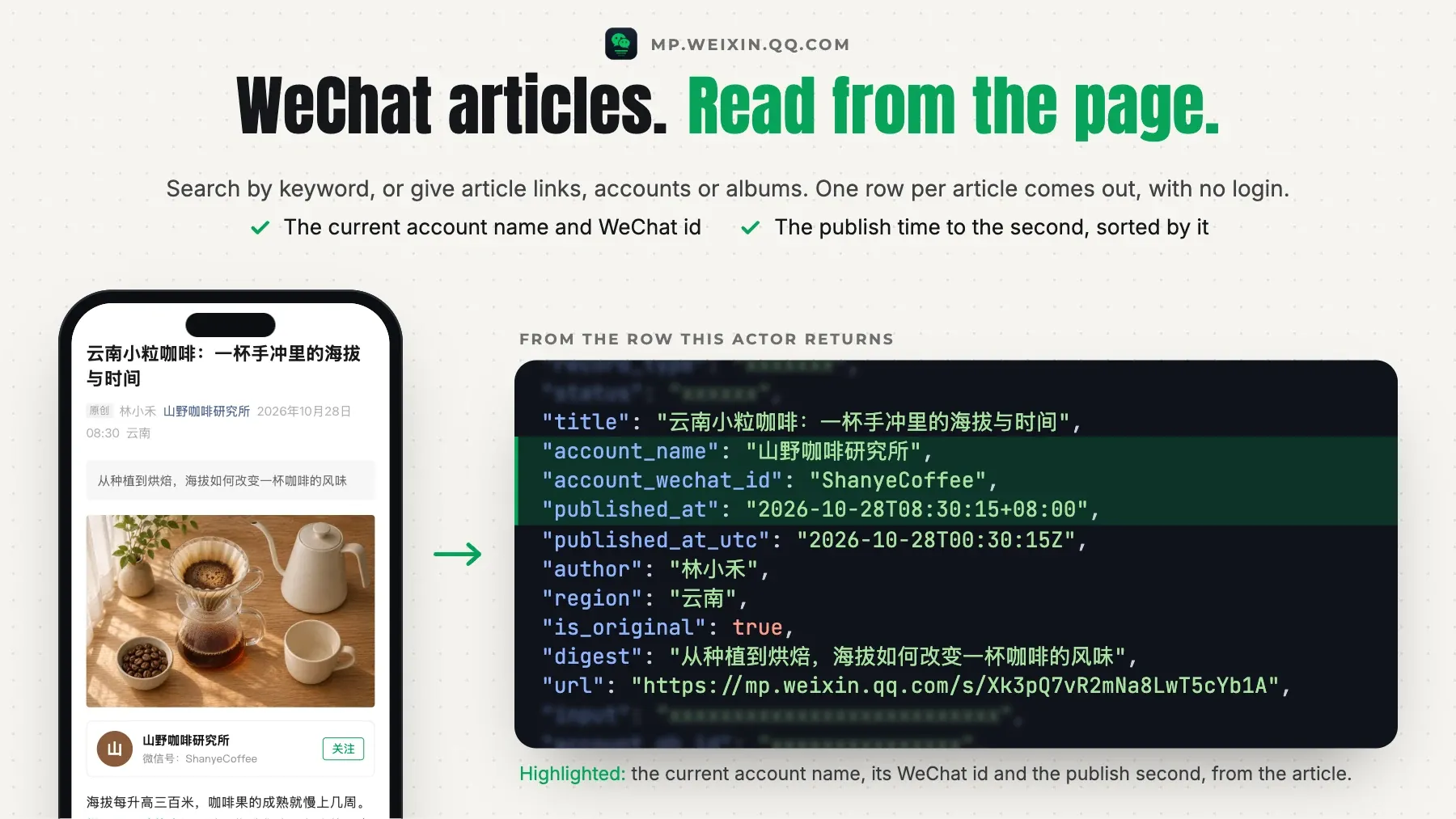
WeChat Official Account (公众号) articles without a login: give article links or albums (合集) and get one row per article read from its own page — title, the account's current name and WeChat id, author, the exact publish second, digest, cover, the permanent link where WeChat serves one, the original or reprint flag, the IP region and, when you ask, the full text. Search by keyword for the search cards: title, account name, index time, snippet, cover and link. A link WeChat answers as deleted, closed or wrong is a free row that says so. No account, no cookie, no browser, proxies handled for you.
From $6.00 per 1,000 rows (article) on the Free plan, $5.10 on Starter; every row and add-on is priced under Pricing below. A run start is $0.05. The default input returns about 21 rows for about $0.17. A link WeChat answers as deleted, closed, moved or wrong, and a search with no article, is a free row that says why.
How it compares
- More data than zen-studio's WeChat Official Account Scraper 公众号: 39 fields per article, against 14. The price is about the same: $6.70 per 1,000 articles, against $6.52.
- Faster and 2 times cheaper than herus13's WeChat Official Account Scraper 公众号: 20 articles in 52 s, against 104 s; $6.70 per 1,000 articles, against $15.00. It gives more data: 57 fields per article, against our 39.
Measured on 2026-11-10. Each line compares one job, run by both scrapers at the same time. Prices are per 1,000 articles: Apify Actors at the Scale plan's prices.
Tested head-to-head on 2026-11-10
The job: the first 20 articles of one WeChat article search (人工智能, the input schema's example), each read from its article page. Every Actor ran on it the same day from the same harness; every run's cost is at the Scale plan's prices: a rival's charged events at its price for that plan, this Actor's at its list price. Fields counts the filled fields of a typical row. Every row here is read from the article's own page; zen-studio's search row is the search card (its page rows need article links), herus13's row opens the page with include_content. Re-measured monthly.
| Actor | Rows | First row | Run time | Cost | Fields | Failures |
|---|---|---|---|---|---|---|
| this Actor | 20 | 11 s | 52 s | $0.13 | 39 | none |
zen-studio/wechat-official-account-scraper | 33 | 4.3 s | 5.0 s | $0.21 | 14 | none |
herus13/wechat-scraper | 20 | 12 s | 104 s | $0.30 | 57 | none |
Why this WeChat article scraper
- A link or an album gives the article's own page, not the search card. The search index carries its own title (with half-width punctuation), an account name that can be old (3 of 10 cards in our test named a renamed account) and its index time (minutes after the publish second as a rule, 8 to 15 days for an article the index took again). Here each such row is read from the article itself: the title, the account's current name, its WeChat id and gh id, the author, the digest and the exact publish second (on 144 of 144 pages we read), at about 170 KB a page because the read stops where the article ends.
- The order and the window are applied, and checked on every row. WeChat's logged-out search honours no sort and no time filter: a filtered request gets the empty home page. Here
sortBylatest or oldest reads the whole list (up to 100), then reads the pages until it holds the newest (or oldest) articles by each page's own publish second, since the index time can trail it by days;publishedWithin/publishedAfter/publishedBeforedrop a card before its page is read where its index time rules it out (no page, no charge) and check each page's own second after it. - Says what WeChat says. A deleted article (该内容已被发布者删除), a closed account (此账号已自主注销), a wrong id or an expired link (参数错误) is a free row with WeChat's own words, read on two connections before it is called gone; an article whose account moved (账号已迁移) is followed to its new link. A search ends where WeChat's list ends (100 articles), and the search row says TRUNCATED with the index's estimate, never COMPLETE.
- Every link form. Permanent links (a bare one gets the checksum the page needs), short links (
/s/…, with the permanent link back), temporary links from a search, Sogou's result links, Sogou search links, album links: each article once a run, however many forms or searches name it. - Honest about what a visitor cannot see. Read, like and comment counts, an account's own history and its verified owner are served only to a signed-in WeChat client, so this Actor does not offer them and never writes a 0 for a count it cannot read. The one public count, an album's total reads, is on every album row.
Who it's for
- Market and media analysts — what Chinese official accounts publish on a topic this week, with each article's account, author, exact time, region and text, in one row shape.
- Brand and PR teams — articles that name a brand or a product, the accounts that carry them, which are reprints and of whom, and the full text to read or translate.
- Researchers, developers and agents — article links in, typed rows out with a stable key per article, a free labelled row for every miss, and a run summary to check a pipeline against.
Quick start
Search cards by keyword, newest first
Articles by link, with the full text
Every article of an album (合集)
Switching from zen-studio/wechat-official-account-scraper?
Your input works as it is. Each name in the left column is read as this Actor's own field and the run log says so (read <theirs> as <ours>); a name marked not read is ignored with a note. A value in the other Actor's shape, an object list or its own date form, is read too.
| zen-studio/wechat-official-account-scraper | this Actor | what to know |
|---|---|---|
operation | not read | Not read: the job follows from the inputs. articleSearch, articleDetail, convertArticleLink, accountHistoryArticles and accountTodayArticles run from keywords, articleUrls (links) and accounts; the client-session operations (articleMetrics, articleComments, articleCommentReplies, accountSearch, accountBasicInfo, accountPrincipalInfo, accountOriginalCount, miniProgramSearch, searchSuggestions, wechatIndexSearch) are refused with the reason. |
keywords | keywords | The same: one search each, up to 100 articles (WeChat's own end). |
articleUrls | articleUrls | The same, plus temporary search links and Sogou result links. |
accounts | accounts | A WeChat id, a name or an article link; a gh_ id alone gives a free row asking for one of those (no logged-out route reads an account by its gh_ id). |
links | articleUrls | Read as article links: every row carries the permanent link where WeChat serves one, the short link and the article's key. |
maxPages | maxItemsPerKeyword | Read as pages × 20 articles (the leader's pages hold about 20–24 rows), at most 100 a search. |
continuePreviousRun | not read | Not read: it continues an account's history, which a logged-out reader cannot list. |
sortBy | sortBy | relevance and latest the same; hot is read as relevance (no logged-out count ranks articles); oldest added. |
publishTime | publishedWithin | all is any; day, week and halfYear the same; month and year added, and exact dates in publishedAfter / publishedBefore. |
businessType | not read | Not read: it scopes search suggestions, which are not served logged out. |
feedback | not read | Not read: write to the support address below. |
What differs:
- No
operationto pick: the job follows from the inputs you give, and one run can mix keywords, article links, accounts and albums. - The read, like, share and comment counts, comments, an account's own history and profile call, its verified owner, WeChat Index, search suggestions and mini programs need a signed-in WeChat client: those operations are refused with the reason, never answered with an empty success.
- An account (a WeChat id, a name or one of its article links) is a sample of the articles the search index finds for it, labelled SAMPLE, not its history.
- Rows from article links and albums are read from the article's own page. A keyword search gives the search cards (
searchCardsOnly, on in the example input): since 2026-11-13 WeChat answers the links a search gives with its verification page. - A temporary link from a search page is read too (the leader refuses it); the row carries it with the article's key, and the permanent link where WeChat serves one.
Output
One row per article (record_type article), and one free summary row per keyword, account or album (record_type target):
| field | meaning |
|---|---|
record_type | article on an article row (charged when status is ok); target on a keyword's, an account's or an album's free summary row. |
status | ok, or why a link or a search gave no article: deleted, account_closed, violation, not_found (WeChat's 参数错误 for a wrong id), expired_or_invalid (an old temporary link), duplicate (an article the run already delivered), no_results, failed (no connection got an answer), invalid_input, not_read (the run stopped first). |
status_detail | WeChat's own words for a typed state (e.g. 该内容已被发布者删除), and whether two connections agreed. |
input | The value you gave that this row answers. |
query | The search words this row came from (a keyword, or an account's WeChat id). |
title | The article's title, from its page (the search card's title when row_source is sogou_card). |
account_name | The official account's current name, from the article's page. |
account_wechat_id | The account's WeChat id (微信号, e.g. rmrbwx), when it has one. |
account_gh_id | The account's original id (gh_…). |
account_biz | The account's __biz value. |
author | The article's byline, when the account set one. |
published_at | The exact publish time in Beijing time (+08:00), as the page shows it. |
published_at_utc | The publish time in UTC. |
published_at_epoch | The publish second as a Unix epoch. |
digest | The article's digest (摘要) as the account wrote it; null when it set none. |
cover_url | The cover image. |
cover_url_1_1 | The cover's square crop. |
cover_url_235_1 | The cover's wide (2.35:1) crop. |
url | The link the article was read from: the temporary link of a search (served for hours), or the link you gave. |
url_kind | permanent, short, temporary or other: the form of url. |
permanent_url | The article's permanent link, when its page carries one (article links you give, album articles); null on search rows. |
permanent_url_note | Why permanent_url is null. |
short_url | The article's short link (mp.weixin.qq.com/s/…), when it has one. |
article_key | The article's stable key: __biz, mid and idx joined by _; the same on every form of the article's link. |
moved_from | The old link, when the account moved (账号已迁移) and the article was read from its new link. |
article_type | article, image_post (图片消息), or another format WeChat names. |
is_original | True when the account marked the article original (原创). |
copyright_kind | original, reprint (转载) or none. |
is_repost | True when the article is a reprint of another account's article. |
repost_of | A reprint's source: its account name, gh id, link and key. |
is_paid | True when the article is a paid one (付费); its text is then the free preview. |
region | The IP region the page shows (发表于): the province, else the country; null on most articles before mid-2022. |
region_country | The country of the IP region. |
album_id | The album (合集) the article is in. |
album_title | The album's title. |
album_size | The album's article count. |
album_read_count | The album's total reads, on rows read from an album link (the one public count). |
source_url | The article's 阅读原文 (read the original) link, when it has one. |
account_description | The account's description. |
account_avatar_url | The account's avatar. |
comment_id | The page's comment thread id (the comments themselves need a signed-in WeChat client). |
hashtags | The article's own hashtags as the page lists them (an empty list where it has none; null on a card row). |
text | The article's text (includeContent). |
text_markdown | The article's text as Markdown, with its pictures and links (includeContent). |
text_html | The article body's own HTML (includeHtml). |
text_length | Characters in text. |
reading_minutes | text_length ÷ 400, rounded (at least 1). |
images | The article's pictures: URL, width and height ÷ width (includeContent). |
image_count | Pictures in the article (includeContent). |
title_translation | A machine translation of title (translateTo). |
digest_translation | A machine translation of digest (translateTo). |
translation_note | Which language the row was machine-translated into, or why a row has no translation. |
row_source | page (read from the article's page), sogou_card (the search card, searchCardsOnly) or album_list (the album's own list). |
snippet | The search card's snippet (Sogou's), on search rows. |
account_name_sogou | The account name on the search card (Sogou's; can be an old name). |
indexed_at_sogou | The search card's time (Sogou's index time, UTC; minutes after the publish second as a rule, days for an article indexed again). |
sogou_docid | The search card's id. |
page | The search page (1–10) the card was on. |
position | The card's place on its page (1–10), or the article's place in its album. |
rank | The row's place in its search: the source's order for relevance, the asked order for latest / oldest. |
results_estimate | On a search row: the index's estimate of its hits (找到约N条结果); on an album row, the album's article count. |
verdict | On a target row: COMPLETE (the list ended), CAPPED (your cap), TRUNCATED (WeChat's list ended at its 100 or under the estimate), PARTIAL (the run stopped: note says why), SAMPLE (an account: what the index finds for it). |
rows_delivered | On a target row: the article rows it delivered. |
note | Why a target row has its verdict (and what its filters left out), or what a search-card row's fields are. |
scraped_at | When this row was read (UTC). |
Example record:
Pricing
Pay for the articles a run delivers, plus one run start; no platform usage is billed to you. The price falls with your Apify plan.
| event | unit | Free | Starter | Scale | Business |
|---|---|---|---|---|---|
Article (article) | per 1,000 | $6.00 | $5.10 | $4.20 | $3.00 |
Full text (article_text) | per 1,000 | $24.00 | $20.40 | $16.80 | $12.00 |
Translation (translation) | per 1,000 | $3.00 | $2.55 | $2.10 | $1.50 |
Run start (start) | per run | $0.05 | $0.05 | $0.05 | $0.05 |
An article row is $6.00 per 1,000 on the Free plan ($0.006 a row) and $5.10 on Starter, read from its page or, with searchCardsOnly, from the search card: the same price. With includeContent each row also carries its full text, Markdown and pictures for $24.00 per 1,000 more ($30.00 a row and its text together on the Free plan); with translateTo the title and digest translation is $3.00 per 1,000 more. An article is charged once a run however many keywords or links name it. Each run that delivers a charged row also pays the run start, $0.05 once; a run that delivers none pays nothing at all. So the 20 articles of one keyword cost $0.17 on the Free plan and $0.152 on Starter; the same 20 with their text $0.65 and $0.56; a whole search (100 articles, WeChat's end) $0.65 and $0.56; every input of a run shares one start. Free: every keyword's, account's and album's own summary row, a search with no article, a deleted, closed, blocked or wrong link, an expired temporary link, an article already delivered in the run, a client-only operation refused with its reason, and an input left unread at maxItems, your charge limit or the time limit. A run that stops early (a timeout, an abort) is charged for the articles it delivered.
Before the first request the log names the prices at your plan and the most the run can cost: maxItemsPerKeyword for each keyword or account (20 when you leave it out, at most 100), one row for each article link, maxItems over the whole run, and never more than your charge limit; an album without maxItems is read to its end, so its line gives the prices and no maximum. A search that ends sooner (WeChat's own list ends) delivers fewer rows and costs less. Enterprise plans have their own rates — the Actor's Pricing tab shows the price for your plan.
Usage patterns
- Keywords — Put words in
keywords(Chinese words give the most results). Each keyword reads WeChat's article search, 10 articles a page, up to 100:maxItemsPerKeyword(default 20; 0 = all 100) caps each search andmaxItemsthe run. Since 2026-11-13 WeChat answers the links a search gives with its verification page (环境异常), so setsearchCardsOnly(the example input does): each row is the search card (title, account name, index time, snippet, cover), itsurlthe temporary link the search gives, beside the article's stablearticle_key. WithsearchCardsOnlyoff, each walled card is a free row that says so. A search row closes each keyword with its verdict: CAPPED (your cap), TRUNCATED (WeChat's list ended at its 100, or under the index's estimate after a second read), COMPLETE.excludeKeywords,strictKeywordMatchand a date window leave cards out before their page is read: no page, no row, no charge; the search row counts them. - Article links and albums — Paste any article link in
articleUrls: permanent, short (mp.weixin.qq.com/s/…), a temporary link from a search, or a Sogou result link. Each is one row, or a free row with WeChat's own words (deleted, the account closed, not found, an expired link). An album link inalbumUrlsgives every article of the album, each read from its page, with the album's title, size and total read count on every row.includeContentadds the text, its Markdown and its pictures;includeHtmlthe body's own HTML. - Accounts — An account in
accountsis its WeChat id (rmrbwx), its name (人民日报) or one of its article links. WeChat lists an account's own articles only to a signed-in client, so this Actor searches the account's WeChat id (in our test 32 of 34 hits were the account's own; a name search 3 of 39) and keeps the articles whose page names the account. The account's search row says SAMPLE and how many of the pages read were its own: it is what the search index holds, old articles included, never the whole history. Since 2026-11-13 an account gives no article: its articles come from the search, whose links WeChat answers with its verification page, and each walled card is a free row that says so. Give the account's article links or an album instead. - Translation and search cards —
translateTo(en, de, ja, pt-BR …) adds a machine translation of each row's title and digest beside the originals, labelled as a machine translation.searchCardsOnlyskips the article pages for searches and albums: a row from the search card (Sogou's title, account name and index time, labelled) or the album's own list, faster and lighter (onlyFromAccountsand the accounts input still read each page: the card names no account id).
Input configuration
| field | type | default | what it does |
|---|---|---|---|
keywords | array | [] | Words to search WeChat Official Account articles for, one search each (Chinese words give the lane's results, e.g. 人工智能). A Sogou WeChat search link (weixin.sogou.com/weixin?…query=…) is read as its words. Up to 100 articles a search (the source's own end). |
articleUrls | array | [] | WeChat article links, one row each: the permanent link (mp.weixin.qq.com/s?__biz=…&sn=…), the short link (mp.weixin.qq.com/s/…), a temporary link from a search (…src=11&signature=…, served for hours) or a Sogou result link (weixin.sogou.com/link?url=…). A link to a deleted article, a closed account or a wrong id gives a free row with the source's own words. |
accounts | array | [] | An official account by its WeChat id (rmrbwx), its name (人民日报) or one of its article links. The Actor searches the account's WeChat id and keeps the articles whose page names the account: a sample of what the search index holds, not the account's history (that list needs a WeChat client session). A gh_ id or a __biz alone gives a free row asking for one of the three forms. |
albumUrls | array | [] | Album links (mp.weixin.qq.com/mp/appmsgalbum?__biz=…&album_id=…): every article of the album, with the album's own article count and total read count. |
maxItemsPerKeyword | integer | 20 | The most article rows each keyword or account search delivers (the source lists at most 100 a search); 0 = all it lists. Albums read every article unless Max results stops the run. |
sortBy | relevance / latest / oldest / hot | "relevance" | relevance = the source's own order; latest or oldest = this Actor reads the whole list (up to 100), then reads the pages until it holds the newest (oldest) articles by each page's own publish second (Sogou's index time can trail it by days; oldest assumes Sogou indexed each article within 31 days of its publish second). The source sorts nothing for a logged-out reader. hot (the lane leader's name) is read as relevance: no logged-out count ranks WeChat articles. |
publishedWithin | any / day / week / month / halfYear / year | "any" | Only articles published in this period, checked on each article's exact publish second (the source applies no time filter for a logged-out reader). An article outside is left out: no row, no charge. |
publishedAfter | string | A date like 2026-11-01 (Beijing time, as the articles show it): only articles published on that day or later. | |
publishedBefore | string | A date like 2026-11-09 (Beijing time): only articles published on that day or earlier. | |
excludeKeywords | array | [] | A search card whose title or snippet holds any of these words is left out before its page is read (no row, no charge). |
onlyFromAccounts | array | [] | Keep only articles of these accounts: names, WeChat ids, gh_ ids or __biz values, matched on each article's own page (its current name). Other articles are left out: no row, no charge. |
strictKeywordMatch | boolean | false | Leave out a search card whose title does not hold the keyword (the source also matches the article body). Words split by spaces: any one of them is enough. |
searchCardsOnly | boolean | false | For searches and albums: a row from the search card (title, account name, the source's index time, snippet, cover, the temporary link) or the album's list, without reading each article's page. The card's title and account name are the search index's (a renamed account can keep its old name there). Off = every row is read from the article's own page. onlyFromAccounts and the accounts input still read each card's page: the card names no account id. On in the example input: since 2026-11-13 WeChat answers the links a search gives with its verification page. |
includeContent | boolean | false | Add the article's text, its Markdown and its pictures (URL, width, ratio), the text length and the reading minutes. |
includeHtml | boolean | false | Add the article body's own HTML (large: inline styles kept). Turns on the full text too. |
translateTo | string | A language code such as en, de, ja or pt-BR: each row gets a machine translation of its title and digest beside the originals (labelled as a machine translation). Empty = no translation. | |
maxItems | integer | 0 | The most charged article rows of the whole run; 0 = no cap beyond your charge limit. |
feedback | string | A note to the people who maintain this Actor: what you needed and did not get. For example a missing field, a wrong or empty result, or the Actor you switch from or to, and why. The run does not read it: the rows and the charges stay the same. A person reads every note. |
Errors
A run does not fail because of your input. When an input cannot be used — a date that is not a date, an id in the wrong form, two settings that contradict each other — the run ends Succeeded, charges nothing, and says what to change:
- the status message starts with
INPUT REJECTED; - the dataset holds one row,
{"error": true, "code": "…", "message": "…"}, and no results; - the key-value store record
ERRORholds the same object.
From code, check error on the first row before reading results.
A search that matches nothing is not an error: the dataset is empty and nothing is charged. A run that ends Failed is a fault on our side, never your input; it charges nothing, and we are alerted.
FAQ
Can I get read counts, likes, 在看 or comments?
No. WeChat serves those only inside a signed-in WeChat client: on the public page they are empty and the counts call answers without them. This Actor never writes a 0 for a count it cannot read. The one public count is an album's total reads (album_read_count).
Why is permanent_url empty on search rows?
A search gives a temporary link, and its page carries no permanent link; a link built from the article's key alone is refused by WeChat (参数错误). The row carries the temporary link (url, served for hours) and the stable article_key. Article links you give and album articles carry the permanent link.
Is a search complete?
WeChat's logged-out search lists at most 100 articles a keyword, ten pages of ten. A search that reaches them says TRUNCATED with the index's estimate (often thousands). Several narrower keywords, or a date window, reach more.
Why are region and author empty on some rows?
They are the page's own: WeChat shows the IP region on articles from mid-2022 on (130 of the 132 articles from 2022 on in our probe of 150 ordinary articles; the two without were from February and April 2022) and on few older ones, and about half of the accounts sign their articles with a byline (75 of the 150).
Do I need Apify Proxy or my own proxy?
No. The Actor uses its own connections, at no extra cost to you.
Integration
JavaScript
Python
CLI
REST
AI agents and MCP
Apify's MCP server offers this Actor as a tool to Claude, Cursor, VS Code and any other MCP client. Connect https://mcp.apify.com?tools=hyperbach/wechat-official-account-scraper and ask, for example: "Get the latest WeChat Official Account articles about 人工智能 with their titles, accounts, publish times and links". The agent fills the input from the table above and reads the rows from the run's dataset. A field under the name another Actor gives it is read as this Actor's own: searchQueries, queries, query, keyword as keywords; links, urls, url, article_urls as articleUrls; account, accountIds, wechatIds, wechatId as accounts; album_urls, albums, albumUrl, albumLinks as albumUrls (and more). An agent or a person can add feedback to any run and say what was needed and not delivered: a missing field, a wrong or empty result, the Actor switched from or to, and why. The run returns the same rows at the same price, and a person reads every note.
n8n, Make and Zapier
The Apify node in n8n, the Apify app in Make and the Apify integration in Zapier run this Actor on a schedule or from a trigger and read its dataset. A webhook on the run's end (Integrations on the Actor page) sends the rows on to your own endpoint. Nothing to install on our side.
Support
Disagree with a charge? Write to apify@hyperbach.com with the run ID. We will ask Apify to compensate you, and the charge comes back to your Apify account as platform credit.
Did it do the job? A short review on the Store, at any rating, helps the next buyer choose.
See also
- Telegram Profile Scraper — Telegram channels, groups, bots and users by username or link, with the exact subscriber or member count.
- YouTube Channel Search Scraper — the YouTube channels a keyword finds, with subscribers, the exact video and view counts and the country.
- Threads Scraper — Threads profiles with the exact follower count, their posts and replies with view counts, and keyword and tag search, without a login.
- Substack Scraper — the posts of a Substack newsletter with the full text of free posts, the date, the paywall flag and the likes.
- Weibo Scraper — Weibo posts, profiles, search, comments and the hot-search boards, without a login.
- Pinterest Search Scraper — the pins of a Pinterest search, with the link each pin points to, the image and the pinner.
This page is generated from the Actor's schemas and a live sample — it cannot describe a field the Actor does not have.


