

Wikipedia Pageviews — Article Traffic, Trends & Top Articles
Pricing
Pay per event
Wikipedia Pageviews — Article Traffic, Trends & Top Articles
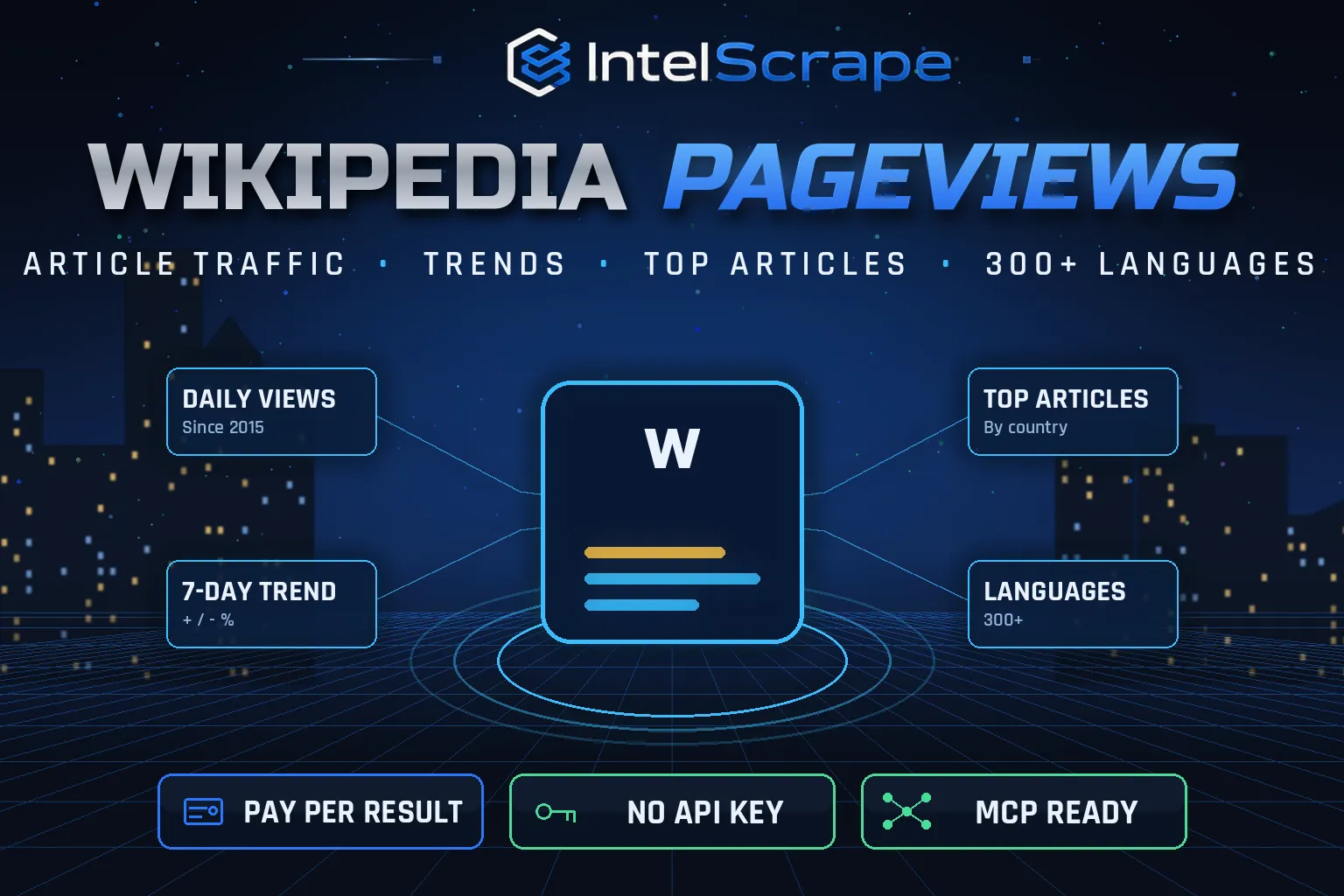
Wikipedia Pageviews scraper: daily or monthly views for any Wikipedia article in any language, with totals, peaks and 7-day trend %, plus the most-viewed articles per day for a language or country. A free, public demand signal for topics, people, brands and products. No API key. Pay per article.
Pricing
Pay per event
Rating
0.0
(0)
Developer

IntelScrape
Maintained by CommunityActor stats
0
Bookmarked
2
Total users
1
Monthly active users
7 days ago
Last modified
Share
🇨🇳 维基百科浏览量采集器:获取任意语言维基百科条目的每日或每月浏览量,计算总量、峰值和 7 天趋势,还可列出某天某语言或某国家浏览最多的条目。这是衡量话题、人物、品牌和产品关注度的免费公开指标。无需 API 密钥。
🇸🇬 Paparan Halaman Wikipedia: tontonan harian atau bulanan bagi mana-mana artikel Wikipedia dalam apa-apa bahasa, dengan jumlah, puncak dan trend 7 hari, serta artikel paling banyak dibaca mengikut hari atau negara. Tiada kunci API.
🤖 NEW: Connect This To Your AI!
Use this actor from Claude, ChatGPT, Cursor or any MCP client through the IntelScrape MCP Server, or call it directly over the Apify API.
🏆 Featured Bots by IntelScrape
- Skip Trace Pro
- TruePeopleSearch Scraper
- TikTok Email Scraper
- Amazon Product Reviews Scraper
- Website Contact Scraper
- Skip Trace MCP Server
⚡ Works with n8n, Make, Zapier, Google Sheets and the Apify API.




Daily public-interest data for any topic: Wikipedia views with totals, peaks, 7-day trend and the top articles per day or country.
Honest coverage & billing: Data appears with about a 1-day delay. You pay only for results actually delivered, and a built-in cost guard stops the run at your max-charge limit.
🌍 Built for teams in the US, China and Singapore, and anyone who needs this data in a spreadsheet or pipeline.
⭐ Found it useful? Please leave a review; it helps others find it.
⚖️ Lawful business use only. Collect public data only, and comply with the source site's terms, copyright and data-protection laws (GDPR, CCPA, China PIPL, Singapore PDPA).
Examples below are illustrative; names and values may be fictional or out of date.
What is Wikipedia Pageviews?
Wikipedia is one of the most visited sites on earth, and every article view is public. That makes pageviews a free, transparent proxy for public interest: how much attention a person, company, product, disease or event is getting, day by day, in any language, going back to 2015. Wikipedia Pageviews turns that data into ready-to-use rows with totals, peaks and a 7-day trend, or lists the most-read articles of any day for a language or a country.
What does it do?
- Any article, any language: titles or URLs; redirects are resolved to the canonical article
- Daily or monthly views for up to 10 years of history (data starts July 2015), human traffic only (bots and spiders excluded)
- Stats per article: total, average, peak and peak date, last 7 days vs previous 7 days with trend %
- Article context: short description, Wikidata ID, page size and last edit time
- Top articles mode: the most-viewed articles of a day for a language edition, or for a country across all languages
- Time series included for charts and models (can be turned off)
Why choose us over cheaper scrapers?
- Honest output: limits are documented, missing data is labeled, never invented
- Clean, consistent schema ready for Excel, Sheets, BI tools or an LLM
- No account risk: no logins, no cookies, no API keys
- Pay per result with a built-in cost guard; no subscription, failed items are never charged
- Fast and light: no residential proxy, so runs finish in seconds and stay cheap
- Maintained by IntelScrape and fixed fast when the source changes
Who is it for?
- Trend research & content planning: see which topics are gaining attention before you write
- Market & investment research: track interest in companies, products, crypto assets and tickers
- Brand & reputation monitoring: spot spikes in attention on your brand or executives
- Data science & forecasting: add a clean public-interest signal to models
- Journalists: find what readers in a country are reading today
- Academic research: build reproducible attention datasets across languages
How to use it
In Apify Console (no code)
- Click Try for free / Start. The form is prefilled with a working example.
- Change the inputs (see examples below).
- Click Start, then export the results as JSON, CSV, Excel, XML or HTML, or open them in Google Sheets.
- Optional: Schedule the actor to run hourly, daily or weekly.
Via API
Or use the official Apify JavaScript and Python clients:
With AI agents (MCP)
Add Apify's MCP server (https://mcp.apify.com) or the IntelScrape MCP Server to Claude Desktop, Cursor, ChatGPT or any MCP client, then ask in plain language, e.g. "Run intelscrape/wikipedia-pageviews-scraper with the default input and summarise the results."
Input examples
Three articles, last 30 days (default)
Monthly history of German articles
Top 100 articles read in Japan on a date
Output fields
| Field | Description |
|---|---|
type | article or top-article |
article / inputTitle / url | Canonical title, what you entered, article URL |
description / wikidataId | Short description and Wikidata item |
pageLengthBytes / lastEdited | Article size and last edit |
startDate / endDate / periods / granularity | Covered range |
totalViews / avgViews | Views in range and average per period |
peakViews / peakDate | Best day (or month) |
last7DaysViews / prev7DaysViews / trendPct7d | Week-over-week trend (daily mode) |
series[] | date + views per period |
rank / views / date / country (top mode) | Position, views and date of each top article; country lists use Wikimedia's rounded-up counts |
Sample output
Pricing (pay per event)
| Event | When it is charged | Price |
|---|---|---|
| Actor start | once per run | $0.005 |
| Article timeline | per article with its pageview history and stats | $0.002 |
| Top article | per row of a top-articles list | $0.0002 |
Cost examples
| Run | Cost |
|---|---|
| Default run: 3 articles, 30 days | $0.011 |
| 500 articles, 1 year daily | $1.005 |
| Top 1,000 articles of a day | $0.205 |
Platform usage is included in these prices. Set Max charge per run in the run options to cap spend; the actor stops cleanly when the limit is reached and keeps everything collected so far.
Tips for best results
- Use exact Wikipedia titles or paste article URLs to avoid ambiguity.
- Wikimedia publishes each day with about a 1-day delay, so the latest complete day is yesterday.
- Use monthly granularity for multi-year history; rows stay small.
- Combine with Google Trending Searches to compare search spikes with reading spikes.
FAQ
Is this real traffic?
Yes. These are Wikimedia's official pageview counts for human users (agent type "user"), with bots and crawlers excluded.
How far back does it go?
July 2015, when the current pageview pipeline started.
Why are country top-list numbers round?
Wikimedia publishes per-country top lists with counts rounded up for privacy; we flag them with viewsAreRoundedUp.
Can I track non-English articles?
Yes. Set language to any edition code (de, fr, ja, zh, es, ru…).
Do I need a key?
No. The Wikimedia APIs are public; the actor identifies itself politely as required by Wikimedia's policy.
What if an article does not exist?
It is logged and skipped, and you are not charged.
Honest limits
- Data appears with about a 1-day delay.
- Mobile app views are included in all-access totals but cannot be separated per article in this actor.
- Country top lists exist for Wikimedia-approved countries only and use rounded counts.
- Pageviews measure reading interest, not search volume.
Related IntelScrape bots
- Google Trending Searches: daily trending searches by country
- Keyword Search Volume: estimated monthly Google searches & trends
- Google Autocomplete Scraper: keyword suggestions from Google, YouTube, Amazon & Bing
- Google News Scraper: headlines & summaries
- Hacker News Scraper: stories & comments by keyword
- Skip Trace MCP Server: IntelScrape tools for AI agents
Legal
This actor collects publicly available data only. You are responsible for using the results lawfully and in line with the source's terms and applicable privacy laws (GDPR, CCPA, PIPL, PDPA). Process personal data only with a legitimate purpose. IntelScrape is not affiliated with, endorsed by or sponsored by the data source; all trademarks belong to their owners.


