

Digital Filter Designer: IIR & FIR Filters, C Code
Pricing
Pay per event
Digital Filter Designer: IIR & FIR Filters, C Code
Design lowpass, highpass, bandpass, bandstop and notch filters from plain text: Butterworth, Chebyshev, elliptic, Bessel or FIR (window, Kaiser, Parks-McClellan). Coefficients, measured response and C/Python/MATLAB code. For AI agents.
Pricing
Pay per event
Rating
0.0
(0)
Developer

Jumble Mog
Maintained by CommunityActor stats
0
Bookmarked
2
Total users
1
Monthly active users
5 days ago
Last modified
Categories
Security
Limited permissionsShare
Design a digital filter by describing it. Type lowpass 100 Hz, fs 1 kHz, 4th order Butterworth or FIR lowpass 5 kHz, fs 48 kHz, 0.5 dB ripple, 60 dB down at 6 kHz, equiripple. You get back:
- The coefficients: second-order sections (the stable way to run an IIR filter), b and a, zeros, poles and gain, or the FIR taps.
- Ready-to-paste code in C (a biquad cascade or an FIR with a circular buffer), Python (SciPy, whole recordings or block by block) and MATLAB/Octave.
- The response as measured: -3 dB points, gain at the cutoff, passband ripple, stopband attenuation, group delay in samples and ms, linear phase, stability and the largest pole radius.
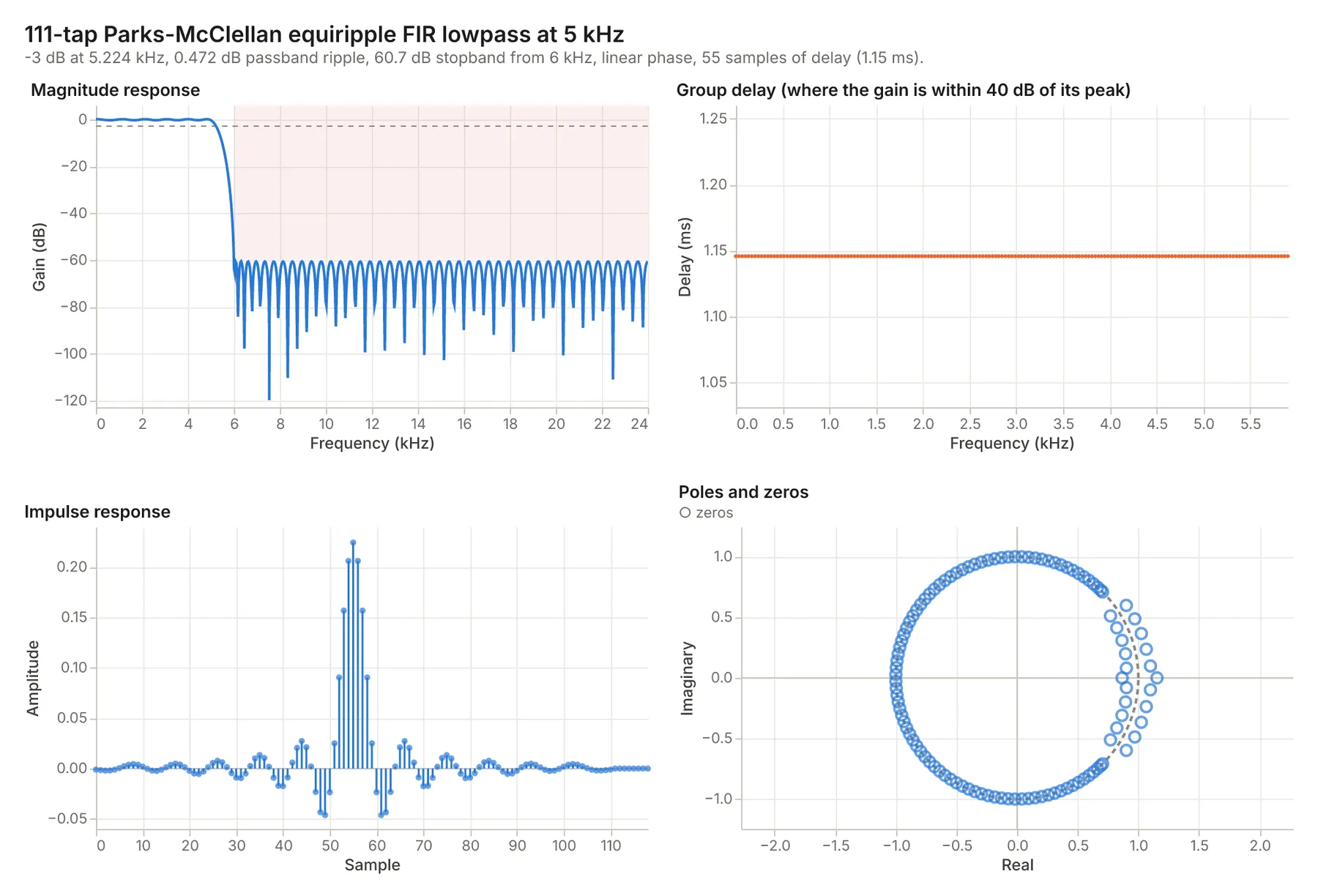
- A chart: magnitude response with your specs drawn in, group delay, impulse response, and poles and zeros on the unit circle.
It also:
- Finds the order or length for you: give the passband edge, the stopband edge, the ripple and the attenuation, and you get the lowest IIR order or the shortest FIR that meets them.
- Checks fixed point: round the coefficients to 16 bits (or any width from 4 to 32) and see the Q format, the integers, and whether the filter still works.
- Filters your data: pass a signal and get it back filtered, causally or with zero phase.
It's made for:
- Embedded and firmware developers putting a filter on a microcontroller or DSP.
- Audio, sensor, biomedical (ECG, EEG) and vibration engineers.
- Students checking filter-design homework.
- AI agents that need correct coefficients instead of guessed ones.
What it does
Filters it designs
- Bands: lowpass, highpass, bandpass, bandstop, notch and peak (resonator).
- IIR families:
- Butterworth (maximally flat).
- Chebyshev I (passband ripple) and Chebyshev II (stopband ripple).
- Elliptic (the sharpest for a given order).
- Bessel (the flattest group delay).
- FIR methods:
- Windowed sinc, with Hamming, Hann, Blackman, Blackman-Harris, Nuttall, flat-top, Bartlett or rectangular windows.
- Kaiser window, with the length and β found from the attenuation and the transition width.
- Parks-McClellan equiripple, the shortest FIR for a given spec.
- Least squares.
- Notch and peak biquads, by Q or bandwidth.
Writing filters
Most specs fit in one line:
- Sample rate:
fs 1 kHz,sample rate 48000,sampled at 250 Hz, or a trailingat 8 kHz. - Order or length:
4th order,order 6,101 taps. - Specs:
1 dB ripple,60 dB attenuation,40 dB down at 200 Hz,stopband 6 kHz,transition 1 kHz. - Family or method:
Butterworth,Chebyshev,Chebyshev II,elliptic,Bessel,FIR,Kaiser,equiripple,Hamming.
Objects work too, with the same fields named. Without a sample rate, frequencies like lowpass 0.2 are read as fractions of the Nyquist frequency.
Finding the order
When you give the stopband edge (or a transition width) and the attenuation, the order or length is found for you:
- IIR: the lowest order that keeps the passband within the ripple and the stopband the given number of dB down.
- Kaiser FIR: the length and β from Kaiser's formula.
- Equiripple and least-squares FIR: the shortest length that meets both specs. It starts from an estimate, checks the result, and lengthens it until both specs are met.
Fixed point
Add coefficientBits and the coefficients are rounded to signed fixed point. You get:
- The Q format (for example Q1.14 for 16 bits) and the integer coefficients.
- Whether the rounded filter is still stable.
- How far the passband moved, and the stopband attenuation that's left.
The chart overlays the rounded response.
Filtering a signal
Add signal (a list of numbers) and the filtered signal comes back. Set zeroPhase to filter forward and backward, with no delay. Up to 1,000,000 samples. Results over 10,000 samples come as a CSV file.
How to use it
- Write Filters, one per line, such as
highpass 0.5 Hz, fs 250 Hz, 2nd order Butterworth. The form has examples. - Optionally set a Default sample rate or Fixed-point coefficient bits for all of them.
- Click Start. Each filter is a row in the results, with its summary, chart, code and report.
Examples
All of these ran on this Actor, and the numbers are from the results.
| Filter | Result |
|---|---|
lowpass 100 Hz, fs 1 kHz, 4th order Butterworth | -3 dB at 99.94 Hz (the same sections as SciPy's butter), group delay 4.02-6.53 ms in the passband, stable |
lowpass 100 Hz, fs 1 kHz, 0.5 dB ripple, 40 dB down at 200 Hz | Order 8 Butterworth: 0.498 dB ripple, 46.8 dB at 200 Hz, -3 dB at 112.9 Hz |
bandpass 300-3400 Hz, fs 8 kHz, 1 dB ripple, 40 dB down at 200 Hz and 3.8 kHz, elliptic + 16 bits | Order 8 (4 per edge): 1 dB ripple, 40 dB stopband. In Q1.14 it's still stable and the passband moves by 0.006 dB |
FIR lowpass 5 kHz, fs 48 kHz, 0.5 dB ripple, 60 dB down at 6 kHz, equiripple | 111 taps (109 fall short): 0.472 dB ripple, 60.7 dB stopband, linear phase, 55 samples (1.15 ms) of delay |
FIR lowpass 5 kHz, fs 48 kHz, transition 1 kHz, 60 dB attenuation, kaiser | 176 taps, β 5.65: 59.7 dB stopband, 0.015 dB ripple |
lowpass 1 kHz, fs 44.1 kHz, 60 dB down at 2 kHz, Chebyshev II | Order 7: 0.98 dB ripple, 60 dB stopband, -3 dB at 1.081 kHz |
notch 50 Hz, Q 20, fs 1 kHz | A full null at 50 Hz, -3 dB at 48.76 and 51.27 Hz |
The tests check that:
- The designs match SciPy.
- The automatic orders are the lowest that meet the specs, and the equiripple length is the shortest.
- A notch's -3 dB width equals f₀/Q.
- The generated C code, compiled with a C compiler, gives the same output as SciPy for a cascade of biquads and for an FIR.
How-to examples
Each example is a complete input; the results are from runs of the Actor (also listed under Examples).
How to design a Butterworth low-pass filter
Result: -3 dB at 99.94 Hz, the same sections as SciPy's butter, a group delay of 4.02-6.53 ms in the passband, and stable. You get the second-order sections, a frequency response chart and ready-to-paste C, Python and MATLAB code.
How to find the filter order that meets a spec
Result: an order 8 Butterworth with 0.498 dB ripple and 46.8 dB at 200 Hz; and a 111-tap equiripple FIR (109 taps fall short) with 0.472 dB ripple, 60.7 dB stopband and 55 samples (1.15 ms) of delay.
How to design a notch filter for 50 or 60 Hz hum
Result: a full null at 50 Hz, with -3 dB points at 48.76 and 51.27 Hz.
How to let an AI agent design filters
Add this Actor to the Apify MCP server with https://mcp.apify.com/?tools=jumblemog/digital-filter-designer. The agent describes the filter in one line and gives the user measured coefficients and code that was compiled and tested, instead of writing filter math from memory.
FAQ
Which filter types are there? IIR Butterworth, Chebyshev I and II, elliptic and Bessel, FIR by window (Kaiser and others) and equiripple, and notch and peak filters, as low-pass, high-pass, band-pass and band-stop.
Can I get C code for a microcontroller? Yes: a biquad cascade or an FIR with a circular buffer. The tests compile it and check its output against SciPy.
Does it check fixed-point coefficients? Yes. Set coefficientBits (4 to 32) and it gives the Q format and integers, and says whether the filter still works.
Can it filter my data? Yes. Pass a signal and get it back filtered, causally or with zero phase.
Does it work with Zapier, Make or n8n? Yes. Call the Actor with its Apify app or an HTTP request and pass the coefficients on.
Input
| Field | What it is |
|---|---|
filters | Filters, as text lines or objects (see below). |
sampleRate | Default sample rate in Hz, for filters that don't give one. |
coefficientBits | Round every filter to this many bits and check it. |
charts | Draw charts (default on). |
A filter as an object takes:
band,sampleRate, andcutoff(one frequency, or two for band filters).type(iirorfir),family(butterworth,chebyshev1,chebyshev2,elliptic,bessel),method(window,kaiser,equiripple,least-squares) andwindow.orderortaps.rippleandattenuationin dB, andstopband(edge frequencies) ortransition(width).qorbandwidth, for notch and peak filters.coefficientBits,signal,zeroPhaseandtitle.text: a line of text to start from, which the other fields override.
Frequencies can be numbers in Hz or text like "1.5 kHz".
Output
One dataset item per filter, also saved together in the run's OUTPUT record:
Some results add more:
- With
coefficientBits:quantizedholdsformat,scale,integers,stable,maxPassbandChangeDbandstopbandAttenuationDb. - With
signal:filteredholdsoutputandcsvUrl. - Every result has
warnings(instability, poles very close to the unit circle, specs not met, fixed-point damage) andnotes(the order found, defaults used).
A filter that can't be designed has "status": "failed" and the reason in error, and isn't billed.
How it works
- The text is split into its parts: frequencies by their units, the sample rate by its label, and orders, taps, dB levels and family names by their words.
- IIR filters are designed in second-order sections with SciPy (
butter,cheby1,cheby2,ellip,bessel). The order comes frombuttord,cheb1ord,cheb2ordorellipord. Notches and peaks come fromiirnotchandiirpeak. - FIR filters come from
firwin(withkaiserordfor Kaiser),remezorfirls. Equiripple weights come from the ripple and the attenuation. - Every filter is then measured on an 8,192-point grid, with the exact gain at the cutoff. Group delay is added up section by section.
- Charts are drawn with Vega-Lite and rendered with vl-convert.
Pricing
You pay one low price per filter designed, at the price shown on this page. It includes the code, the chart, the report, the fixed-point check and the filtered signal. Filters that can't be designed are never charged. If you set a maximum cost per run, the Actor stops before a filter that wouldn't fit.
Speed
A filter takes a few hundredths of a second plus its chart. A run through the API answers in about 5 to 10 seconds, including the cloud container starting.
Tips and limits
- Use second-order sections for IIR filters above order 2 or so. The single b/a polynomial loses precision, and the result warns when the poles sit very close to the unit circle. The C code switches to double precision there.
- Butterworth and Bessel cutoffs are their -3 dB points. A windowed FIR cutoff is its -6 dB point. Give a stopband edge to design to the passband edge instead.
- Chebyshev II with an order and no stopband: the frequency you give is where the stopband begins.
- Highpass and bandstop FIRs need an odd number of taps; an even count is raised by one.
- Limits: IIR order up to 40, FIR up to 20,001 taps (8,001 when the length is found for you), 500 filters per run, signals up to 1,000,000 samples.
For AI agents and developers
This Actor works with the Apify MCP server, so AI agents can call it as a tool. Pass filters as plain text and read summary, coefficients.sos (or coefficients.b) and code from the result. A direct API call that waits for the answer:
run-sync instead returns the run's OUTPUT: the status, the counts and every result as JSON.
In Python, with the apify-client package:
Credits
- Filter design and analysis: SciPy
scipy.signal(BSD-3-Clause). - Charts: Vega-Lite and vl-convert (BSD-3-Clause), with the Inter font (SIL Open Font License).
- Methods:
- McClellan, J. H., Parks, T. W. and Rabiner, L. R. (1973), A computer program for designing optimum FIR linear phase digital filters, IEEE Trans. Audio Electroacoustics 21(6), 506-526.
- Kaiser, J. F. (1974), Nonrecursive digital filter design using the I₀-sinh window function, Proc. IEEE ISCAS.
- Oppenheim, A. V. and Schafer, R. W., Discrete-Time Signal Processing, 3rd ed., Pearson.


