

Wind & Snow Load Calculator (ASCE 7-16)
Pricing
Pay per event
Wind & Snow Load Calculator (ASCE 7-16)
ASCE 7-16 design loads from plain text: wind pressures on walls and roofs and base shear by the directional procedure, roof snow loads with unbalanced loads and drifts at steps and parapets, and LRFD and ASD load combinations.
Pricing
Pay per event
Rating
0.0
(0)
Developer

Jumble Mog
Maintained by CommunityActor stats
0
Bookmarked
2
Total users
1
Monthly active users
2 days ago
Last modified
Categories
Security
Limited permissionsShare
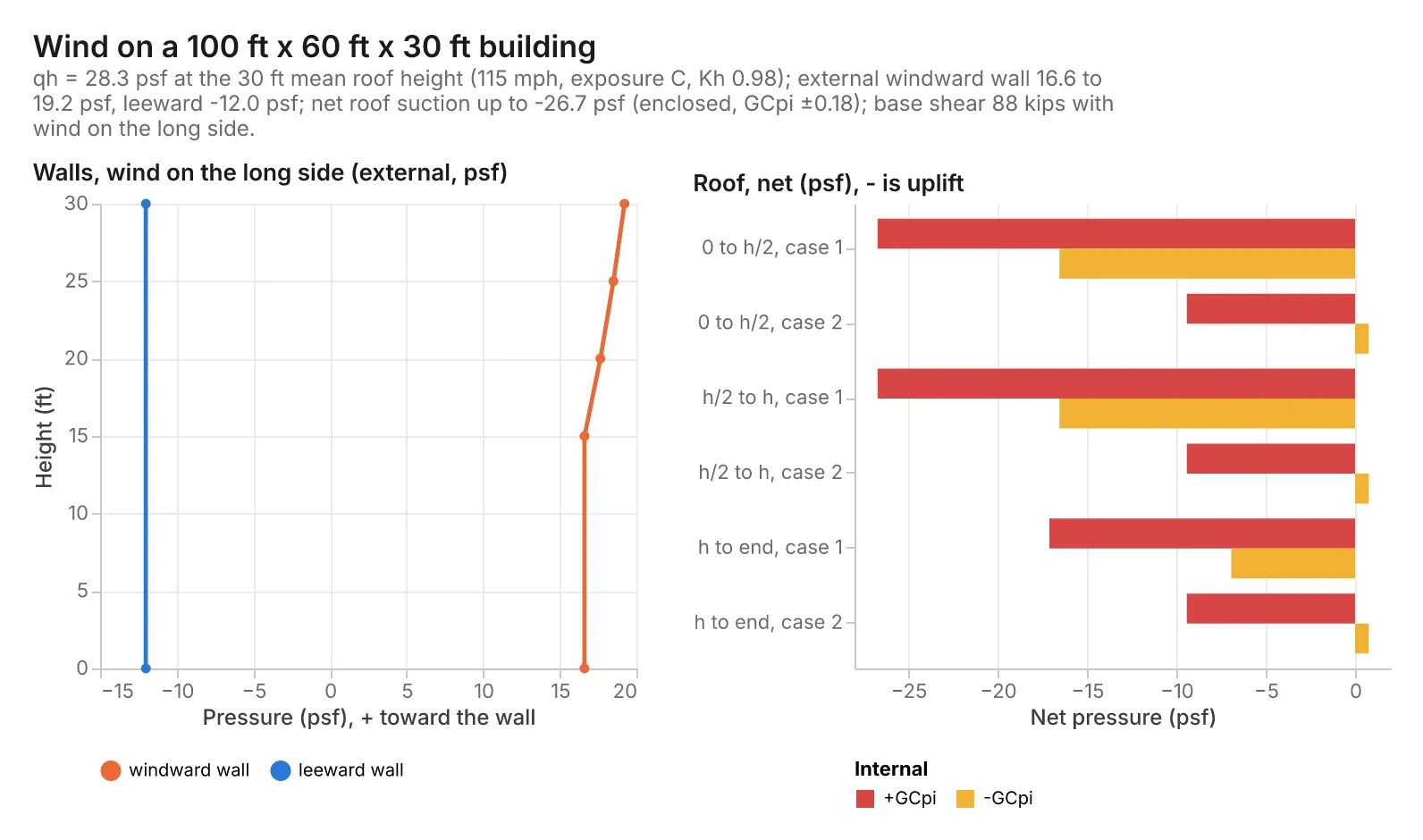
ASCE 7-16 design loads from one line of text: wind pressures on a building, roof snow loads with drifts, and the LRFD and ASD load combinations. Ask 115 mph, exposure C, 30 ft high, 100 x 60 ft, flat roof, ground snow 30 psf, upper roof 100 ft, step 6 ft or D = 20, L = 50, S = 30, W = 25 psf and you get back:
- Wind (main wind force resisting system, directional procedure): the velocity pressure qz up the height and qh at the roof, external and net wall and roof pressures with internal pressure both ways, roof zones (0 to h/2, h/2 to h, h to 2h ...) or windward and leeward slopes for gable and hip roofs, and the base shear with the wind on each face, checked against the 16 psf minimum.
- Snow: the flat roof load pf, the sloped roof load ps, the minimum load, rain-on-snow, unbalanced loads on gable roofs, and drifts against a roof step or a parapet, with the drift height, width and surcharge.
- Load combinations: every ASCE 7-16 strength (LRFD) and allowable stress (ASD) combination with its largest and smallest value, the loads it uses, and which one governs for gravity and for uplift.
- A chart and a Markdown report with every coefficient, so the numbers can be checked by hand.
It's made for:
- Structural engineers and designers who want a quick check of a wind or snow calculation, or loads for a beam or connection.
- Contractors, architects, solar and sign installers, and metal building and shed sellers who need design pressures before they call an engineer.
- Students learning ASCE 7, and AI agents that need wind and snow loads they can explain.
How to use it
- Write Buildings, roofs and loads, one per entry. The form has examples.
- Optionally set the Units: US (mph, ft, psf) by default; m/s, m or kPa in a request switch it to metric.
- Click Start. Each request is a row in the results, with its summary, chart and report.
What you can write
| You write | It means |
|---|---|
115 mph, 50 m/s | Basic wind speed V for the building's risk category (from the ASCE 7-16 maps or the ASCE Hazard Tool) |
exposure C | Exposure B (towns, suburbs), C (open terrain) or D (flat coasts) |
30 ft high, mean roof height 9 m, eave height 20 ft | Building height |
100 x 60 ft | Plan: length along the ridge x width |
flat roof, 6/12 gable, 20° hip | Roof shape and slope |
partially enclosed, Kzt 1.2, elevation 5000 ft | Enclosure, hill speed-up, ground elevation |
ground snow 30 psf, pg 1.5 kPa | Ground snow load pg |
terrain B, fully exposed, sheltered | Snow exposure (Ce) |
unheated, cold ventilated, freezer, greenhouse | Thermal condition (Ct) |
risk category III, metal roof, 40 ft wide | Importance, slippery surface, width for unbalanced loads |
step 6 ft, upper roof 100 ft, lower roof 50 ft | Drift at a roof step |
parapet 3 ft, roof 120 ft long | Drift at a parapet or rooftop unit |
D = 20, L = 50, Lr = 20, S = 30, R = 5, W = 25 psf | Loads to combine (or dead, live, roof live, snow, rain, wind) |
W = 20 / -35, wind uplift -40, E = 12, SDS 1.0 | Wind both ways, one-way uplift, earthquake with vertical effect |
LRFD, ASD, live factor 0.5 | One method only; the 0.5 live load factor |
The same as an object: {"speed": "115 mph", "exposure": "C", "height": "30 ft", "length": "100 ft", "width": "60 ft", "roof": "flat"}, {"groundSnow": "1.5 kPa", "parapet": "1 m", "lowerLength": "40 m"} or {"D": 15, "Lr": 20, "W": [-30], "method": "asd", "unit": "psf"}.
Examples
115 mph, exposure C, 30 ft high, 100 x 60 ft, flat roof→ qh = 28.3 psf (Kh 0.98); windward wall 16.6 to 19.2 psf, leeward -12.0 psf; net roof suction up to -26.7 psf near the windward edge; base shear 88 kips with the wind on the long side.110 mph, exposure B, mean roof height 25 ft, 80 x 40 ft, 6/12 gable roof→ qh = 17.5 psf; windward slope Cp -0.31 or +0.17, leeward slope -0.6; base shear 33 kips normal to the ridge.ground snow 30 psf, upper roof 100 ft, lower roof 50 ft, step 6 ft→ pf = 21 psf; leeward drift 3.52 ft high and 14.1 ft wide, up to 63 psf extra (84 psf at the step).ground snow 25 psf, 3/12 gable, 50 ft wide, risk category IV, sheltered→ pf = 23.1 psf, the 24 psf minimum governs as a separate case, unbalanced 6.9 psf windward and 23.1 psf leeward plus 13.4 psf over 8.3 ft by the ridge.D = 20, L = 50, S = 30, W = 25 psf→ LRFD max 122 psf (1.2D + 1.6S + L), min -7 psf (0.9D + 1.0W); ASD max 91.25 psf, min -3 psf.
How-to examples
Each example is a complete input; the results are from runs of the Actor (also listed under Examples).
How to calculate wind pressures on a building (ASCE 7-16)
Result: qh = 28.3 psf (Kh 0.98); windward wall 16.6 to 19.2 psf, leeward -12.0 psf; net roof suction up to -26.7 psf near the windward edge; base shear 88 kips with the wind on the long side.
How to calculate roof snow load and a drift at a roof step
Result: pf = 21 psf; the leeward drift is 3.52 ft high and 14.1 ft wide, adding up to 63 psf (84 psf at the step).
How to find the governing LRFD and ASD load combinations
Result: LRFD maximum 122 psf (1.2D + 1.6S + L) and minimum -7 psf (0.9D + 1.0W); ASD maximum 91.25 psf and minimum -3 psf.
How to let an AI agent work out design loads
Add this Actor to the Apify MCP server with https://mcp.apify.com/?tools=jumblemog/wind-snow-load-calculator. The agent passes the wind speed, snow load or loads in one line and answers with the pressures, drifts or governing combinations, with the ASCE 7-16 factors used.
FAQ
Which code does it follow? ASCE 7-16: chapters 26 and 27 (part 1) for wind, chapter 7 for snow, and sections 2.3 and 2.4 for the combinations.
Does it cover gable roofs and unbalanced snow? Yes. ground snow 25 psf, 3/12 gable, 50 ft wide, risk category IV, sheltered gives pf 23.1 psf, the 24 psf minimum as a separate case, and the unbalanced loads with the surcharge by the ridge.
Does it give components and cladding pressures? No. Wind covers the main wind force resisting system of enclosed, partially enclosed and partially open rigid buildings with flat, gable and hip roofs.
Where do the wind speed and ground snow load come from? From the ASCE 7-16 maps, the ASCE Hazard Tool or the local building department. This is a design aid, not a stamped calculation.
Input
| Field | What it is |
|---|---|
requests | Buildings, roofs and loads, as lines of text or objects (up to 200 per run) |
units | us (mph, ft, psf, kips) or metric (m/s, m, kPa, kN) for values without a unit |
charts | Draw a chart for each request (default on) |
Output
One dataset item per request, also saved together in the run's OUTPUT record:
Snow items have snow (pg, Ce, Ct, Is, Cs, flatRoofLoad, slopedRoofLoad, minimumLoad, rainOnSnowLoad, designUniformLoad, snowDensity), unbalanced, drift and profile; combination items have loads, governing and combinations (each with max, min and the loads used). Every item also has warnings, notes (the method and every assumption), a Markdown report and links to the chart and report. A request that can't be computed has "status": "failed" and the reason in error, and isn't billed.
How it works
- Wind (ASCE 7-16 chapters 26 and 27 part 1): qz = 0.00256 Kz Kzt Kd Ke V² psf with Kz from Table 26.10-1, Kd = 0.85 and G = 0.85 (rigid); p = q G Cp - qh (GCpi) with Cp from Figure 27.3-1 (interpolated in L/B, h/L and roof slope) and GCpi from Table 26.13-1. Gable and hip roofs of 10° or more get windward and leeward slope coefficients for wind normal to the ridge and the flat-roof zones for wind along it.
- Snow (chapter 7): pf = 0.7 Ce Ct Is pg; ps = Cs pf with Figure 7.4-1; the minimum load for roofs under 15°; 5 psf rain-on-snow where pg ≤ 20 psf on flat roofs; unbalanced gable loads for slopes from 1/2 on 12 to 7 on 12; drifts hd = 0.43 lu^(1/3) (pg + 10)^(1/4) - 1.5 ft (leeward, and 0.75 hd windward) limited by the clear height above the balanced snow.
- Combinations (2.3 and 2.4): every combination is tried with each transient load present or absent, one of Lr, S or R, and wind and earthquake each way, so both the gravity maximum and the uplift minimum come out.
Pricing
You pay one low price per request, at the price shown on this page. The chart and report are included. Requests that can't be computed are never charged. If you set a maximum cost per run, the Actor stops before a request that wouldn't fit.
Speed
A request takes a few milliseconds. A run through the API answers in about 10 seconds, including the cloud container starting.
Tips and limits
- This is a design aid, not a stamped calculation. The wind speed and ground snow load must come from the ASCE 7-16 maps (or the ASCE Hazard Tool) or the local building department for the building's risk category; many mountain areas need a site-specific snow study.
- Wind covers the main wind force resisting system of enclosed, partially enclosed and partially open rigid buildings with flat, gable and hip roofs. Components and cladding (chapter 30), open buildings, monoslope roofs of 10° or more, and flexible buildings aren't covered.
- Snow doesn't cover sliding snow onto a lower roof, curved roofs or ponding.
- Combinations take W and E as the strength-level ASCE 7-16 loads; enter loads with a consistent sign (gravity positive).
- Limits: 200 requests per run.
For AI agents and developers
This Actor works with the Apify MCP server, so AI agents can call it as a tool. Pass requests as plain text and read summary, wind, snow, drift, governing and warnings. A direct API call that waits for the answer:
run-sync instead returns the run's OUTPUT: the status, the counts and every result as JSON.
In Python, with the apify-client package:
Credits
- Method: ASCE/SEI 7-16, Minimum Design Loads and Associated Criteria for Buildings and Other Structures (chapters 2, 7, 26 and 27). This Actor is not affiliated with ASCE.
- Charts: Vega-Lite and vl-convert (BSD-3-Clause), with the Inter font (SIL Open Font License).


