
NextFlow E-commerce Catalog Quality Auditor
Pricing
from $20.00 / 1,000 audited producs
NextFlow E-commerce Catalog Quality Auditor
Audit Shopify, WooCommerce, and other e-commerce catalogs. Detect missing product data, inconsistencies, duplicate identifiers, and SEO issues, then get an explainable quality score from 0–100.
Pricing
from $20.00 / 1,000 audited producs
Rating
0.0
(0)
Developer

Luis Ramirez
Maintained by CommunityActor stats
0
Bookmarked
2
Total users
1
Monthly active users
2 months ago
Last modified
Categories
Share
Audit e-commerce catalogs before bad product data becomes a sales problem
NextFlow E-commerce Catalog Quality Auditor audits public e-commerce product catalogs and turns incomplete, inconsistent, duplicated, or SEO-poor product data into clear, actionable findings.
Enter a store URL, choose how many products to process, and the Actor will discover product pages, extract catalog data, detect Shopify and WooCommerce structures, apply fallback extraction for JavaScript-heavy pages, and generate an explainable quality score from 0–100.
Main features
- Discover products from XML sitemaps and internal links
- Deduplicate product URLs before extraction
- Extract product data from HTML metadata, JSON-LD / Schema.org, and page content
- Dedicated Shopify extraction
- Dedicated WooCommerce extraction
- Automatic DOM fallback
- Automatic Playwright fallback for supported JavaScript-heavy pages
- Audit catalog completeness
- Detect duplicate products, SKUs, and identifiers
- Check data consistency
- Audit SEO and content quality
- Generate an explainable catalog quality score from 0–100
- Produce detailed errors and warnings
- Apply retries, timeouts, response limits, and controlled error handling
How much does it cost?
The Actor uses Pay per event pricing.
- Audited product: $0.02 per product
- 1,000 audited products: $20.00
- Actor start: $0.00005
- Platform usage: included in the price
You only pay for products written to the default dataset, plus the small Actor-start event.
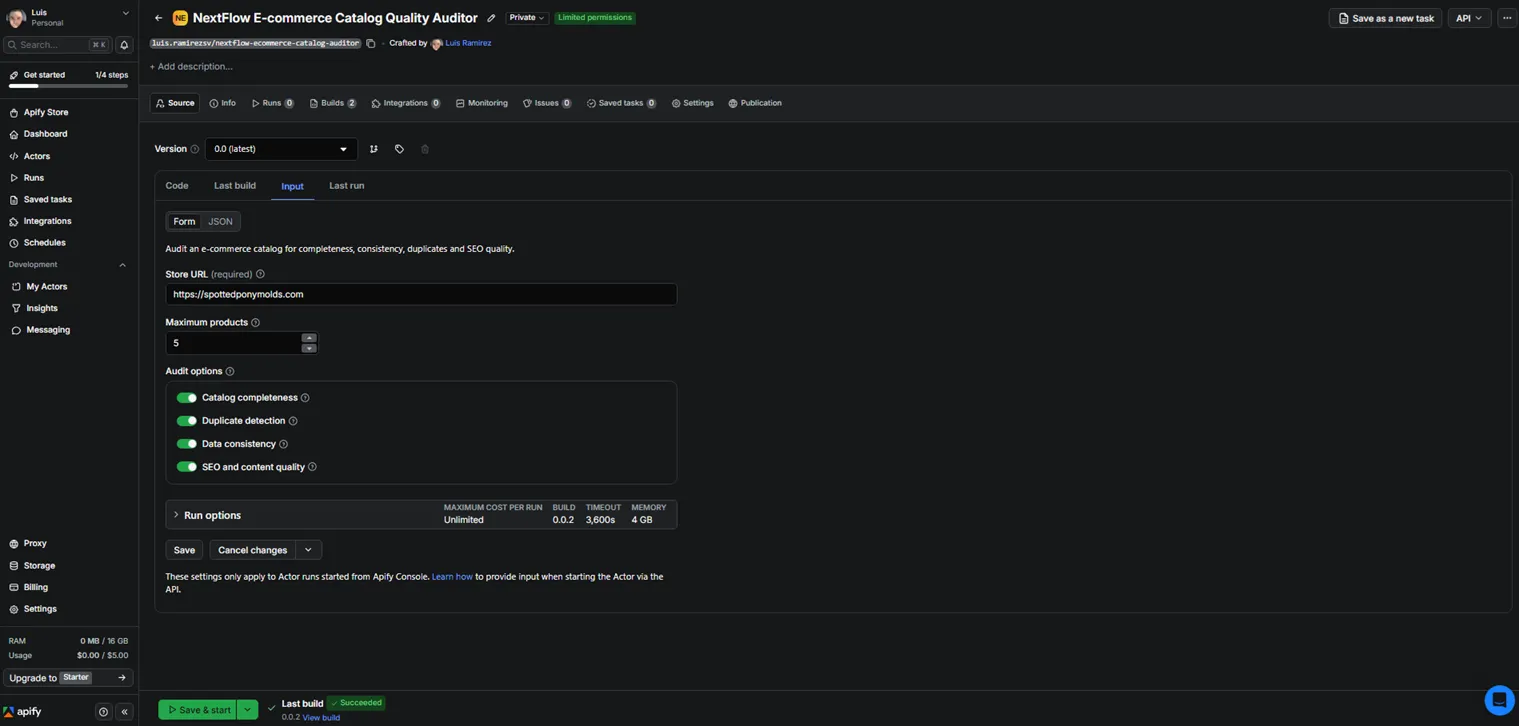
Input
The only required field is storeUrl.
Optional input:
maxProducts— maximum number of products to discover and processauditOptions.checkCompletenessauditOptions.checkDuplicatesauditOptions.checkConsistencyauditOptions.checkSeo
Default maxProducts is 100.
Input form
Basic audit
Limited audit
Shopify audit
No Shopify-specific input is required. The Actor detects compatible Shopify product data automatically.
WooCommerce audit
No WooCommerce-specific input is required. The Actor detects compatible WooCommerce product data automatically.
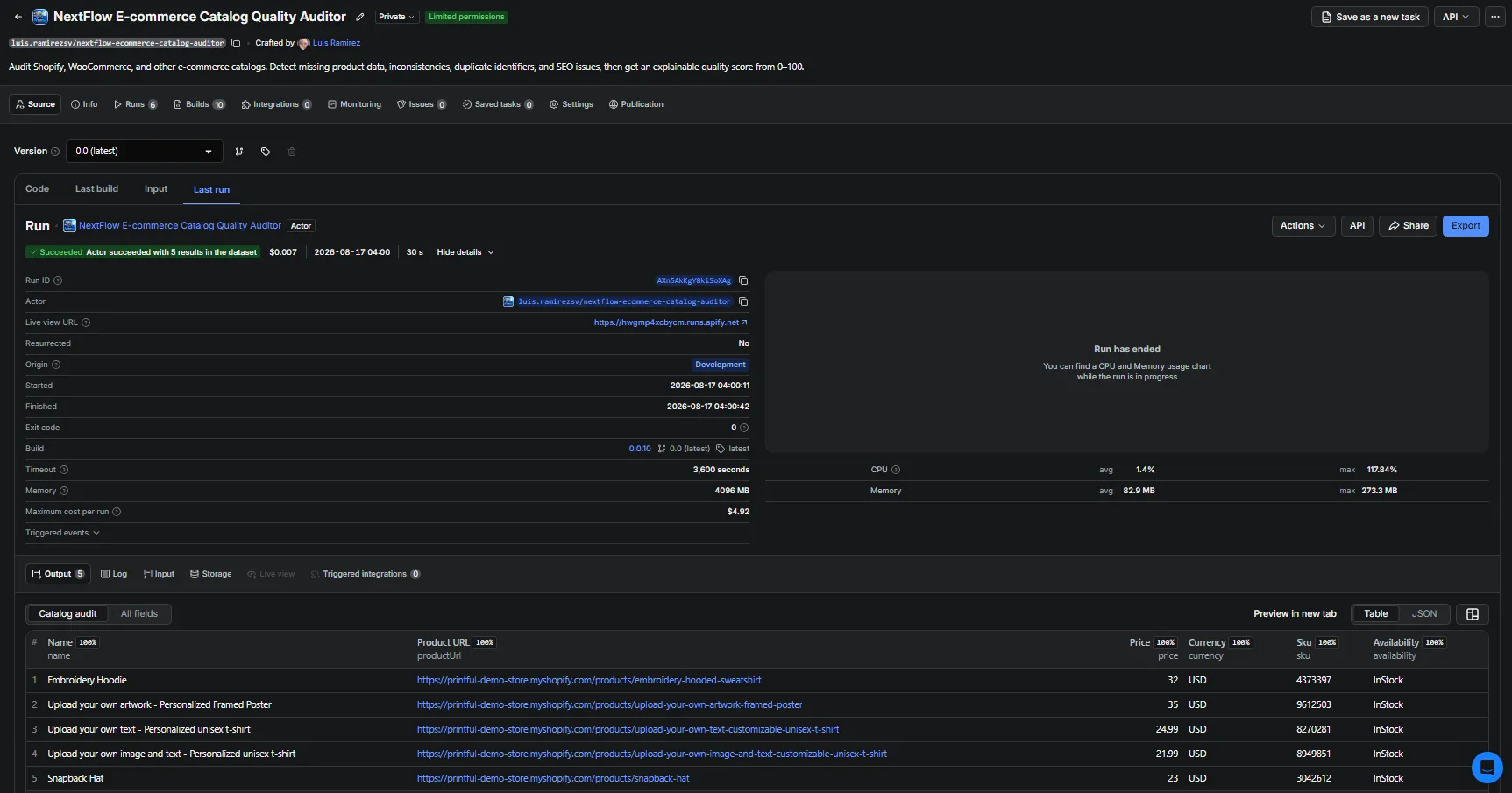
Successful run example
The Actor can process a public catalog and write the extracted products directly to the default dataset.
Output
The default dataset can contain fields such as:
storeUrlplatformproductUrlnamepricecurrencyskugtinavailabilitycategoryimagesdescription
Additional data such as product variants and metadata can be extracted when the target store exposes it.
Dataset example

Example dataset item:
Fields that cannot be extracted reliably are returned as missing values instead of being invented.
Quality score
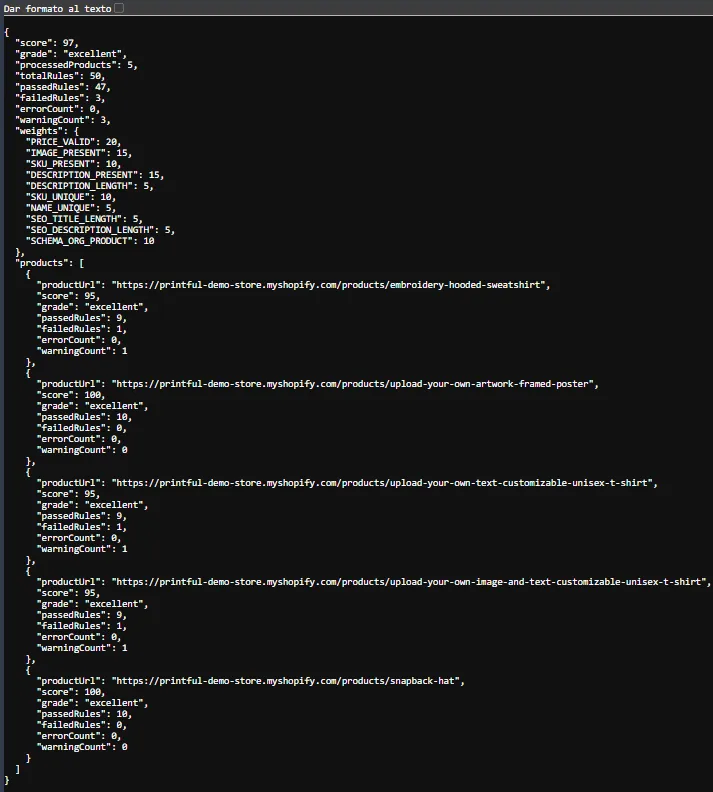
After extraction, the Actor runs catalog audit rules and calculates an overall score from 0 to 100.
The score includes:
- Overall score
- Grade
- Number of processed products
- Total audit rules
- Passed rules
- Failed rules
- Error count
- Warning count
The Actor also generates explainable findings so the score can be traced back to concrete catalog issues.
Real audit score example
A real validation run over 5 Shopify products produced a 97/100 — excellent score.
Audit categories
Catalog completeness
Checks whether important product information is missing or incomplete, including:
- Product name
- Price
- Images
- Description
- Identifiers
- Availability
Duplicate detection
Detects duplicated catalog information such as repeated products, SKUs, or identifiers when identified by the audit rules.
Data consistency
Checks catalog data for inconsistencies involving:
- Prices
- Currency
- Stock information
- Product identifiers
SEO and content quality
Reviews product-facing content and SEO-related fields such as:
- Product titles
- Descriptions
- Images
- Product URLs
Supported platforms
Shopify
The Actor can detect Shopify product pages and use Shopify-compatible product endpoints when publicly available.
Shopify processing can include:
- Product information
- Price and currency
- Availability
- Variants
- Variant SKU
- Barcode
- Compare-at price
- Variant options
- Shipping and tax attributes
WooCommerce
The Actor can detect WooCommerce product pages and use public WooCommerce Store API data when available.
WooCommerce processing can include:
- Product information
- Price and currency
- Availability
- Variants
- Metadata
- Identifiers
- Additional public catalog fields
Other e-commerce websites
The Actor is not limited to Shopify and WooCommerce.
For other public stores, it can use:
- Base HTML metadata
- JSON-LD / Schema.org Product data
- DOM fallback extraction
- Playwright JavaScript fallback when automatically detected and allowed by the runtime budget
Product discovery
Sitemap discovery
The Actor checks sitemap data and collects product URLs.
Internal-link discovery
If sitemap discovery does not reach the requested product limit, the Actor continues by crawling internal links from the same store.
Deduplication
URLs found through multiple discovery methods are normalized and deduplicated before extraction.
Extraction strategy
The extraction pipeline can combine:
- Base page metadata
- JSON-LD structured data
- DOM fallback
- Shopify-specific extraction
- WooCommerce-specific extraction
- Playwright JavaScript fallback
This layered approach improves coverage across stores that expose product catalog data in different ways.
JavaScript-heavy stores
Some stores render important product information only after JavaScript execution.
The Actor includes an automatic Playwright fallback for detected cases. Browser processing is intentionally limited by runtime budgets to keep runs controlled.
Key-value store records
The Actor can generate these named records:
DISCOVERY_SUMMARYEXTRACTION_SUMMARYSHOPIFY_SUMMARYWOOCOMMERCE_SUMMARYPLAYWRIGHT_SUMMARYROBUSTNESS_SUMMARYAUDIT_RULESAUDIT_SCOREAUDIT_ERRORS
Reliability controls
Production safeguards include:
- HTTP retries
- Request timeouts
- Controlled HTTP errors
- Response-size limits
- URL normalization
- Product URL deduplication
- Maximum product limits
- Restricted Playwright usage
- Single-browser concurrency for fallback processing
Typical use cases
- Audit a catalog before migration
- Find missing product information
- Review catalog quality before an SEO project
- Detect inconsistent product data
- Audit Shopify product quality
- Audit WooCommerce product quality
- Review product identifiers and availability
- Identify products needing content improvements
- Establish a measurable catalog quality baseline
- Re-run audits after catalog cleanup and compare progress
Important notes
- The Actor audits information publicly accessible from the target store.
- Extraction quality depends on the data exposed by the website.
- Some stores may block automated requests or expose limited product data.
- JavaScript fallback is intentionally limited to keep executions controlled.
- Missing fields are preserved as missing values rather than invented.
Local development
Requirements:
- Node.js 22+
- TypeScript
- Apify SDK
- Crawlee
- Playwright
Install dependencies:
Build:
Run:
Technology
- Node.js 22+
- TypeScript
- Apify SDK
- Crawlee
- Playwright
Built by NextFlow.


