
Google & Bing Rank Tracker — SERP Position Tracking
Pricing
from $0.50 / keyword batch
Google & Bing Rank Tracker — SERP Position Tracking
Track where your domains rank on Google and Bing for any keywords. Get position, URL, and title for each match. Supports up to 100 results per keyword. JSON or CSV out.
Pricing
from $0.50 / keyword batch
Rating
0.0
(0)
Developer

Muhamed Didovic
Maintained by CommunityActor stats
0
Bookmarked
2
Total users
1
Monthly active users
7 hours ago
Last modified
Categories
Share
Track where your domains rank on Google and Bing for any keywords. Get the position, URL, and title for every match — with subdomain matching. Supports up to 100 results per keyword. One row per ranking, clean JSON out.
Why use this rank tracker
- Google + Bing. Track rankings on both search engines from one actor. Run "both" to compare.
- Subdomain matching. Track
example.comand it matchesshop.example.com,blog.example.com, and any subdomain automatically. - Up to 100 positions. Scan deep into the SERP — not just the top 10.
- Full SERP export. Optionally push every organic result (not just matches) for full SERP analysis.
- Structured output. Clean flat rows — keyword, engine, position, domain, URL, title — ready for spreadsheets or databases.
Overview
This actor searches Google and/or Bing for your keywords, parses the organic results, and finds where your target domains rank. Each output row is a single ranking result: the keyword, the search engine, the position, the ranking domain/URL/title, and which target domain it matched.
Use cases
- SEO rank tracking — monitor where your site ranks for target keywords over time.
- Competitor analysis — track competitor domains alongside your own.
- SERP auditing — export full SERPs to see who ranks for any keyword.
- Multi-engine comparison — compare Google vs Bing rankings side by side.
- Local SEO — use the
locationparam to track geo-targeted Google results.
How it works
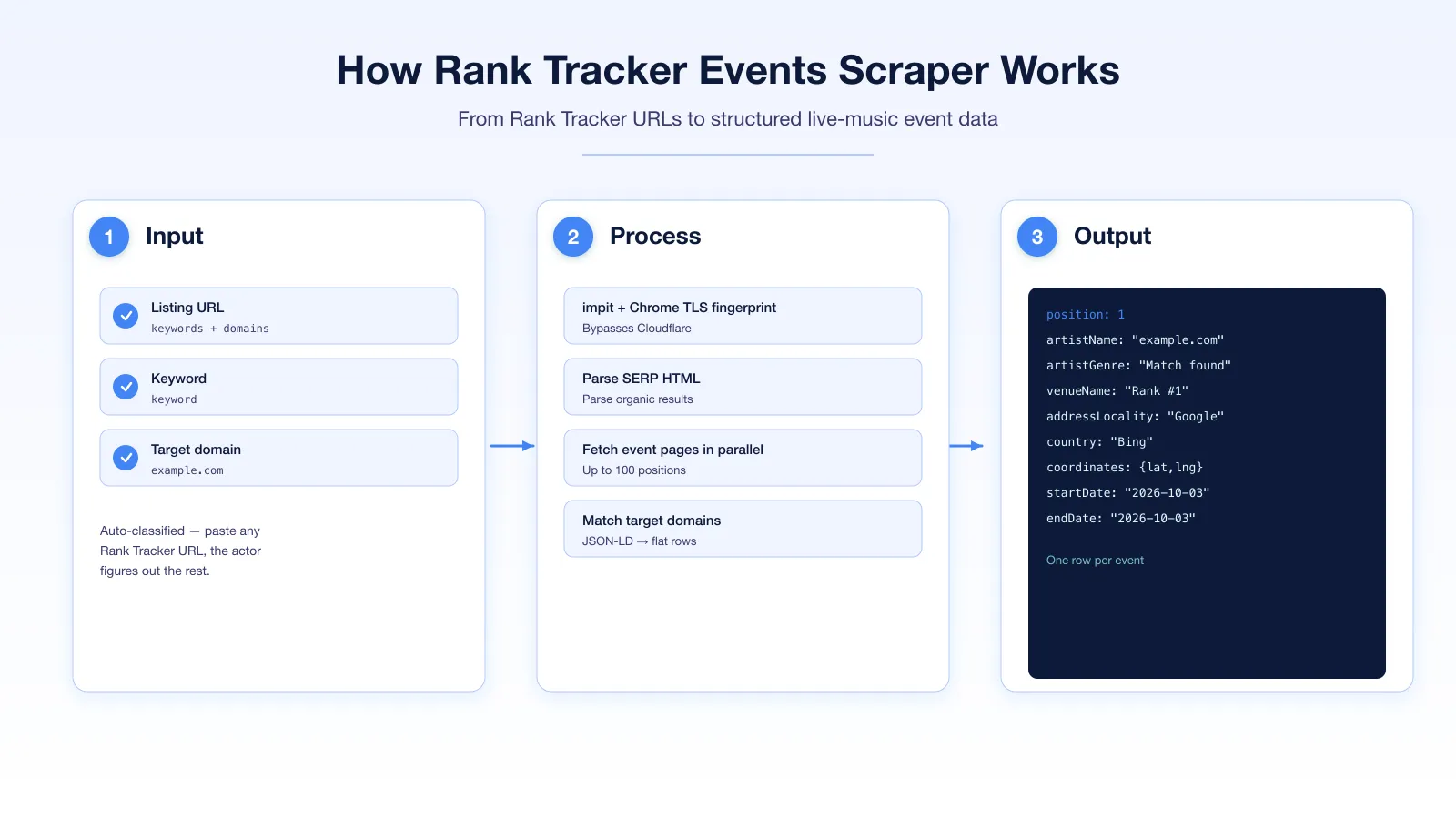
- You provide keywords and target domains.
- The actor fetches the SERP for each keyword on each search engine.
- It parses the organic results (position, title, URL, domain).
- It matches each result against your target domains (with subdomain support).
- Each match becomes one row in the dataset.
Input
| Field | Type | Default | Notes |
|---|---|---|---|
keywords | array | — | Keywords to track. One SERP fetch per keyword per engine. |
targetDomains | array | — | Domains to find. example.com matches all subdomains. |
searchEngine | string | google | google, bing, or both. |
maxResults | integer | 100 | How many organic results to scan per SERP (1-100). |
location | string | us | Google country code (us, uk, de, ...). Google only. |
onlyMatching | boolean | true | If false, push all organic results (full SERP export). |
proxy | object | Apify proxy | Residential proxies recommended for Google. |
Output
One row per ranking result:
Key output fields
keyword— the keyword that was searched.searchEngine— which engine (googleorbing).position— organic rank position (1 = first result).domain— the ranking domain.url— the ranking URL.title— the result title.targetDomain— which of your target domains matched (null if no match).isMatch— whether this result matched a target domain.
FAQ
Does Google work without residential proxies? Google may serve a JS challenge to datacenter IPs. Use Apify's residential proxy pool (the default) for reliable Google results. Bing works with datacenter IPs.
How does subdomain matching work?
If you track example.com, the actor matches example.com, www.example.com, shop.example.com, blog.example.com, and any other subdomain. You don't need to list every subdomain.
Can I track competitors?
Yes — pass multiple domains in targetDomains. Each result row shows which target domain it matched.
Can I export the full SERP?
Yes — set onlyMatching: false to push every organic result, not just matches.
How many keywords can I track? As many as you need. The actor fetches one SERP per keyword per engine, with a polite delay between requests.
⚠️ Disclaimer
This Actor scrapes publicly available search engine results. It does not access authenticated or private content. You are responsible for using the output in line with Google's and Bing's terms of service and any applicable law in your jurisdiction. This Actor is not affiliated with, endorsed by, or sponsored by Google or Bing.
SEO Keywords
rank tracker, serp position tracking, google rank checker, bing rank checker, keyword ranking tracker, seo rank monitor, serp scraper, search engine rank tracker, organic position tracker, keyword position checker, google ranking api, serp position api, rank tracking tool, seo position tracker, domain rank checker, serp monitoring, keyword rank tracker, google serp scraper, bing serp scraper, seo rank reporting


