Liquorland Product Scraper 🍻🍺
Pricing
from $0.80 / 1,000 results
Liquorland Product Scraper 🍻🍺
Extract product data from liquorland.com.au. Scrape any category or search page for prices, specials, brands, and ratings. Auto-paginates through listings for full category coverage. Ideal for price monitoring, competitor research, and catalog analysis. AU residential proxy included.
Pricing
from $0.80 / 1,000 results
Rating
0.0
(0)
Developer

MrDoe
Maintained by CommunityActor stats
0
Bookmarked
1
Total users
0
Monthly active users
4 days ago
Last modified
Categories
Share
What does Liquorland Product Scraper do?
Liquorland Product Scraper collects clean, structured product data from any category or search results page on liquorland.com.au, one of Australia's largest liquor retailers. Give it a listing URL — a beer, wine, or spirits category, or a search results page — and it pages through the full result set to return structured data for every product, not just the first screen.
Running on the Apify platform means automatic proxy handling, one-click scheduling for recurring price checks, dataset export in multiple formats, and an API for pulling results straight into your own systems — no infrastructure to manage.
Why use Liquorland Product Scraper?
- Price monitoring — track prices and special/multi-buy offers across the Liquorland catalog over time.
- Competitor research — benchmark your own pricing against Liquorland's listed prices.
- Catalog and product research — pull clean product names, brands, images, and pack sizes to enrich your own product database.
- Assortment analysis — see which brands and products Liquorland stocks in a given category.
- Recurring monitoring — schedule runs to keep price and promotion data current.
Designed for practical, cost-efficient product data collection: clean structured output without unnecessary data, and control over run size with maxItems.
What data can you extract?
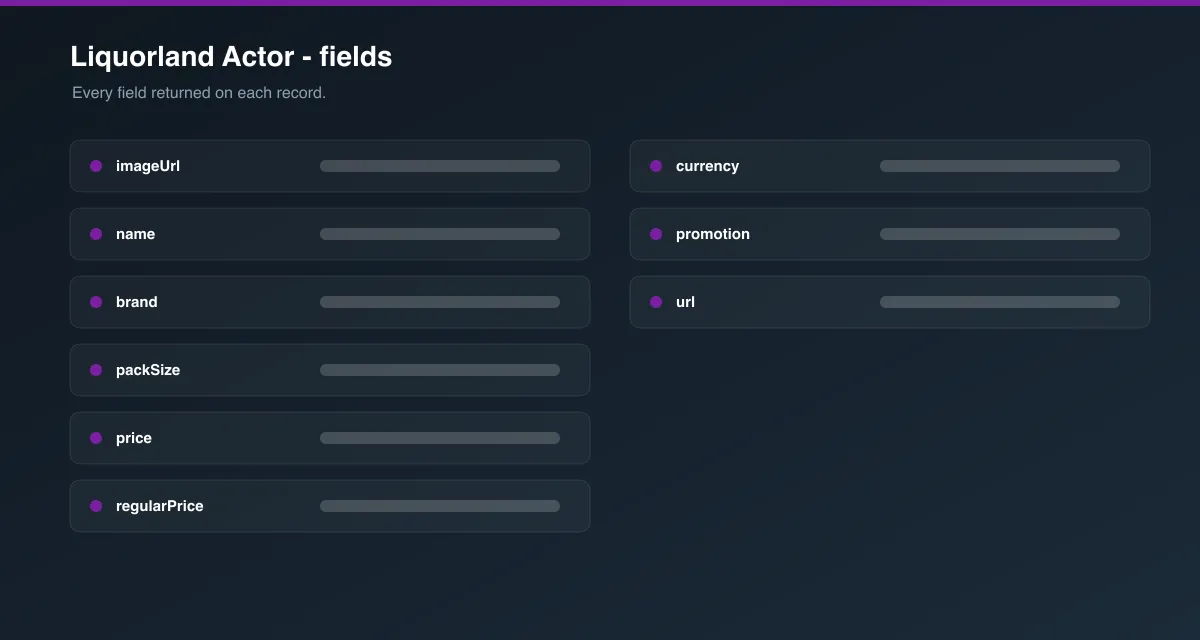
- Product ID
- Product name and brand
- Product URL
- Image URL
- Size / pack size
- Price and regular price
- Currency
- Promotion text (e.g. multi-buy offers)
- Whether the product is currently on special
- Promotional badge flag
- Source category URL
How to use it
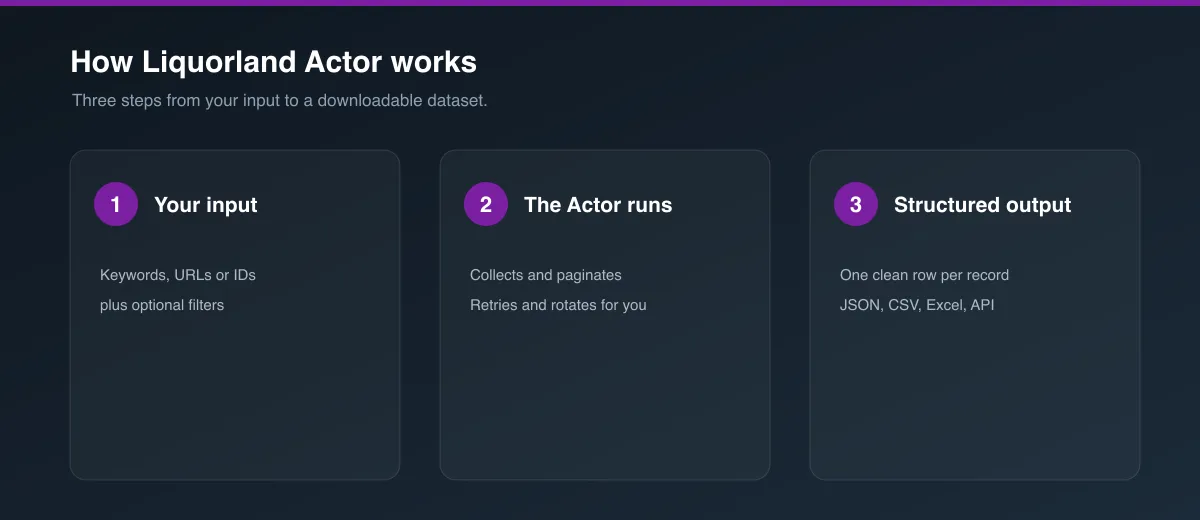
- Click Try for free or Run on the Actor page.
- In Start URLs, paste one or more Liquorland category or search URLs (e.g.
https://www.liquorland.com.au/beer). - Optionally adjust Max products per start URL. Leave it at
0to collect the entire listing. - Click Start and wait for the run to finish.
- Open the Dataset tab to preview, filter, and export your results.
Input Parameters
| Parameter | Type | Required | Default | Description |
|---|---|---|---|---|
startUrls | array | Yes | [{ "url": "https://www.liquorland.com.au/beer" }] | Category or search listing pages to scrape. Add multiple URLs to scrape several listings in one run. |
maxItems | integer | No | 5 | Maximum products to collect per start URL. 0 = no limit — page through the entire listing. |
proxyConfiguration | object | No | Apify Proxy (Residential, AU) | Proxy settings for the crawl. |
Example input:
Output Data
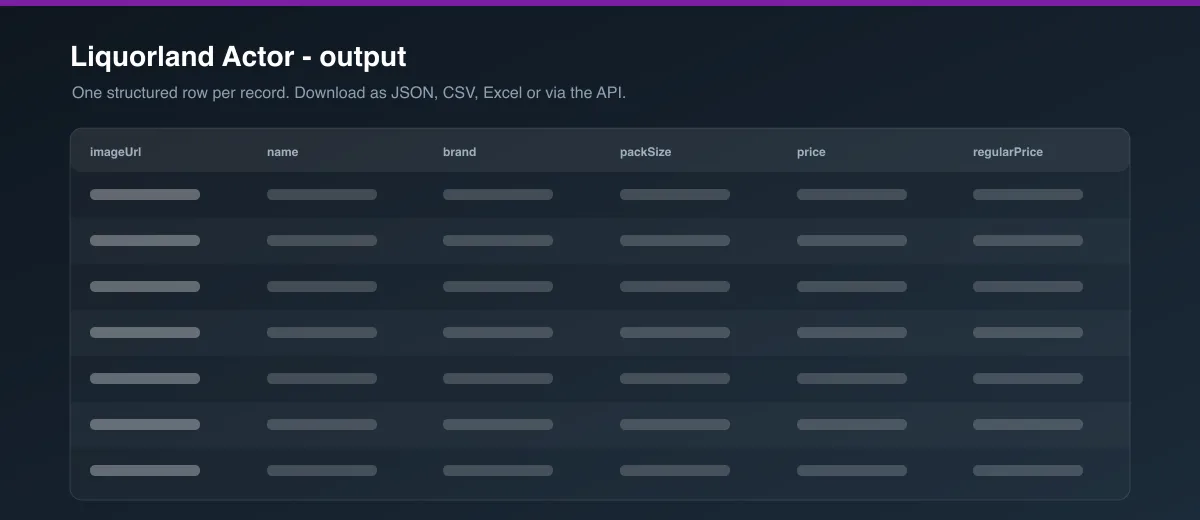
Each dataset item represents one product. Every start URL you provide gets its own maxItems budget, and duplicate products (matched by product ID) are removed automatically as pages are collected.
| Field | Description |
|---|---|
productId | Liquorland's internal product ID. |
name | Full product name, including pack description. |
brand | Product brand. |
url | Canonical product page URL. |
imageUrl | Product image URL. |
size | Bottle/can size (e.g. 375mL), when available. |
packSize | Pack configuration (e.g. Pack (30)), when available. |
price | Current listed price. |
regularPrice | Regular price before any discount. Equal to price when not on special. |
promotion | Multi-buy or other promotion text shown on the listing (e.g. "2 for $114"), when present. |
onSpecial | Whether the product is currently discounted from its regular price. |
badge | Whether a promotional badge is shown on the listing tile. |
categoryUrl | The start URL this product was collected from. |
Usage Examples
- Track weekly specials: Point
startUrlsat your key categories and schedule a weekly run to see how prices and promotions change. - Build a competitor price index: Scrape a set of category URLs, export to CSV, and join against your own catalog by product name or brand.
- Research a category: Set
maxItemsto0on a single category URL to pull the full assortment for analysis.
Tips for Best Results
- Start from a specific category or search URL rather than the homepage — scraping is scoped to the listing page you provide.
- Use
maxItems: 0when you want the full listing; otherwise set a smaller number for quick tests or sampling. - Provide multiple start URLs to cover several categories in a single run; each gets its own
maxItemsbudget. - Liquorland applies bot protection to non-residential traffic — keep the default Australian residential proxy setting for reliable results.
Integrations
Connect this Actor to Make, Zapier, Google Sheets, Slack, or your own systems via Apify's integrations and API, or schedule recurring runs directly from the Apify platform.
Export Formats
Datasets can be exported as JSON, CSV, Excel, or XML directly from the Dataset tab, or pulled programmatically via the Apify API.
FAQ
How many products can I collect?
As many as the listing exposes. Set maxItems: 0 to collect the full category or search listing.
Can I scrape a whole category?
Yes — point a start URL at any category page and the Actor will page through all available products up to your maxItems setting.
Does maxItems = 0 collect everything?
Yes, for each start URL. The Actor keeps paging until Liquorland stops returning new products.
Can I provide multiple URLs?
Yes. Add multiple entries to startUrls; maxItems applies separately to each one.
Are duplicates removed? Yes, products are deduplicated by product ID as pages are collected.
Why can some fields be null?
Not every product has a promotion, badge, or explicit size — those fields are null when the site doesn't show them.
Can I schedule price monitoring? Yes — use the Apify platform's built-in Scheduler to run this Actor automatically on a recurring basis.
Is cache available? Not currently required for this Actor; each run collects fresh data directly from the listing pages you provide.
Is the data current? Data reflects what was published on the site at the time of the run.
What happens when a product is unavailable? If a product is out of stock or removed, it simply won't appear in the listing — the Actor only reports what Liquorland currently displays.
Legal / Responsible Use
This Actor only collects publicly visible product listing data. Users are responsible for complying with Liquorland's terms of use, applicable law, and responsible data-use requirements.
Preview