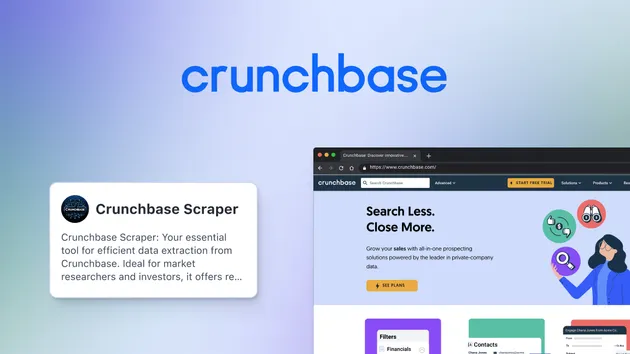
Crunchbase Company Scraper — Funding & Investors ✅ No API Key
Pricing
$15.00 / 1,000 results
Crunchbase Company Scraper — Funding & Investors ✅ No API Key
Turn a Crunchbase company URL into structured JSON — funding rounds, total raised, investors, acquisitions, HQ, employees, IPO status, rank, socials and contact email. No Crunchbase API key or login. You pay per completed lookup — matched or not.
Pricing
$15.00 / 1,000 results
Rating
0.0
(0)
Developer
NeuralVerge
Maintained by CommunityActor stats
0
Bookmarked
8
Total users
1
Monthly active users
a month ago
Last modified
Categories
Share
Crunchbase Company Scraper — Funding & Investors ✅ No API Key
Turn a Crunchbase company URL into a structured company profile — funding rounds, total raised, investors, acquisitions, key people and board, HQ, employees, IPO status, rank, socials, contact email and a dated press timeline (launches, legal proceedings, layoffs, leadership changes). Powered by the Neuralverge API. No Crunchbase API key or login. You pay per completed lookup — matched or not; failed runs are never charged. Export to JSON, CSV or Excel.
Ideal for investor research, competitive intelligence, deal sourcing, CRM enrichment, and feeding company intelligence to AI agents.
✨ Why this Actor
- 💸 One flat price per row — $0.015 per company, no run fee and no start fee. A company we
can't resolve comes back as one
no resultrow, billed like any other row. - 🧩 The whole profile in one row — 42 fixed columns: identity, HQ, funding, investors, acquisitions, people, board and press timeline.
- 🔓 No Crunchbase API key or login — fetching and structuring run on the Neuralverge backend.
- ⚡ Real-time & structured — fresh data each run, one predictable JSON schema, ready for a spreadsheet, database or AI pipeline (MCP-ready). A typical lookup takes 5–10 seconds.
🔧 How it works
- Provide a Crunchbase company URL — e.g.
https://www.crunchbase.com/organization/revolut. - Run the Actor. Fetching and structuring happen on the Neuralverge backend.
- Get one flat dataset row — 42 columns, all at the top level (
companyName,fundingTotalUsd,numInvestors,lastFundingType,categories,founders, …). Export to CSV, JSON, or Excel, or pull it over the Apify API.
Companies that can't be resolved still return a row — an explicit no result row that echoes your
query, so nothing is silently dropped.
Input
One company per run.
| Field | Type | Notes |
|---|---|---|
url | string | A Crunchbase company URL (https://www.crunchbase.com/organization/<slug>). |
What you'll receive
One flat row per company. Every field sits at the top level of the row, so the Output tab shows a single table with all 42 columns — there are no views to switch between. Exports (CSV, JSON, XML, Excel) contain exactly the same fields.
Columns: url, companyName, legalName, permalink, shortDescription, description, website, linkedinUrl, facebookUrl, twitterUrl, contactEmail, city, region, country, continent, companyType, operatingStatus, ipoStatus, foundedOn, employeeCount, rankOrgCompany, fundingTotalUsd, numFundingRounds, numInvestors, lastFundingType, lastFundingAt, acquiredBy, acquiredByOn.
Lists — categories, industries, founders, employees, advisors, investors, fundingRounds, acquisitions, subOrganizations, keyEmployeeChanges, layoffs, legalProceedings, productLaunches, currentValuation — come back as arrays. The table renders each as
an expandable "N items" cell; a CSV/JSON/Excel export carries them in full.
categories, industries and founders are arrays of names; the other lists carry one object per
entry (employees/advisors: name, title; investors: name, permalink, funding_round;
fundingRounds: name, announced_on, investment_type; acquisitions: company, permalink,
announced_on; the press lists: date, description).
The long lists are capped at the 10 most recent entries.
numFundingRoundsandnumInvestorscarry the real totals, so a company with 75 investors shows 75 there and the ten most relevant in theinvestorsarray.
Nulls are normal. The column set is the same on every run, so a field the source does not expose for this company comes back
nullrather than disappearing — a spreadsheet or CRM mapping built on one run keeps working on the next.
Updated 28 August 2026 — leaner, faster, and some columns are gone
The upstream profile was rebuilt: a lookup is now ~2× faster and returns a curated profile instead of a raw dump. Two things changed for you:
- New columns:
continent,numInvestors,industries,acquiredBy,acquiredByOn,employees,advisors,subOrganizations,currentValuation. - Removed columns — the source no longer publishes them:
locationGroup,categoryGroups(replaced byindustries),hubs,fundingCurrency(amounts are USD),numLeadInvestors,numAcquisitions,numContacts,numContactEmails,numContactPhones,numCurrentPositions,growthScore,heatScore,semrushGlobalRank,semrushVisitsLatestMonth,semrushVisitsMomPct,builtwithNumTechnologiesUsed,sifteryNumProducts,apptopiaTotalDownloads,ipqweryNumPatentGranted,ipqweryNumTrademarkRegistered,offices,products,awards,partnershipAnnouncements,similarCompanies. employeeCountis now human-readable —"10001+"instead of the raw"c_10001_max"enum.
Every other column kept its name and meaning. If your pipeline maps one of the removed columns,
drop it — the value would be null from now on. Questions: support@neuralverge.ai.
When nothing is found
A lookup that runs but matches nothing still returns a row, so a batch never silently loses an input:
| Column | Value |
|---|---|
url | echoed back exactly as submitted |
found | false |
message | why nothing was returned |
Filter these out with found != false (or drop rows where message is set). This row is billed as
one company — see Pricing.
Example output (real run)
A real dataset row, with the longest lists trimmed to 2 entries for readability (categories (4), industries (5), founders (2), employees (10), advisors (8), investors (10), fundingRounds (10), acquisitions (3), keyEmployeeChanges (10), layoffs (3), legalProceedings (10), productLaunches (10) — full length in brackets).
Pricing
Pay per event — $0.015 per company ($15 per 1,000) written to the dataset. There is no run fee and no start fee.
| Event | Price | Charged |
|---|---|---|
| Actor start | free | never |
| Failed run — invalid input, API error, timeout | free | never |
| Row written to the dataset | $0.015 ($15 / 1,000) | every row, including the "no result" row |
A completed lookup is billed as one company, matched or not. When the source returns
nothing, the Actor writes one explicit no-result row — the query you submitted plus
found: false and a message explaining it — and that row is charged at the normal
per-company price. A run that fails (missing input, bad key, upstream error) writes
no row and costs $0.00.
Pricing is on top of your Apify platform usage.
Rate limit
There is a ceiling on how fast one Apify account can pull from the Neuralverge backend: 10 requests per second for this Actor, counted separately from the other Neuralverge Actors. One run is normally one request, so this is about how many runs you start at once, not about the size of a single run — at typical run times that is dozens of runs in flight at once, which is well above ordinary use.
Updated August 2026: this ceiling was doubled from 5 to 10 requests per second. Bulk jobs that used to hit 429s now go through.
Above the ceiling the backend answers HTTP 429. The Actor waits out the Retry-After it asks
for and retries a few times before giving up; a run that does give up writes no row and is not
charged.
If you need a higher rate for a bulk job, get in touch.
Free plan limits
Users on any paid Apify plan are not affected by anything in this section.
On the Apify Free plan this Actor may be started 5 time(s) per calendar month per user. A run that finds nothing still counts, because the lookup is performed either way. Every Neuralverge Actor carries its own allowance — running one never uses up another's. When a limit is reached the Actor stops gracefully with a status message naming it; everything resets on the 1st of every month, and any paid Apify plan removes all of it.
Integrations & API
Results are stored in a standard Apify dataset — export as CSV, JSON, XML or Excel, or fetch on demand through the Apify API. The Actor also plugs into Apify's integrations (Make, Zapier, n8n, webhooks) and can be called from any MCP client to give an AI agent live company data.
FAQ
Do I need a Crunchbase account or API key? No. Fetching runs on the Neuralverge backend — you never provide credentials.
Am I charged if a company isn't found? Yes — a lookup that ran is billed as one company even
when it matched nothing, and you get a no result row that says so. A run that fails (missing
input, bad key, upstream error) is not charged.
Why do the lists stop at 10 entries? The upstream profile caps them at the ten most recent or
most relevant entries. The count columns (numFundingRounds, numInvestors) still report the real
totals.
A column I used to map is gone. See "Updated 28 August 2026" above — the source stopped publishing those fields. Write to support@neuralverge.ai if one of them is critical for you.
How fresh is the data? Each run fetches the profile at run time.
🔗 Related Neuralverge Actors
Other Actors from Neuralverge that pair well with this one:
- LinkedIn Company Scraper — description, size, specialties and recent posts from the company's LinkedIn page.
- LinkedIn Company Search — find companies by keyword, industry and size.
- UK Companies House Scraper — the official UK register record for the same company.
- LEI Lookup Search — the company's LEI code and legal entity data.
- Capterra Scraper — the product side: pricing, features and ratings.
- More Neuralverge Actors — the full catalogue (LinkedIn, contact data, company registers, reviews): apify.com/neuralverge.
Disclaimer: This Actor is an independent tool and is not affiliated with, endorsed by, or sponsored by Crunchbase, Inc. Crunchbase® is a trademark of Crunchbase, Inc. All trademarks are property of their respective owners.