Sentiment Analysis — Review & Text Sentiment Scoring (VADER)
Pricing
from $20.00 / 1,000 sentiment records
Sentiment Analysis — Review & Text Sentiment Scoring (VADER)
Sentiment analysis for reviews, social posts, support tickets and any English text. Review sentiment analysis with VADER (rule-based, deterministic, tuned for short informal text): label, compound and pos/neu/neg scores. No API keys, no LLM fees.
Pricing
from $20.00 / 1,000 sentiment records
Rating
0.0
(0)
Developer

NexGenData
Maintained by CommunityActor stats
1
Bookmarked
7
Total users
2
Monthly active users
10 days ago
Last modified
Share
Sentiment analysis for any English text — built for review sentiment analysis, social posts and support tickets, scored with VADER.
Score sentiment on reviews or any text — sentiment label, scores and key phrases. Pipe reviews through it to quantify what customers feel.
Public reviews only — reviewer identities are shown exactly as published on the source platform.
Coverage note: this source doesn't return a result for every input, so output is best-effort where the data is public.
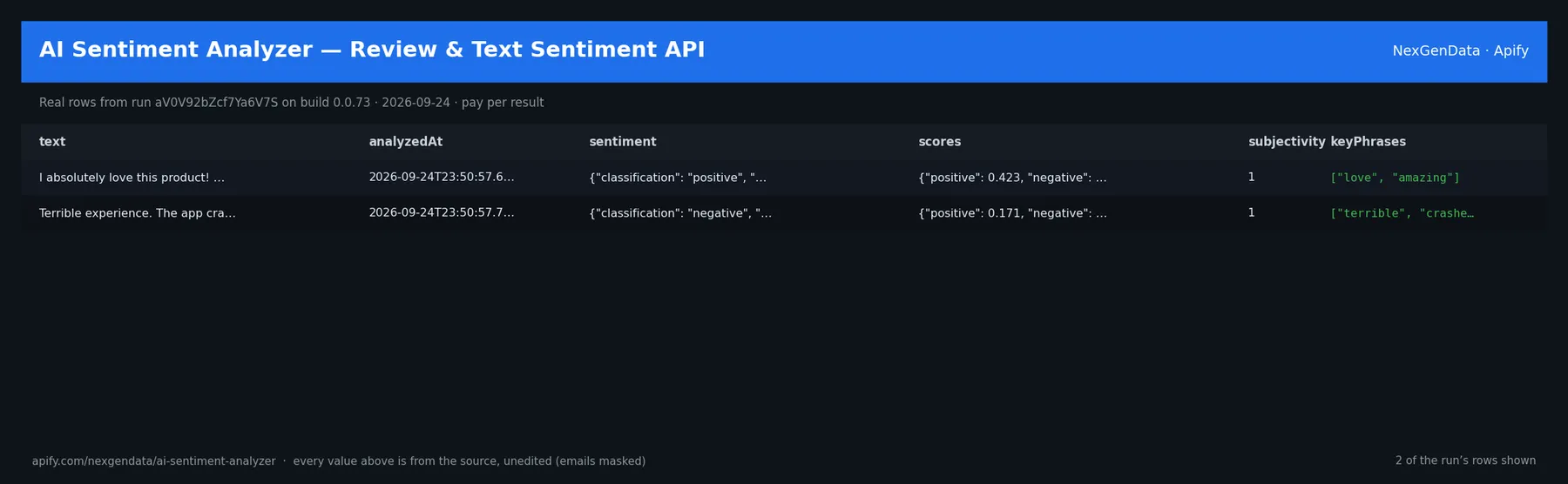
📊 Sample Output
text | analyzedAt | sentiment | scores | subjectivity | keyPhrases |
|---|---|---|---|---|---|
| I absolutely love this product! It completely solved my problem and t… | 2026-09-24T23:50:57.615920+00:00 | {'classification': 'positive', 'confidence': 1, 'compoundScore': 0.84… | {'positive': 0.423, 'negative': 0.114, 'neutral': 0.463} | 1 | ['love', 'amazing'] |
| Terrible experience. The app crashed twice and support was rude. | 2026-09-24T23:50:57.746365+00:00 | {'classification': 'negative', 'confidence': 1, 'compoundScore': -0.5… | {'positive': 0.171, 'negative': 0.386, 'neutral': 0.443} | 1 | ['terrible', 'crashed', 'rude'] |
Real rows from run aV0V92bZcf7Ya6V7S on build 0.0.73 (2026-09-24), unedited apart from masked emails/phones and shortened long text; fields the source does not publish are empty.
⚙️ Sample inputs
This is the Store example input — the same input Apify's automated check runs — so it is proven to return rows on the current build. Paste it into the input form, or send it through the API, CLI or a schedule:
🔧 Input reference
| Field | Type | Default | What it does |
|---|---|---|---|
texts | array of string | ["I absolutely love this product! It completely solved my p… | List of text strings to analyze for sentiment. One dataset row (one charge) per non-empty string. Leave empty and the run succeeds with 0 rows and nothing is charged. |
includeEmotions | boolean | true | Detect specific emotions (joy, anger, frustration, etc.) |
🧾 JSON sample record
One real record from run aV0V92bZcf7Ya6V7S (emails/phones masked, long text shortened):
💰 Pricing
| Event | Price (USD) | When it is charged |
|---|---|---|
Actor Start (apify-actor-start) | $5e-05 | Charged when the Actor starts running. Number of events charged depends on Actor memory (one event per GB, minimum one event). |
Sentiment record (apify-default-dataset-item) | $0.02 | Single result in the default dataset. |
Pay-per-event: you pay only for what the run delivers. A run that delivers nothing bills no result events (only the actor-start event, when the actor defines one). Example: a run that delivers 100 results costs 100 × $0.02 = $2.00 plus the start fee.
🔗 Related Actors
More from the NexGenData Data APIs family:
- Airbnb Scraper — Listings, Prices & Reviews API
- APAC Disclosure Monitor — Pan-Asia Regulatory Filings API
- APAC IPO Calendar Sweep — Pan-Asia New Listings API
30 more in this family on the NexGenData Store page.
📊 What you get
Clean JSON, one record per text analyzed (full output has 10 fields):
text— TextanalyzedAt— Analyzed Atsentiment— Sentimentscores— Scoressubjectivity— Subjectivitylanguage— LanguagekeyPhrases— Key PhrasestextLength— Text Lengthengine— Engineemotions— Emotions
Pricing: $0.020 per text analyzed (Pay-Per-Event) — about 50 text analyzeds per $1.
🤖 Use with AI agents
Point Claude, the OpenAI Agents SDK, an n8n flow or any MCP-aware client at it and pull data on demand.
Agentic payments (x402): Supports agentic payment via x402 — agents can call this actor with USDC, no API key required.
🔗 Related actors
Review & app intelligence family — monitor reviews across every platform, score them, pipe them to Notion:
Apple App Store · Google Play Store · Google Play Reviews · iOS App Store Reviews · Google Maps Reviews · Amazon Reviews · Capterra Reviews · Review Intelligence to Notion
Agent front door — Review Intelligence MCP: Review Intelligence MCP
Public web data, assembled for research and monitoring.