

Company LEI Lookup — Company Data, SEC Form D & Tech Stack
Pricing
from $50.00 / 1,000 company profile aggregation per domains
Company LEI Lookup — Company Data, SEC Form D & Tech Stack
Company LEI lookup and company data from official sources: legal identity via GLEIF, real funding signals (SEC Form D) and a domain/tech profile (WHOIS, DNS, GitHub, tech stack). No paid APIs, no keys.
Pricing
from $50.00 / 1,000 company profile aggregation per domains
Rating
1.0
(1)
Developer
NexGenData
Maintained by CommunityActor stats
0
Bookmarked
7
Total users
1
Monthly active users
4 days ago
Last modified
Categories
Share
🏢 Company LEI Lookup — Company Data, SEC Form D & Tech Stack
Company LEI lookup: a company name in, its GLEIF legal entity identifier with legal and headquarters addresses out — plus Form D and domain data.
A company data lookup from official sources: company LEI lookup, SEC Form D funding signals and a domain/tech profile in one record.
Aggregate a company's official-source footprint into one record — legal identity, real funding signals, and a domain/tech profile — from public data only. No Crunchbase scraping, no API keys, no paid data. Enter a company name or domain; get back what's verifiable from authoritative sources.
What this is — and isn't. This Actor reports what official, public sources actually disclose: the global LEI registry (GLEIF), SEC Form D filings, and a company's own web/domain footprint. It is not a scraped copy of a proprietary database, and it won't invent a funding history that isn't publicly filed. When a source has no verified match, the Actor says so rather than guessing.
📊 Sample Output
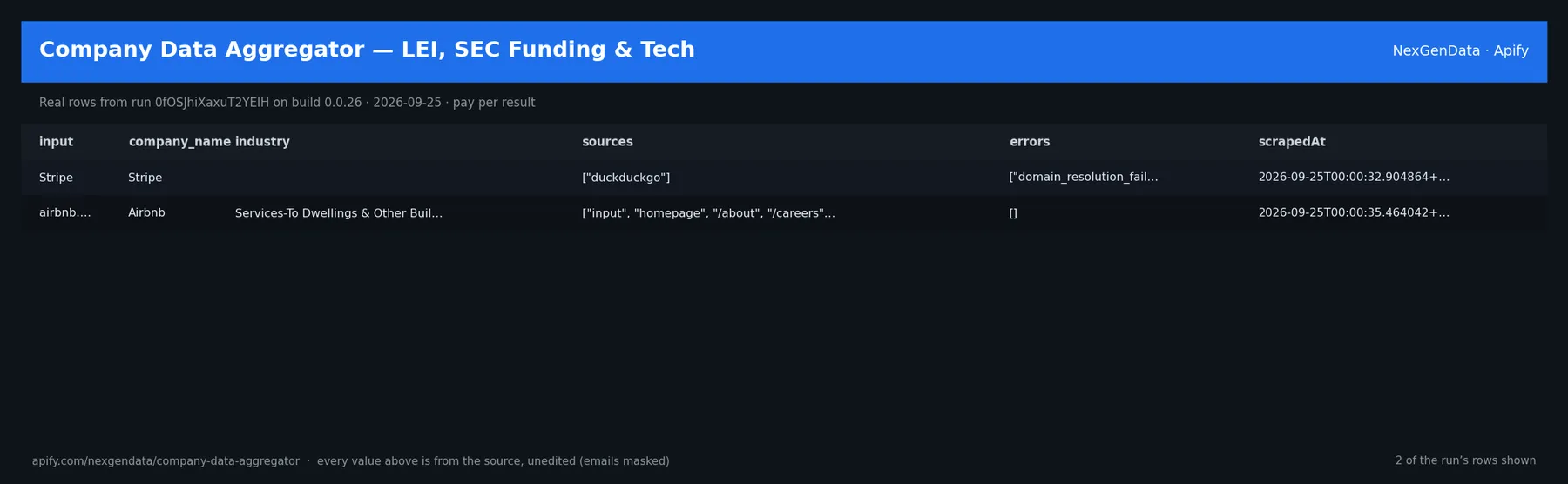
input | company_name | industry | sources | errors | scrapedAt |
|---|---|---|---|---|---|
| Stripe | Stripe | ['duckduckgo'] | ['domain_resolution_failed'] | 2026-09-25T00:00:32.904864+00:00 | |
| airbnb.com | Airbnb | Services-To Dwellings & Other Buildings | ['input', 'homepage', '/about', '/careers', 'gleif_lei', 'sec_edgar'] | [] | 2026-09-25T00:00:35.464042+00:00 |
Real rows from run 0fOSJhiXaxuT2YEIH on build 0.0.26 (2026-09-25), unedited apart from masked emails/phones and shortened long text; fields the source does not publish are empty.
🧾 JSON sample record
One real record from run 0fOSJhiXaxuT2YEIH (emails/phones masked, long text shortened):
💰 Pricing
| Event | Price (USD) | When it is charged |
|---|---|---|
Company profile aggregation per domain (company-profile) | $0.05 | One company profile per domain: homepage, about and careers data (industry, founded year, HQ, employee band), tech stack, plus GLEIF LEI and SEC Form D funding signals when requested. |
Actor Start (apify-actor-start) | $0.005 | Charged when the Actor starts running. Number of events charged depends on Actor memory (one event per GB, minimum one event). |
Pay-per-event: you pay only for what the run delivers. A run that delivers nothing bills no result events (only the actor-start event, when the actor defines one). Example: a run that delivers 100 results costs 100 × $0.05 = $5.00 plus the start fee.
🔗 Related Actors
More from the NexGenData Leads, contacts & enrichment family:
- B2B Leads Finder — Prospects by Title, Industry & Location API
- Building Permit Leads — New Construction Project Prospects API
- Childcare License Leads — Licensed Provider Prospects API
- Company Enrichment API — Domain to Firmographics & Tech
- Company Financial Fundamentals — SEC XBRL Metrics API
- Company Logo API — Clearbit Logo Alternative
30 more in this family on the NexGenData Store page.
🎯 The NexGenData Lead-Gen Pipeline
Turn this into a full pipeline: find prospects → enrich with firmographics → verify deliverability → export. Each step is its own NexGenData actor.
Find leads
- b2b-leads-finder — Apollo/ZoomInfo alternative — build targeted prospect lists
- made-in-china-b2b-suppliers — Find China/APAC manufacturers & wholesale suppliers
- contact-info-scraper — Pull emails & phone numbers from any website
- website-email-extractor — Bulk-extract email addresses from a list of sites
- company-email-finder — Find B2B contact emails by company domain
- person-business-email-finder — Name + company → verified business email
Enrich
- b2b-contact-enricher — Add verified emails, roles & firmographics to a company
- company-enrichment-tool — Domain → firmographics, size, industry & contacts
- company-data-aggregator — LEI, SEC funding & tech-stack company intelligence ← you are here
- lead-list-enricher — Enrich any domain with emails, phones & social profiles
Verify
- email-verification-tool — Bulk deliverability, SMTP & MX verification
- email-validator — Bulk email validator — syntax, MX & clean your lists
⚡ What you get
| Field | Source | Notes |
|---|---|---|
legal_name, lei, hq_country, legal_address | GLEIF LEI (open) | Strict legal-name match; omitted if not confidently matched |
funding.form_d_filings[] | SEC EDGAR Form D | Real Reg D private-placement filings: offering amount, amount sold, date, industry, source URL |
total_funding_usd, last_round | derived from Form D | Latest disclosed offering (backward-compatible fields) |
sec_industry, state_of_incorporation, business_address, former_names, is_public, tickers | SEC EDGAR company facts | Authoritative profile for any SEC-registered company (CIK matched) |
financials (annual_revenue_usd, net_income_usd, fiscal_year_end) | SEC XBRL | Real reported financials for public companies |
industry, founded, headquarters, employee_band | company website / JSON-LD | Best-effort from the company's own pages (SEC industry preferred when available) |
key_people, social | /about, /team, homepage | CEO/CTO/founder mentions, social handles |
tech_stack | HTTP headers + scripts | When includeTechStack is on |
domain, WHOIS/DNS/GitHub signals | domain footprint | Technology & infrastructure profile |
📊 Funding via SEC Form D — what to expect
Form D is the SEC notice companies file for exempt (Reg D) private offerings. It's real, public funding data — e.g. a recent Databricks Form D discloses a >$1B offering. Coverage is honest, not universal:
- ✅ Companies that file under their exact legal name appear with offering amounts.
- ⚠️ Some well-known startups raise via structures that don't file Form D under their own name (SPVs, 4(a)(2) offerings) — those return no Form D, and the Actor reports that plainly rather than attaching a fund's filing.
🏛️ Beyond funding — authoritative company facts
For any company registered with the SEC (public companies and private Form D filers), the Actor adds official EDGAR facts: industry (SIC), state of incorporation, business address, former names, and public-vs-private status. Public companies also get real reported financials (annual revenue, net income) straight from XBRL filings.
🎯 Use cases
- Sales / GTM enrichment — append legal entity, HQ country, and tech stack to a lead list.
- Diligence & research — pull a company's verifiable identity (LEI) and any SEC-filed raises.
- Competitive / market mapping — profile a set of domains by tech and official footprint.
- Compliance / KYC pre-checks — legal name + LEI + jurisdiction from the authoritative registry.
🚀 Input
Accepts company names or domains. includeFunding adds GLEIF identity + SEC Form D; includeTechStack adds the technology profile.
⚖️ Sources & compliance
- GLEIF — Global Legal Entity Identifier Foundation, open data.
- SEC EDGAR — public filings, accessed with a declared User-Agent per SEC fair-access policy.
- Company's own public web pages.
- No login-gated or ToS-restricted third-party databases are scraped.
❓ FAQ
Is this a Crunchbase replacement? It's an official-source company-intelligence aggregator. For SEC-filed funding and legal identity it's a free, clean alternative; it does not replicate Crunchbase's proprietary curated dataset.
Why is funding sometimes empty? The company likely hasn't filed a Form D under its own legal name (foreign-domiciled, bootstrapped, publicly traded, or raised via an exempt structure that doesn't file Form D). We report that instead of attaching an unrelated filing.
Why is identity sometimes empty? We only attach an LEI on a strict legal-name match, and we drop matches whose country conflicts with a US SEC filing — to avoid same-name collisions. No match is reported rather than a wrong one.
🔗 Related Actors — Company & Markets Intelligence
Built by NexGenData. New to Apify? Start free.
⭐ Found this useful?
If this Actor saved you time, a quick review on the Apify Store genuinely helps other teams discover it. Feature request or issue? Open it from the Issues tab.
Related NexGenData actors
Part of the 7. Company Registry & Entity Intelligence workflow. Related NexGenData actors:


