๐Ÿญ EPA TRI Toxic Release Inventory Facilities avatar

๐Ÿญ EPA TRI Toxic Release Inventory Facilities

Pricing

$10.00 / 1,000 weather forecast per coordinates

Go to Apify Store
๐Ÿญ EPA TRI Toxic Release Inventory Facilities

๐Ÿญ EPA TRI Toxic Release Inventory Facilities

EPA Toxics Release Inventory (TRI) reporting facilities by state and city: facility name, address, county, FIPS, EPA region. For ESG, environmental compliance, and community researchers.

Pricing

$10.00 / 1,000 weather forecast per coordinates

Rating

0.0

(0)

Developer

NexGenData

NexGenData

Maintained by Community

Actor stats

1

Bookmarked

3

Total users

0

Monthly active users

4 days ago

Last modified

Categories

Share

Pay-per-result EPA Toxics Release Inventory facility data โ€” $0.10 per facility. No Enhesa subscription, no IHS Markit EHS contract, no per-seat compliance-database licence. The official TRI reporting-facility roster, delivered as flat JSON, queryable by state and city.

The EPA Toxics Release Inventory (TRI) is the federal program that tracks industrial facilities handling toxic chemicals โ€” manufacturers, chemical plants, metal-finishers, power generators, and other reporters covered under EPCRA Section 313. The TRI facility roster is the foundational layer of US environmental-compliance and ESG intelligence: it tells you which facilities, in which communities, are on the federal toxic-release radar. For ESG analysts, environmental-compliance teams, community and environmental-justice researchers, and site-selection diligence, knowing every TRI-reporting facility in a given state or city is step one.

This actor returns a clean record per facility: the facility name, its city, county, state, ZIP, and EPA region. Filter by two-letter state code, optionally narrow to a single city, and pull the full roster of TRI-reporting facilities that match โ€” as structured JSON you can drop straight into a map, an ESG model, or a compliance database.

Why use this

Commercial environmental-compliance platforms like Enhesa and IHS Markit (now part of S&P Global) bundle TRI-style data into broad EHS subscriptions that run into five figures a year and lock the data behind a seat-based portal you cannot pipe into your own models. The EPA's own TRI tooling is free and authoritative, but it is built for interactive browsing and bulk-file downloads, not for a clean "give me every TRI facility in Harris County, Texas as JSON" API call. Pulling it yourself means handling the EPA's data-services endpoints, paginating, and normalizing the facility records.

This actor is the practical middle: official EPA TRI facility data, normalized to a flat, ETL-ready record, filtered to exactly the state (and optional city) you care about, for cents per facility. Because billing is pay-per-result, a query scoped to one city returns and bills only those facilities โ€” not a whole-country bulk file you then have to filter. No subscription, no seat, no minimum.

What you get

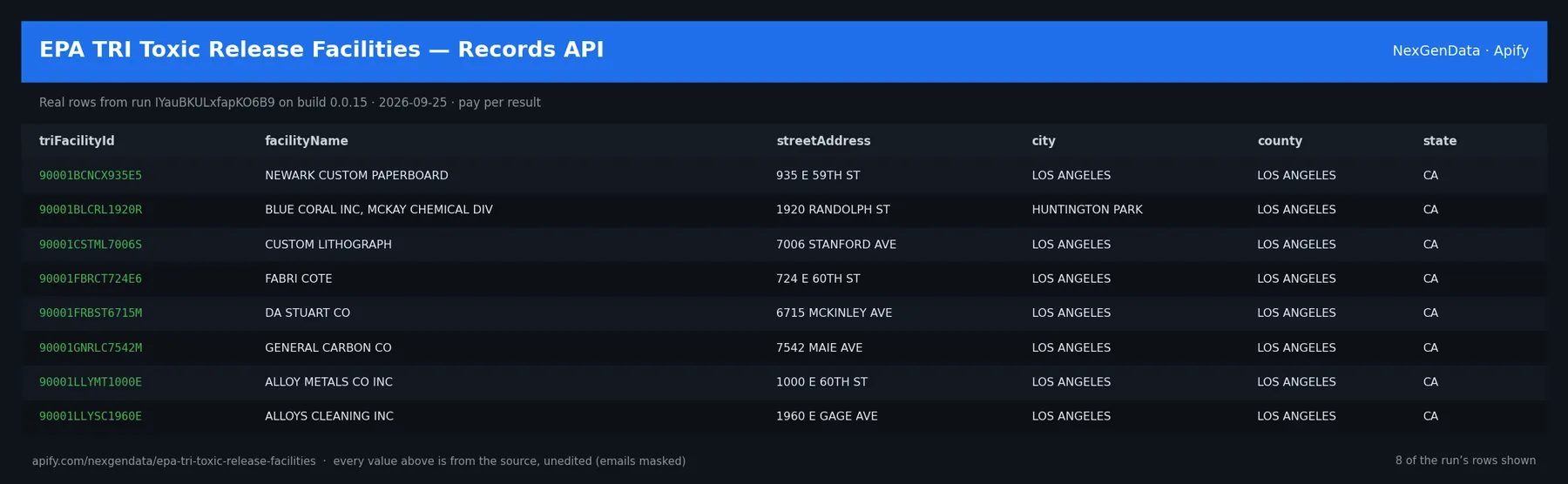
Every record represents one TRI-reporting facility and carries exactly these fields:

  • facilityName โ€” the facility name as registered in the TRI program
  • city โ€” the facility's city
  • county โ€” the facility's county
  • state โ€” the two-letter state code
  • zip โ€” the facility's ZIP code
  • epaRegion โ€” the EPA region the facility falls under (1โ€“10)

Records are flat JSON, ready for a GIS layer, Snowflake, BigQuery, Postgres, a pandas DataFrame, or an ESG / compliance database without remapping.

Use cases

  • ESG facility-footprint mapping โ€” Pull every TRI-reporting facility in the states where a portfolio company or counterparty operates, and quantify its exposure to federal toxic-release reporting at the facility level. The county + city fields let you roll exposure up to community and county granularity.
  • Environmental-justice & community research โ€” Researchers and advocacy organizations can enumerate the TRI facilities in a specific community, county, or EPA region to study the geographic concentration of toxic-release reporters relative to demographic data.
  • Site-selection & real-estate diligence โ€” Before acquiring or developing a site, pull the TRI facility roster for the target city to understand the surrounding industrial-emissions landscape and any nearby reporting facilities.
  • Compliance-team facility inventory โ€” EHS teams can reconcile their own facility list against the official TRI roster for a state, catching facilities that should be (or unexpectedly are) on the federal reporting radar.
  • EPA-region benchmarking โ€” Aggregate facility counts by epaRegion to benchmark industrial-emissions reporting density across the ten EPA regions for policy and research work.
  • Supply-chain ESG screening โ€” Screen a supplier's operating cities against the TRI roster to flag suppliers co-located with toxic-release reporters as part of supply-chain ESG due diligence.
  • Lead generation for environmental services โ€” Environmental-consulting, remediation, and compliance-software vendors can build a prospect list of TRI-reporting facilities by state and city.

Sample output

{
"facilityName": "EXAMPLE CHEMICAL PROCESSING LLC",
"city": "HOUSTON",
"county": "HARRIS",
"state": "TX",
"zip": "77015",
"epaRegion": "6"
}

A facility in a different region:

{
"facilityName": "EXAMPLE METAL FINISHING CO",
"city": "CLEVELAND",
"county": "CUYAHOGA",
"state": "OH",
"zip": "44115",
"epaRegion": "5"
}

Input parameters

ParameterTypeDescription
statestringTwo-letter state code to filter facilities (e.g. CA, TX, OH).
citystringOptional city-name filter to narrow within the state.
maxResultsintegerMaximum number of facilities to return. Bounds result size and cost.

How to use

Python (apify-client)

from apify_client import ApifyClient
client = ApifyClient("YOUR_TOKEN")
run = client.actor("nexgendata/epa-tri-toxic-release-facilities").call(run_input={
"state": "TX",
"city": "HOUSTON",
"maxResults": 500,
})
for item in client.dataset(run["defaultDatasetId"]).iterate_items():
print(item["facilityName"], item["city"], item["county"], item["epaRegion"])

cURL

curl -X POST "https://api.apify.com/v2/acts/nexgendata~epa-tri-toxic-release-facilities/run-sync-get-dataset-items?token=YOUR_TOKEN" \
-H "Content-Type: application/json" \
-d '{
"state": "TX",
"city": "HOUSTON",
"maxResults": 500
}'

Schedule it on Apify's built-in scheduler to refresh your facility roster periodically, and use webhooks to push new facilities into your ESG warehouse or GIS pipeline automatically.

Pricing

This actor runs on Apify's pay-per-event model โ€” you pay only for results:

  • $0.10 per facility record โ€” the primary event, charged once per facility pushed to the dataset
  • No subscription, no seat licence, no minimum commitment

Cost worked example

  • Every TRI facility in a single city (say 40 facilities) โ†’ 40 ร— $0.10 = $4.00
  • A full-state roster of 600 facilities โ†’ 600 ร— $0.10 = $60.00
  • A small-city scan returning 8 facilities โ†’ $0.80

You set state, optional city, and maxResults, so you control cost before the run. Browse 200+ buyer-intent actors at https://apify.com/nexgendata?fpr=2ayu9b

How this compares to Enhesa / IHS Markit

PlatformTRI coverageAnnual costProgrammatic export
Enhesa EHS IntelligenceGlobal EHS regulatory + facility dataFive-figure enterprise subscriptionPortal-based, seat-locked
IHS Markit / S&P Global EHSBroad EHS / environmental datasetsEnterprise contractAPI, enterprise-priced
EPA TRI tools (DIY)Complete official TRI dataFreeBulk files / interactive search, not a clean per-query JSON API
EPA TRI Facilities (this actor)Official TRI reporting facilities by state / city$0.10 per facility, no subscriptionApify REST API + webhooks; flat JSON, state/city filtered

Enhesa and IHS Markit bundle TRI-style data into broad EHS platforms priced for enterprise compliance departments โ€” powerful, but overkill (and over-priced) if all you need is the official TRI facility roster for a state or city, in JSON, in your own pipeline. This actor delivers exactly that official EPA data, normalized and scoped, for cents per facility, with no seat to license.

FAQ

Q: Where does the data come from?

A: The actor reads the official EPA Toxics Release Inventory facility data. The fields returned โ€” facility name, city, county, state, ZIP, EPA region โ€” come from the EPA's TRI program records.

Q: Does this include the actual chemical-release quantities?

A: This actor returns the facility roster โ€” which facilities are TRI reporters and where they are located. It does not return per-chemical release tonnage; the fields are facilityName, city, county, state, zip, and epaRegion. Use it to enumerate and locate facilities, then pull release detail from EPA's release-data products downstream if needed.

Q: Can I pull the whole country at once?

A: The actor filters by state (with an optional city). To cover the country, run it once per state and concatenate the results โ€” each run bills only for the facilities it returns.

Q: What is an EPA region?

A: The EPA divides the US into ten regions, each covering a group of states. The epaRegion field (1โ€“10) tells you which regional EPA office oversees the facility โ€” useful for benchmarking and for routing compliance inquiries.

Q: How current is the facility list?

A: The actor reads the current EPA TRI facility data at run time. The TRI program is updated by the EPA on its own reporting cycle; schedule a periodic run to keep your roster in sync.

Schema stability & versioning

This actor follows NexGenData's additive-only schema contract:

  • New fields may be added at any time โ€” they appear as new keys defaulting to null for older runs.
  • Existing fields (facilityName, city, county, state, zip, epaRegion) are never renamed or removed without a major-version bump and an advance changelog notice.
  • Field semantics are never silently changed.

Build your ESG / compliance ETL on this schema with confidence. Report anything unexpected via the actor's Apify Issues tab.

  • The actor reads public EPA Toxics Release Inventory facility data โ€” federal environmental data published for public use.
  • All requests route through Apify's compliant infrastructure with polite pacing.
  • This actor is a data tool, not legal or environmental-compliance advice. Facility presence on the TRI roster reflects federal reporting obligations, not a finding of wrongdoing; verify specifics against official EPA records before acting.
  • You are responsible for downstream-use compliance with applicable data-protection and environmental regulations.

Part of NexGenData's Environmental / ESG suite โ€” pair this actor with:

Explore the full catalog of 200+ buyer-intent actors at https://apify.com/nexgendata?fpr=2ayu9b.