💊 FDA Drug Shortages Monitor — Current & Resolved avatar

💊 FDA Drug Shortages Monitor — Current & Resolved

Deprecated

Pricing

Pay per event

Go to Apify Store
💊 FDA Drug Shortages Monitor — Current & Resolved

💊 FDA Drug Shortages Monitor — Current & Resolved

Deprecated

Monitor current & resolved FDA (CDER) drug shortages with drug, manufacturer, status, availability, category and dates. For hospital pharmacy, GPOs, 503B compounders, and pharma supply chain.

Pricing

Pay per event

Rating

0.0

(0)

Developer

NexGenData

NexGenData

Maintained by Community

Actor stats

0

Bookmarked

3

Total users

1

Monthly active users

4 days ago

Last modified

Categories

Share

Track every drug on the FDA's official shortage list — current and resolved — with manufacturer, status, availability, therapeutic category, dosage form, and update dates. Pay-per-result JSON, $0.10 per record. No IQVIA contract, no Cortellis seat, no enterprise data subscription.

Drug shortages are an operational emergency for anyone who dispenses, compounds, sources, or insures medications. When a sterile injectable goes short, hospital pharmacies scramble for substitutes, 503B compounders spin up production, GPOs renegotiate allocations, and supply-chain teams race to qualify a second source — and every hour of delay has clinical consequences. The FDA's CDER Drug Shortages database is the authoritative public record of which products are short, why, and whether they've recovered, but it lives behind a search-one-drug-at-a-time web UI that is impossible to monitor at scale. This actor turns that database into a clean, filterable, structured feed you can poll on a schedule, diff against yesterday, and pipe straight into your formulary, ERP, or alerting stack.

Why use this

The commercial drug-shortage intelligence market is dominated by a handful of expensive enterprise platforms — IQVIA, Clarivate Cortellis, and specialty supply-chain vendors — that bundle shortage data into six-figure annual contracts and lock it behind per-seat logins you cannot pipe into your own pharmacy system. The underlying source they all reference is the same public FDA CDER list this actor reads. The problem is never access to the FDA data; it is turning a one-drug-at-a-time web search into a monitored, diff-able feed.

This actor does exactly that. It pulls the full current-and-resolved shortage record set, lets you filter by generic name, manufacturer, therapeutic category, dosage form, and status, and returns each shortage as a structured row with the fields that actually drive a decision — what's short, who makes it, whether it's available, and when the record last changed. Run it daily and dedupe on genericName + companyName and you have a live shortage-monitoring system for cents per run instead of a six-figure platform.

What you get

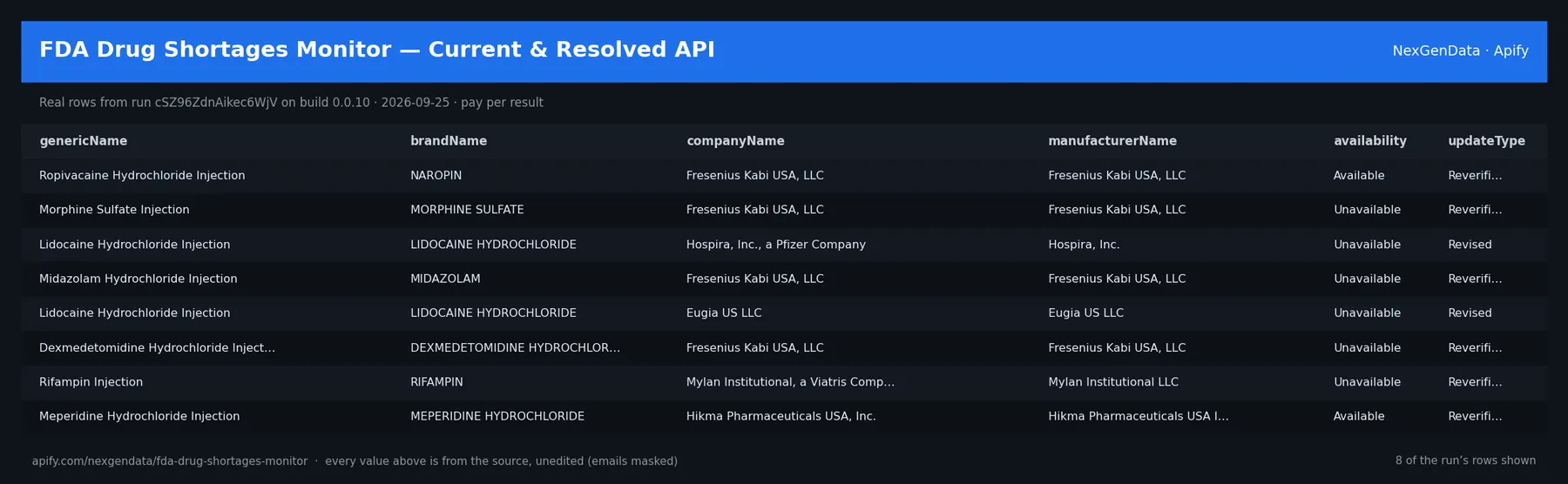
Every record is structured JSON with the fields below, populated wherever the FDA CDER source provides them:

  • genericName — the drug's generic (non-proprietary) name, e.g. "Amoxicillin"
  • companyName — the manufacturer / labeler reporting the shortage
  • status — the FDA-reported shortage status text (e.g. "Currently in Shortage", "Resolved")
  • availability — the FDA's availability note describing what supply exists and any allocation detail
  • therapeuticCategory — the drug's therapeutic class (e.g. "Oncology", "Anesthesia")
  • dosageForm — the formulation affected (e.g. "Injection", "Tablet")
  • updateDate — the date the FDA last updated this shortage record

The schema is stable across runs, so you can append straight to Snowflake, BigQuery, Postgres, or your pharmacy data warehouse without re-mapping each refresh.

Use cases

  • Hospital pharmacy formulary monitoring — Run daily with onlyCurrentShortages on, diff against yesterday's pull, and auto-alert your P&T committee the moment a formulary drug enters or exits shortage so substitution protocols and conservation measures kick in immediately.
  • 503B outsourcing-facility demand signal — Filter by dosageForm=Injection and therapeuticCategory to spot newly-short sterile injectables that represent a compounding-demand opportunity, and watch status flip to "Resolved" to know when to wind a batch down.
  • GPO and procurement allocation — Track shortages across your contracted manufacturers (companyName filter) to anticipate allocation, pre-position alternate-vendor orders, and brief member hospitals before the shortage bites.
  • Pharma supply-chain and competitive intelligence — Monitor competitors' products entering shortage to time your own launch, marketing, or capacity decisions; a competitor's anesthesia injectable going short is a market-share opening.
  • Payer and PBM coverage management — Feed current shortages into utilization-management logic so prior-auth and step-therapy rules account for which preferred agents are actually obtainable.
  • Clinical decision-support enrichment — Surface real-time shortage status inside EHR ordering so prescribers see availability at the point of care.
  • Health-policy and academic research — Pull the full current-and-resolved history (set a high maxResults, leave onlyCurrentShortages off) for longitudinal analysis of shortage frequency, duration, and therapeutic-class concentration.

Sample output

{
"genericName": "Amoxicillin Oral Suspension",
"companyName": "Aurobindo Pharma USA, Inc.",
"status": "Currently in Shortage",
"availability": "Some presentations available; others on back order. Estimated recovery dates vary by presentation.",
"therapeuticCategory": "Anti-Infective",
"dosageForm": "Oral Suspension",
"updateDate": "2026-06-18"
}

Input parameters

ParameterLabelDescription
genericNameGeneric nameFilter by drug generic name (e.g. amoxicillin).
companyNameCompanyFilter by manufacturer / company name.
therapeuticCategoryTherapeutic categoryFilter by therapeutic class (e.g. Oncology, Anesthesia).
dosageFormDosage formFilter by formulation (e.g. Injection, Tablet).
statusStatus containsFilter by status text (e.g. Current, Resolved).
onlyCurrentShortagesOnly current shortagesExclude resolved / discontinued records.
maxResultsMax resultsMaximum number of records to return.

How to use

Python (apify-client)

from apify_client import ApifyClient
client = ApifyClient("YOUR_TOKEN")
run = client.actor("nexgendata/fda-drug-shortages-monitor").call(run_input={
"onlyCurrentShortages": True,
"dosageForm": "Injection",
"maxResults": 500,
})
for item in client.dataset(run["defaultDatasetId"]).iterate_items():
print(item["genericName"], item["companyName"], item["status"], item["updateDate"])

cURL

curl -X POST "https://api.apify.com/v2/acts/nexgendata~fda-drug-shortages-monitor/run-sync-get-dataset-items?token=YOUR_TOKEN" \
-H "Content-Type: application/json" \
-d '{
"onlyCurrentShortages": true,
"dosageForm": "Injection",
"maxResults": 500
}'

Schedule it daily via Apify's built-in scheduler and dedupe on genericName + companyName into your warehouse. Diff consecutive runs to detect new shortages and resolutions, and wire a webhook to push a Slack or n8n alert whenever a watched drug changes status.

Pricing

This actor runs on Apify's pay-per-event (PPE) model — you pay only for results, not run-time:

  • $0.10 per shortage record pushed to your dataset
  • A negligible per-actor-start charge

No subscriptions, no seat licences, no per-CPU-second billing.

Worked cost example

A daily monitoring run pulling the full current-shortage list — typically around 100-150 active records:

  • 130 records × $0.10 = $13.00
  • plus one negligible actor-start charge

So roughly $13 per full daily current-shortage pull, all-in. If you only watch a focused slice — say injectable oncology drugs, returning 20 records — that run costs about $2.00. Compare that to IQVIA / Cortellis enterprise shortage modules that start in the high five to six figures per year.

Why pay-per-event beats time-based pricing

  • Predictable — cost equals record count, known before the run.
  • Failure-safe — if the FDA page changes and a run returns 0 rows, you pay 0.
  • Easy to attribute — 1 shortage record = 1 unit of cost, so per-facility or per-service-line accounting is trivial.

How this compares to IQVIA / Cortellis

CapabilityIQVIA / Clarivate CortellisFDA Drug Shortages Monitor (this actor)
Shortage data sourceFDA + proprietary enrichmentOfficial FDA CDER shortage database
CoverageGlobal, enrichment-heavyUS FDA CDER current & resolved shortages
Annual costHigh five to six figures / enterprise contractPay-per-record, no subscription
Programmatic accessEnterprise API, seat-lockedApify REST API + webhooks, no seat lock
Pipe into your pharmacy / ERP systemRestricted by contractNative JSON / JSONL / CSV export

If you need global commercial-availability forecasting, NDC-level supply analytics, and proprietary manufacturing-disruption intelligence, the enterprise platforms still offer more. But if your workflow is monitoring the authoritative FDA shortage list and pushing status changes into your formulary, compounding, or procurement process, this actor delivers the same source data at a fraction of the cost with full programmatic access.

FAQ

Q: How current is the data?

A: As current as the FDA CDER Drug Shortages database, which the FDA updates as manufacturers report changes. The updateDate field on every record tells you exactly when the FDA last touched that shortage entry.

Q: What's the difference between this and the FDA drug-recall list?

A: Shortages are supply-availability problems (a drug is hard to get); recalls are safety/quality removals of specific lots. They're separate FDA programs — pair this actor with a recall monitor for full supply-and-safety coverage.

Q: Can I get only the drugs currently in shortage?

A: Yes — set onlyCurrentShortages to true to exclude resolved and discontinued records and return only the active shortage list.

Q: Does this cover biologics and vaccines?

A: This actor reads the CDER (drugs) shortage database. Biologics regulated by CBER follow a separate FDA process and are not included here.

Q: How do I detect newly-added or newly-resolved shortages?

A: Run on a daily schedule and diff consecutive datasets on genericName + companyName; a record appearing or its status changing flags a new shortage or a resolution.

Q: What output formats are supported?

A: JSON, JSONL, CSV, and Excel via Apify's dataset export, plus webhook delivery.

Schema stability & versioning

This actor follows NexGenData's additive-only schema contract:

  • New fields may be added at any time — they appear as new JSON keys and default to null for older runs.
  • Existing fields are never renamed or removed without a major-version bump and an advance changelog notice.
  • Field semantics (date formats, the meaning of status and availability) are never silently changed — if a change is needed, we add a new field and keep the old one for at least 90 days.

You can build production formulary and supply-chain pipelines on this actor without an unannounced change breaking your ETL.

  • The actor reads the public, unauthenticated FDA CDER Drug Shortages database — the same pages any browser can open, with no login.
  • NexGenData is not affiliated with, endorsed by, or sponsored by the U.S. Food and Drug Administration. "FDA" and "CDER" are designations of the U.S. government.
  • Shortage status, availability notes, and recovery estimates are the FDA's published values; for any clinical or sourcing decision, verify against the primary FDA record referenced by each entry.
  • This data supports operational and research use; it is not medical advice and must not be the sole basis for patient-level treatment decisions.
  • You are responsible for ensuring downstream use complies with applicable healthcare data and procurement regulations.

Part of NexGenData's Pharma / Health intelligence suite — pair this actor with:

Browse the full catalog of 200+ buyer-intent actors at https://apify.com/nexgendata?fpr=2ayu9b.