🟣 FDA Purple Book — Biologics & Biosimilars Tracker avatar

🟣 FDA Purple Book — Biologics & Biosimilars Tracker

Pricing

from $20.00 / 1,000 results

Go to Apify Store
🟣 FDA Purple Book — Biologics & Biosimilars Tracker

🟣 FDA Purple Book — Biologics & Biosimilars Tracker

Search the FDA Purple Book: licensed biologics, biosimilars, and interchangeables with reference-product linkage and exclusivity-expiry dates that signal when biosimilar competition can begin. For biosimilar developers, pharma investors, and IP/regulatory teams.

Pricing

from $20.00 / 1,000 results

Rating

0.0

(0)

Developer

NexGenData

NexGenData

Maintained by Community

Actor stats

0

Bookmarked

3

Total users

0

Monthly active users

4 days ago

Last modified

Categories

Share

The licensed-biologics and biosimilar database behind every biosimilar pipeline decision — reference-product linkage, exclusivity-expiry dates, and 351(k) competitive status, delivered as pay-per-record JSON for cents instead of a five-figure IQVIA, Cortellis, or Evaluate seat.

The FDA Purple Book is the official register of every biological product licensed by the FDA under the Public Health Service Act — reference biologics (351(a)), biosimilars and interchangeables (351(k)), and the exclusivity windows that gate when biosimilar competition can legally begin. This actor pulls that register as structured records you can filter, join, and load straight into a model: proper (nonproprietary) name, proprietary (brand) name, applicant, license type, the reference product a biosimilar is licensed against, approval date, exclusivity-expiration date, and current marketing status.

For a biosimilar developer deciding which molecule to chase, an IP team mapping when a blockbuster biologic loses exclusivity, or a pharma investor sizing a biosimilar-erosion thesis, the single most valuable field in the entire dataset is the exclusivity-expiration date tied to a reference product. That one date tells you when the door opens. This actor lets you query it directly — "show me every reference biologic whose exclusivity expires before 2028" — instead of paying for an enterprise life-sciences platform to surface the same public FDA data behind a login.

Why use this

The Purple Book itself is free to browse on the FDA website, but it is built for one-product-at-a-time lookups, not pipeline analysis. You cannot ask it "list every adalimumab biosimilar and the dates each was approved," you cannot sort the universe by exclusivity-expiry, and you certainly cannot pipe it into a screening model. The commercial platforms that do let you do that — IQVIA, Clarivate Cortellis, Evaluate Pharma — wrap the same public regulatory facts in a seat licence that runs from low five figures to well over six figures a year.

This actor gives you the structured, queryable layer without the licence. You pass a filter — a molecule, a brand, an applicant, a license type, or an exclusivity-expiry date window — and you get back clean JSON records with the reference-product linkage and dates already parsed. It runs pay-per-result: you pay for the records you actually pull, nothing else. There is no seat, no annual commitment, and no minimum.

Three things make it specifically useful rather than just cheap:

  • Reference-product linkage is first-class. Pass a reference biologic (by proper or brand name) and the referenceProduct filter returns every 351(k) product licensed against it. That is the biosimilar-competition map for a molecule, on demand.
  • Exclusivity-expiry is a queryable range, not a buried cell. The exclusivityExpiringBefore / exclusivityExpiringAfter window lets you isolate near-term biosimilar opportunities — the products whose protection lapses inside your investment or development horizon.
  • The output schema is stable and additive. Load it into Snowflake, BigQuery, or your CRM once and refresh it on a schedule without re-mapping columns each time.

What you get

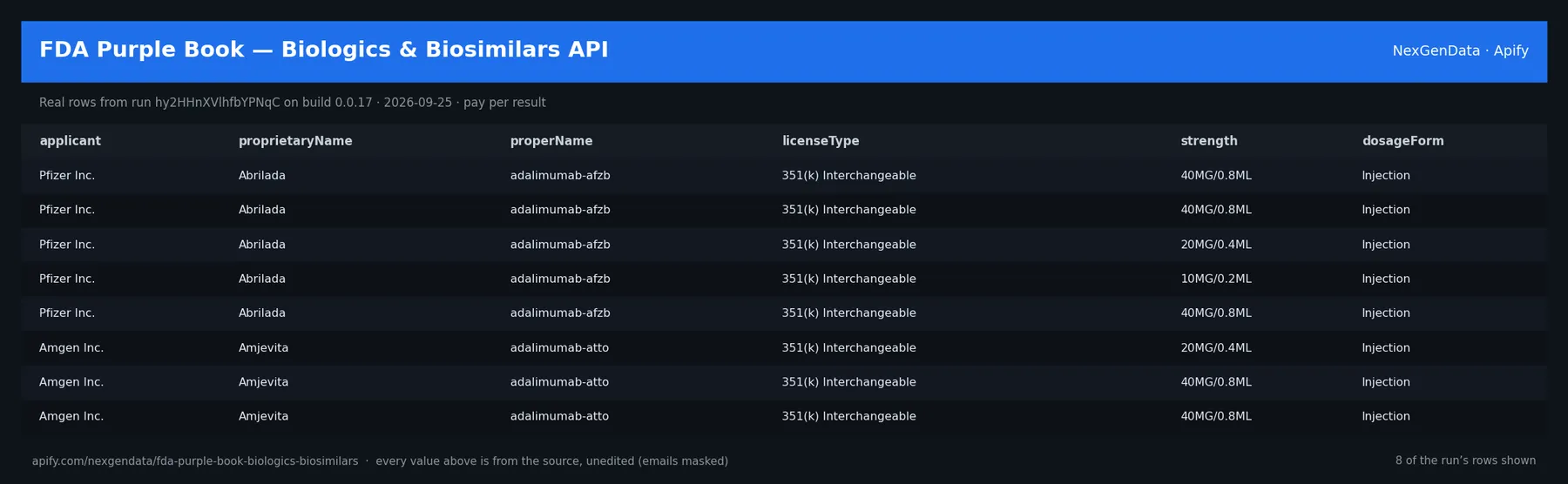
Every record this actor returns is structured JSON populated from the FDA Purple Book wherever the source provides the field:

  • proprietaryName — the proprietary (brand) name of the product (e.g. "Humira", "Hadlima")
  • properName — the proper / nonproprietary name, i.e. the active substance (e.g. "adalimumab", "adalimumab-bwwd")
  • applicant — the sponsoring company that holds the licence
  • licenseType — 351(a) reference biologic, 351(k) Biosimilar, or 351(k) Interchangeable
  • referenceProduct — for a biosimilar, the reference biologic it is licensed against
  • approvalDate — the date the product was licensed by the FDA
  • exclusivityExpirationDate — when the exclusivity period protecting the product expires (the gate for biosimilar entry)
  • marketingStatus — the product's current marketing status

Because the schema is additive-only, you can build a pipeline on these eight fields and trust that a future run will not rename or drop them out from under your ETL.

Use cases

  • Biosimilar opportunity screening. Set onlyBiosimilars off, filter licenseType to 351(a), and apply exclusivityExpiringBefore to surface every reference biologic losing protection inside your development window — the canonical "what molecule should we develop next" question.
  • Reference-product competition mapping. Pass referenceProduct=adalimumab (or a brand) to pull the complete roster of biosimilars and interchangeables already approved against a given originator, with each one's approval date and applicant — instant competitive-density read on a molecule.
  • Interchangeability tracking. Filter licenseType to 351(k) Interchangeable to isolate the products that have cleared the higher FDA bar for pharmacy-level substitution, the status that most changes a biosimilar's commercial trajectory.
  • IP / patent-cliff calendars. Use the exclusivityExpiringAfter / exclusivityExpiringBefore window to build a biologics exclusivity-cliff calendar for an IP, licensing, or litigation team.
  • Applicant / competitor portfolio audit. Pass an applicant substring to enumerate every licensed biologic and biosimilar a given company holds — useful for M&A diligence, competitor monitoring, or partnership scouting.
  • Pharma investment theses. Size a biosimilar-erosion or originator-defence thesis by pulling the reference product plus every biosimilar approved against it and the dates each entered — the raw inputs to a revenue-erosion model.
  • Regulatory affairs verification. Confirm a product's exact license type, BLA, approval date, and current marketing status before a filing, a contract, or a due-diligence sign-off.
  • Market-access and pricing research. Combine biosimilar count per reference product with marketing status to gauge competitive intensity entering payer negotiations.

Sample output

A single record returned by the actor:

{
"proprietaryName": "Hadlima",
"properName": "adalimumab-bwwd",
"applicant": "Organon LLC",
"licenseType": "351(k) Biosimilar",
"referenceProduct": "Humira (adalimumab)",
"approvalDate": "2019-07-23",
"exclusivityExpirationDate": "2023-06-30",
"marketingStatus": "Marketed"
}

A run filtered to referenceProduct=adalimumab returns one such record per biosimilar licensed against Humira, each carrying its own applicant, approval date, and marketing status — the full competitive basket for the molecule in one dataset.

Input parameters

ParameterLabelDescription
properNameProper (nonproprietary) nameActive substance / nonproprietary name, contains match (e.g. adalimumab).
proprietaryNameProprietary (brand) nameBrand name, contains match (e.g. Humira, Hadlima).
applicantApplicant / companySponsoring company, contains match.
blaNumberBLA numberExact Biologics License Application number.
referenceProductReference productFind biosimilars of this reference biologic (matches reference proper / brand name).
licenseTypeLicense type351(a) = reference biologic; 351(k) Biosimilar; 351(k) Interchangeable.
onlyBiosimilarsOnly biosimilars / interchangeablesReturn only 351(k) products (biosimilars and interchangeables).
exclusivityExpiringAfterExclusivity expiring afterKeep products whose exclusivity expires on/after this date (YYYY-MM-DD).
exclusivityExpiringBeforeExclusivity expiring beforeKeep products whose exclusivity expires on/before this date (YYYY-MM-DD). Useful for near-term biosimilar opportunities.
maxResultsMax resultsMaximum number of product records to return.

How to use

Python (apify-client)

from apify_client import ApifyClient
client = ApifyClient("YOUR_TOKEN")
run = client.actor("nexgendata/fda-purple-book-biologics-biosimilars").call(run_input={
"referenceProduct": "adalimumab",
"onlyBiosimilars": True,
"maxResults": 100,
})
for item in client.dataset(run["defaultDatasetId"]).iterate_items():
print(item["proprietaryName"], item["applicant"], item["approvalDate"], item["exclusivityExpirationDate"])

cURL

curl -X POST "https://api.apify.com/v2/acts/nexgendata~fda-purple-book-biologics-biosimilars/run-sync-get-dataset-items?token=YOUR_TOKEN" \
-H "Content-Type: application/json" \
-d '{
"licenseType": "351(a)",
"exclusivityExpiringBefore": "2028-12-31",
"maxResults": 200
}'

Schedule it monthly via Apify's built-in scheduler to keep a fresh biosimilar-exclusivity calendar, and wire a webhook to Slack, Zapier, Make, or n8n so a new biosimilar approval against a molecule you track fires an alert the moment it lands in the dataset.

Pricing

This actor runs on Apify's pay-per-event (PPE) model — $0.10 per result record, plus a negligible one-time actor-start charge per run. No subscription, no seat licence, no minimum.

Worked examples:

  • Every biosimilar against one reference product (10 records) → **$1.00**
  • A full near-term exclusivity-cliff scan of 200 reference biologics → ~$20.00
  • A one-off audit of an applicant's entire 40-product portfolio → ~$4.00

You pay only for records pushed to the dataset. If a filter matches nothing, you pay nothing for results. Apify's free monthly tier covers most exploratory runs outright. Browse the full NexGenData catalog at https://apify.com/nexgendata?fpr=2ayu9b

How this compares to IQVIA / Cortellis / Evaluate

SourcePriceWhat you get
IQVIA biosimilar intelligenceEnterprise contract (high five / six figures)Deep biosimilar analytics, forecasting, claims data — bundled, seat-locked
Clarivate Cortellis~$tens of thousands / seat / yrRegulatory + competitive intelligence across the pipeline, seat licence
Evaluate Pharma~$tens of thousands / seat / yrConsensus forecasts and biosimilar-erosion models, seat licence
FDA Purple Book (official site)FreeOne-lookup-at-a-time web UI; no bulk query, no API, no exclusivity-range filter
NexGenData Purple Book TrackerPPE $0.10 / recordQueryable, structured biologics + biosimilar register with reference-product linkage and exclusivity-expiry windows, as JSON

The honest framing: if you need consensus revenue forecasts, claims-level erosion curves, and a full regulatory-intelligence workspace, you still buy a Cortellis or Evaluate seat. But if your actual need is the structured, filterable facts — which biosimilars exist, against what reference product, approved when, with exclusivity expiring when — this actor delivers exactly that layer for a tiny fraction of the cost, and pipes it straight into your own model instead of trapping it behind someone's terminal.

FAQ

Q: Where does the data come from? A: The FDA Purple Book, the agency's official database of biological products licensed under the Public Health Service Act. The actor reads the public register and returns it as structured records.

Q: What is the difference between 351(a) and 351(k)? A: 351(a) products are reference (originator) biologics licensed on their own full data package. 351(k) products are biosimilars and interchangeables licensed against an existing reference product. Use licenseType or onlyBiosimilars to isolate either group.

Q: How do I find every biosimilar of a specific drug? A: Pass the molecule or brand to the referenceProduct filter. The actor returns every 351(k) product licensed against that reference biologic, each with its own approval date, applicant, and marketing status.

Q: Can I find biologics losing exclusivity soon? A: Yes — that is what exclusivityExpiringBefore is for. Combine it with licenseType=351(a) to list reference biologics whose protection lapses before your chosen date, the leading indicator of an opening biosimilar opportunity.

Q: Is exclusivity-expiration the same as patent expiry? A: No. This field reflects the FDA regulatory-exclusivity period recorded in the Purple Book, which is distinct from a product's patent estate. For patent-cliff analysis, pair this actor with patent data; treat exclusivity-expiry as the regulatory gate, not the full IP picture.

Q: How current is it? A: Each run reads the live Purple Book, so results reflect the FDA's current published register at run time. Schedule a monthly refresh to keep a rolling exclusivity calendar.

Schema stability & versioning

This actor follows NexGenData's additive-only schema contract. New fields may be added over time — they appear as new JSON keys, defaulting to null for older records — but existing fields are never renamed or removed without a major-version bump and an advance changelog note. Field semantics (date formats, license-type value sets) are never silently changed; if a change is unavoidable, a new field is added and the old one kept for at least 90 days. You can build production ETL on the eight documented fields and trust it to keep parsing.

  • The actor reads the public, unauthenticated FDA Purple Book — the same data any browser sees, published by the FDA specifically for public access.
  • No login, credentials, or paywalled source is involved; nothing is collected or stored on your behalf beyond the records you request.
  • The Purple Book is US-government regulatory data and is not subject to copyright, but you remain responsible for ensuring your downstream use complies with your jurisdiction's rules and any sector-specific obligations.
  • Treat exclusivity and license data as informational, not legal advice — verify against the primary FDA record before relying on it for a regulatory filing or litigation decision.

Part of NexGenData's pharma & regulatory intelligence lane — pair this actor with:

Explore the full catalog of 200+ buyer-intent actors at https://apify.com/nexgendata?fpr=2ayu9b