๐ŸŸ  FDA Orange Book โ€” Drug Patent & Exclusivity Tracker avatar

๐ŸŸ  FDA Orange Book โ€” Drug Patent & Exclusivity Tracker

Pricing

from $20.00 / 1,000 results

Go to Apify Store
๐ŸŸ  FDA Orange Book โ€” Drug Patent & Exclusivity Tracker

๐ŸŸ  FDA Orange Book โ€” Drug Patent & Exclusivity Tracker

Search the FDA Orange Book: every approved drug product joined with its listed patents and exclusivity, plus a computed estimated generic-entry date. Built for generic manufacturers, pharma IP attorneys, and biotech investors tracking patent cliffs.

Pricing

from $20.00 / 1,000 results

Rating

0.0

(0)

Developer

NexGenData

NexGenData

Maintained by Community

Actor stats

0

Bookmarked

7

Total users

2

Monthly active users

4 days ago

Last modified

Categories

Share

Search the official FDA Orange Book (Approved Drug Products with Therapeutic Equivalence Evaluations) joined to every listed patent and FDA marketing-exclusivity entry โ€” plus a computed estimated generic-entry date that no other public dataset hands you pre-calculated. This is the structured, queryable version of the patent-cliff intelligence that generic manufacturers, pharma IP attorneys, and biotech investors otherwise reconstruct by hand from PDFs and FDA flat files. Filter by active ingredient, brand name, applicant, application type, marketing status, and patent-expiry window, and the actor returns one clean JSON record per approved drug product with its full patent and exclusivity picture.

One actor. One token. The drug-patent-cliff dataset behind IQVIA, Cortellis, and Evaluate Pharma โ€” delivered as pay-per-record JSON for cents per drug product, with the estimated generic-entry date already computed for you.

Why use this

  • The estimated generic-entry date is pre-computed. The raw Orange Book gives you a list of patents and exclusivity expirations; it does not tell you when generics can actually launch. This actor reconciles the two (latest blocking patent vs latest exclusivity, whichever is later) into a single estimatedGenericEntryDate field โ€” the number every generics business-development and investment thesis hinges on.
  • Patents and exclusivity are joined to the product, not scattered. A single brand drug can carry a dozen patents and several overlapping exclusivities. The actor attaches the full arrays to each product so you stop manually cross-referencing Appendix tables.
  • Near-term-opportunity filtering built in. patentExpiringBefore plus onlyWithUnexpiredPatents lets you ask "which products have a patent expiring in the next 18 months but are still protected today" โ€” the canonical generic-pipeline screen โ€” in one call.
  • Official source, no anti-bot wall. Reads the FDA's public Orange Book data. No login, no enterprise contract, no per-seat licence.
  • ETL-ready. Stable, flat JSON loads straight into Snowflake, BigQuery, Postgres, or a notebook without re-mapping each refresh.

What you get

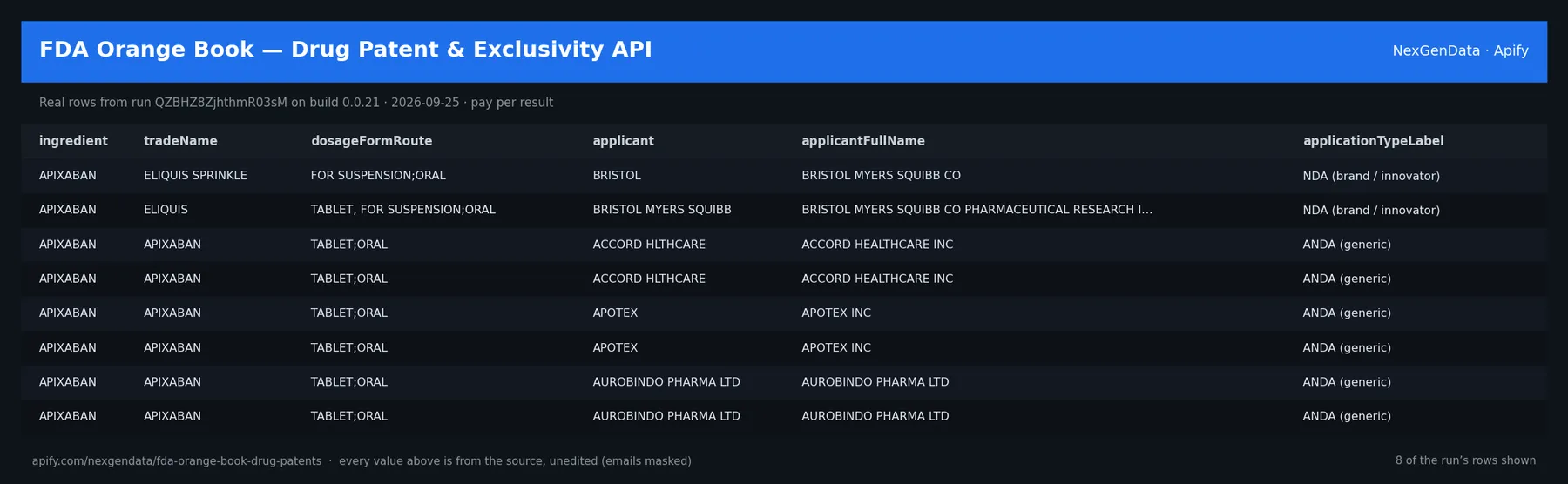
Each record represents one approved drug product (an NDA or ANDA application/product line) with its patent and exclusivity context. Core fields:

  • ingredient โ€” active ingredient(s) (e.g. APIXABAN, SEMAGLUTIDE)
  • tradeName โ€” brand / trade name (e.g. ELIQUIS, OZEMPIC)
  • applicant โ€” applicant / sponsor company holding the application
  • applicationTypeLabel โ€” NDA (brand / innovator) or ANDA (generic), human-readable
  • marketingStatusLabel โ€” Prescription (RX), Over-the-counter (OTC), or Discontinued (DISCN)
  • patentCount โ€” number of listed patents attached to the product
  • exclusivityCount โ€” number of FDA exclusivity entries attached to the product
  • estimatedGenericEntryDate โ€” the computed earliest plausible generic-entry date (latest blocking patent or exclusivity expiry, whichever is later)
  • hasUnexpiredProtection โ€” boolean: does the product still have at least one patent or exclusivity not yet expired?

When includePatents=true and includeExclusivity=true, each record additionally carries the full patents array (patent number, expiry date, drug-substance / drug-product / use-code flags, delisted flag) and the full exclusivity array (exclusivity code and expiry date) exactly as the Orange Book lists them.

Use cases

  • Generic-pipeline prioritization โ€” Set patentExpiringBefore=2027-12-31 and onlyWithUnexpiredPatents=true to surface every still-protected brand product whose last patent falls inside your development-and-filing window. This is the Para IV / ANDA target list that BD teams pay six figures a year to license.
  • Patent-cliff investing โ€” Filter to a sponsor (applicant=Pfizer) or a molecule and read estimatedGenericEntryDate across its franchise to model the revenue cliff. Biotech / pharma equity analysts use this to time short theses and loss-of-exclusivity (LOE) revenue fade.
  • Pharma IP / litigation diligence โ€” For a specific product, pull includePatents=true to see the full Orange-Book-listed patent estate (drug-substance vs method-of-use), the input layer for freedom-to-operate and Para IV certification analysis.
  • Licensing & in-licensing scouting โ€” Identify innovator products with thin patent estates (patentCount low) and near-term exclusivity expiry โ€” attractive 505(b)(2) or authorized-generic partnering candidates.
  • Formulary & payer strategy โ€” PBMs and health plans model when a high-spend brand (tradeName=Eliquis) loses protection to plan formulary and rebate negotiations around the generic-entry date.
  • Supply-chain & API sourcing โ€” Generic CDMOs and API suppliers forecast demand by reading the wave of products with estimatedGenericEntryDate clustering in a given year.
  • Competitive intelligence โ€” Track which applicant companies dominate a therapeutic area and how exposed each is to imminent loss of exclusivity.
  • Regulatory / academic research โ€” Aggregate estimatedGenericEntryDate and patentCount across the whole book for studies on patent-thicketing and generic-entry delay.

Sample output

{
"ingredient": "APIXABAN",
"tradeName": "ELIQUIS",
"applicant": "BRISTOL MYERS SQUIBB",
"applicationTypeLabel": "NDA (brand/innovator)",
"marketingStatusLabel": "Prescription (RX)",
"patentCount": 4,
"exclusivityCount": 1,
"estimatedGenericEntryDate": "2028-11-21",
"hasUnexpiredProtection": true,
"patents": [
{
"patentNumber": "6967208",
"patentExpireDate": "2026-09-17",
"drugSubstanceFlag": true,
"drugProductFlag": false,
"patentUseCode": null,
"delistFlag": false
},
{
"patentNumber": "9326945",
"patentExpireDate": "2028-11-21",
"drugSubstanceFlag": false,
"drugProductFlag": true,
"patentUseCode": "U-1234",
"delistFlag": false
}
],
"exclusivity": [
{
"exclusivityCode": "NCE",
"exclusivityExpireDate": "2017-12-28"
}
]
}

Input parameters

ParameterWhat it does
ingredientFilter by active ingredient (contains, case-insensitive). E.g. apixaban, semaglutide.
tradeNameFilter by brand / trade name (contains, case-insensitive). E.g. Eliquis, Ozempic.
applicantFilter by applicant company name (contains, case-insensitive). E.g. Pfizer, Teva.
applicationNumberExact NDA/ANDA application number, e.g. 202155.
applicationTypeN = NDA (brand/innovator), A = ANDA (generic).
marketingStatusRX = prescription, OTC = over-the-counter, DISCN = discontinued.
onlyWithUnexpiredPatentsReturn only products that still have at least one patent not yet expired.
patentExpiringAfterKeep products with a patent expiring on/after this date (YYYY-MM-DD).
patentExpiringBeforeKeep products with a patent expiring on/before this date (YYYY-MM-DD). Useful for finding near-term generic opportunities.
includePatentsInclude the full array of listed patents per product.
includeExclusivityInclude the full array of FDA exclusivity entries per product.
maxResultsMaximum number of drug-product records to return.

How to use

Python (apify-client)

from apify_client import ApifyClient
client = ApifyClient("YOUR_TOKEN")
run = client.actor("nexgendata/fda-orange-book-drug-patents").call(run_input={
"ingredient": "apixaban",
"onlyWithUnexpiredPatents": True,
"includePatents": True,
"includeExclusivity": True,
"maxResults": 100,
})
for item in client.dataset(run["defaultDatasetId"]).iterate_items():
print(item["tradeName"], item["applicant"], item["estimatedGenericEntryDate"])

cURL

curl -X POST "https://api.apify.com/v2/acts/nexgendata~fda-orange-book-drug-patents/run-sync-get-dataset-items?token=YOUR_TOKEN" \
-H "Content-Type: application/json" \
-d '{
"patentExpiringBefore": "2027-12-31",
"onlyWithUnexpiredPatents": true,
"applicationType": "N",
"maxResults": 500
}'

No-code (Zapier / Make)

Use the Apify app's "Run actor and get dataset items" action with actor ID nexgendata/fda-orange-book-drug-patents, then map tradeName, estimatedGenericEntryDate, and hasUnexpiredProtection into your sheet, CRM, or alerting workflow.

Pricing

This actor runs on Apify's pay-per-event (PPE) model โ€” $0.10 per result (one charge per drug-product record returned), plus a sub-cent actor-start event. No subscription, no seat licence, no minimum commitment.

Worked example:

  • A targeted molecule pull returning 40 products โ†’ $4.00
  • A therapeutic-area screen returning 500 products โ†’ $50.00
  • A near-term-cliff screen capped at maxResults=1000 โ†’ up to $100.00

Because billing is per result, a filter that returns 0 matching products costs effectively nothing โ€” you never pay for empty runs.

How this compares to IQVIA / Cortellis / Evaluate Pharma

The patent-cliff and exclusivity intelligence in this actor is the same data layer sold inside IQVIA, Clarivate Cortellis, and Evaluate Pharma โ€” platforms that run tens of thousands of dollars per seat per year and lock the underlying fields behind dashboards and enterprise contracts. Those suites add curated forecasts, analyst commentary, and global coverage you should still pay for if you need them. But if your workflow is a generic-pipeline screen, a patent-cliff revenue model, or a diligence pull on a specific molecule, you do not need a full Cortellis seat to get the Orange Book's patent and exclusivity facts plus a computed generic-entry date โ€” you need this actor, at a 95%+ cost saving, queryable from your own code.

FAQ

Q: Where does the data come from? A: The FDA's official Orange Book (Approved Drug Products with Therapeutic Equivalence Evaluations) โ€” the product, patent, and exclusivity files the FDA publishes publicly.

Q: How is estimatedGenericEntryDate calculated? A: It is the later of (a) the latest unexpired blocking patent expiry and (b) the latest exclusivity expiry attached to the product. It is an estimate for planning โ€” it does not account for Para IV settlements, 30-month stays, pediatric extensions granted after the data snapshot, or at-risk launches. Always verify against the primary filing for legal decisions.

Q: What's the difference between NDA and ANDA records? A: NDA products are brand/innovator applications (these carry the patents and exclusivities that block generics). ANDA products are generics themselves and generally carry no listed patents. Use applicationType=N to focus on the innovator products that define a patent cliff.

Q: Why do some products show patentCount: 0? A: Generics (ANDAs), discontinued products, and older off-patent brands often have no Orange-Book-listed patents. Combine applicationType=N with onlyWithUnexpiredPatents=true to keep only still-protected innovator products.

Q: Can I get the full patent list, not just the count? A: Yes โ€” set includePatents=true (and includeExclusivity=true) and each record carries the full arrays with patent numbers, expiry dates, and drug-substance / drug-product / use-code flags.

Q: How current is it? A: The Orange Book is updated by the FDA on a rolling basis (with monthly cumulative supplements). Schedule the actor monthly via Apify's built-in scheduler to track newly listed patents and newly granted exclusivities.

Schema stability & versioning

This actor follows NexGenData's additive-only schema contract. New fields may be added over time (they appear as new JSON keys, defaulting to null for older runs), but existing fields are never renamed or removed without a major-version bump and advance changelog notice. Field semantics โ€” units, date formats, value-sets โ€” are never silently changed. You can build production pipelines on this output without fear of a refresh breaking your ETL.

  • This actor reformats public, official FDA Orange Book data. It is not affiliated with, endorsed by, or sponsored by the FDA.
  • estimatedGenericEntryDate is a computed convenience estimate, not legal or investment advice. For any regulated decision โ€” Para IV strategy, LOE forecasting, freedom-to-operate, formulary timing โ€” verify against the primary FDA Orange Book filing and consult qualified counsel.
  • You are responsible for ensuring your downstream use complies with applicable laws and any sector-specific rules.

Part of NexGenData's Pharma & Health intelligence cluster โ€” pair this actor with:

Browse the full 200+ actor catalog at https://apify.com/nexgendata?fpr=2ayu9b.