

Hiring Signals to Notion — Hiring Intent Feed API
Pricing
from $50.00 / 1,000 company scorecards
Hiring Signals to Notion — Hiring Intent Feed API
Feed it companies, get a hiring-signal scorecard per company — who's hiring, which teams are growing, momentum. Optional ready-to-use Notion database in the same run. Spot expansion and buying intent early for sales & recruiting.
Pricing
from $50.00 / 1,000 company scorecards
Rating
0.0
(0)
Developer
NexGenData
Maintained by CommunityActor stats
0
Bookmarked
2
Total users
1
Monthly active users
2 days ago
Last modified
Categories
Share
Hiring Signals to Notion
Push company hiring signals straight into Notion — open-role counts, departments and hiring velocity as an intent feed for your team.
📊 Sample Output
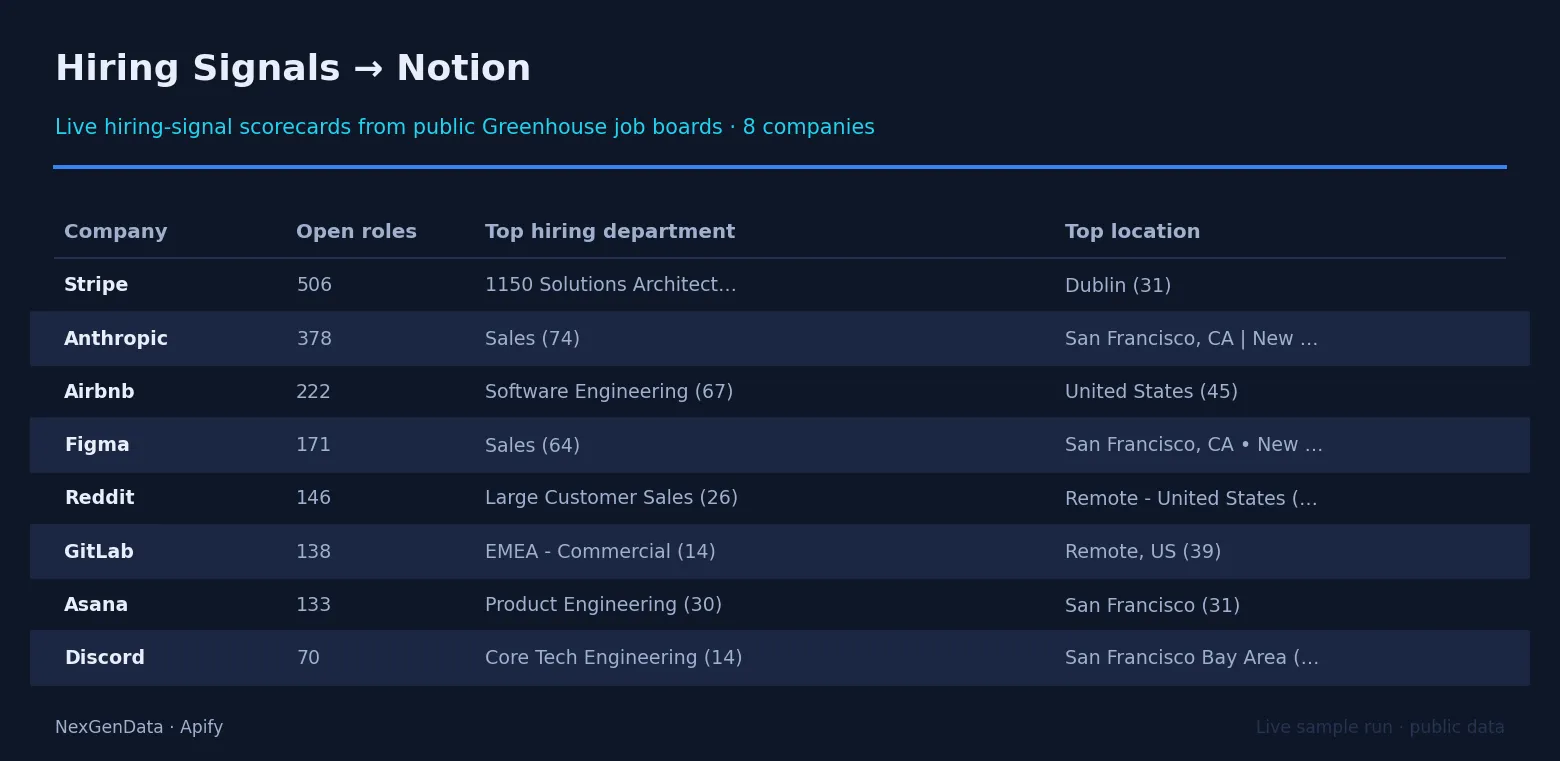
company | company_slug | open_roles_count | source | data_source | as_of_timestamp |
|---|---|---|---|---|---|
| stripe | stripe | 692 | https://boards.greenhouse.io/stripe | greenhouse.io (public job-board API) | 2026-09-25T00:03:21.821758+00:00 |
| airbnb | airbnb | 157 | https://boards.greenhouse.io/airbnb | greenhouse.io (public job-board API) | 2026-09-25T00:03:22.335222+00:00 |
| anthropic | anthropic | 622 | https://boards.greenhouse.io/anthropic | greenhouse.io (public job-board API) | 2026-09-25T00:03:23.119867+00:00 |
Real rows from run DOBPxqNVQHTukLVEC on build 0.0.13 (2026-09-25), unedited apart from masked emails/phones and shortened long text; fields the source does not publish are empty.
⚙️ Sample inputs
This is the Store example input — the same input Apify's automated check runs — so it is proven to return rows on the current build. Paste it into the input form, or send it through the API, CLI or a schedule:
🔧 Input reference
| Field | Type | Default | What it does |
|---|---|---|---|
companies (required) | array | ["stripe", "airbnb", "anthropic"] | Companies to score, by Greenhouse slug or company name. Names are normalized to slug candidates automatically. Verified-working: stripe, airbnb, anthropic, figma, discord, gitlab,… |
notionConnector | string | Connect your Notion workspace and this Actor builds your hiring-signals database there in the same run — it never sees your Notion credentials. Authorize a Notion MCP connector in… | |
notionParentId | string | Optional. The Notion page ID to create the hiring-signals database under. If blank, Notion creates it as a private page in your workspace. | |
supabaseConnector | string | Optional. Connect your own Supabase project and the results are also inserted into a table in the same run — the Actor never sees your Supabase credentials. Authorize a write-scop… | |
supabaseTable | string | "nexgendata_leads" | Target table in the public schema (created if missing, with id, a jsonb data column, and a scraped_at timestamp). Default: nexgendata_leads. |
supabaseProjectId | string | Your Supabase project reference (e.g. abcdefghijklmnop). Required unless your connector URL is already project-scoped. Find it in your project URL: supabase.com/dashboard/project/… | |
deliveryDedup | boolean | true | When on (default), records already delivered in a previous run are not delivered again to the same destination — so scheduled runs only push new items. Turn off to deliver every r… |
🧾 JSON sample record
One real record from run DOBPxqNVQHTukLVEC (emails/phones masked, long text shortened):
💰 Pricing
| Event | Price (USD) | When it is charged |
|---|---|---|
Actor Start (apify-actor-start) | $0.005 | Charged when the Actor starts running. Number of events charged depends on Actor memory (one event per GB, minimum one event). |
Company scorecard (result) | $0.05 | Charged per company hiring-signal scorecard. |
Pay-per-event: you pay only for what the run delivers. A run that delivers nothing bills no result events (only the actor-start event, when the actor defines one). Example: a run that delivers 100 results costs 100 × $0.05 = $5.00 plus the start fee.
🔗 Related Actors
More from the NexGenData Jobs & hiring signals family:
- Foundit India Jobs Scraper — Salaries & Skills, No API Key
- Greenhouse Jobs Scraper — Hiring Data API
- H-1B Visa Salary Search — Employer & Wage Data API
- Tech Hiring Signals — ATS Job Postings API
- Workday Jobs Scraper — Hiring Data API
2 more in this family on the NexGenData Store page.
⏰ Run this as a weekly hiring monitor (recommended)
Point it at a watchlist of companies and schedule a weekly sweep (0 8 * * 1). New roles become an always-on hiring-signal feed — see who's scaling which teams, week over week, before it's obvious.
📊 What you get
Clean JSON, one record per result (full output has 10 fields):
company— Companycompany_slug— Company slugopen_roles_count— Open roles countdepartments— Departmentsnotable_roles— Notable roleslocations— Locationshiring_velocity_note— Hiring velocity notesource— Sourcedata_source— Data sourceas_of_timestamp— As of timestamp
Pricing: $0.05 per company scorecard delivered (Pay-Per-Event) — about 20 scorecards per $1 — plus $0.005 per GB of memory at Actor start. You are charged only for scorecards actually delivered: companies with no public Greenhouse board are reported in the run status, not returned and not charged.
🤖 Use with AI agents
Point Claude, the OpenAI Agents SDK, an n8n flow or any MCP-aware client at it and pull hiring data on demand.
Agentic payments (x402): Supports agentic payment via x402 — agents can call this actor with USDC, no API key required.
🔗 Related jobs & hiring actors
The ATS family — every major ATS, one schema: Greenhouse · Lever · Workday · Workable & SmartRecruiters · ATS Job Aggregator · Company Job Board
Other job sources: HN Who's Hiring · We Work Remotely · H-1B Salary Search
Hiring-intelligence layer (signals): Hiring Signal Detector · Tech Hiring Signals
Deepest single source — LinkedIn Jobs Scraper: LinkedIn Jobs Scraper
APAC coverage: Singapore MyCareersFuture
Agent front door — Job Market MCP: Job Market MCP
Public job-posting and hiring-signal data.


