

Sequoia Portfolio Scraper — VC Companies, Sectors & Stage
Pricing
from $100.00 / 1,000 portfolio companies
Sequoia Portfolio Scraper — VC Companies, Sectors & Stage
Scrape every company in Sequoia Capital's public portfolio. Clean JSON — name, website, description, sector, stage, founding year, the Sequoia partner, founders, and status (active, acquired, IPO). No API key. Pay per record.
Pricing
from $100.00 / 1,000 portfolio companies
Rating
0.0
(0)
Developer
NexGenData
Maintained by CommunityActor stats
0
Bookmarked
3
Total users
0
Monthly active users
14 days ago
Last modified
Categories
Share
Sequoia Portfolio Scraper
Scrape the Sequoia Capital portfolio companies. Built for VCs, deal scouts, founders and AI agents.
📊 Sample Output
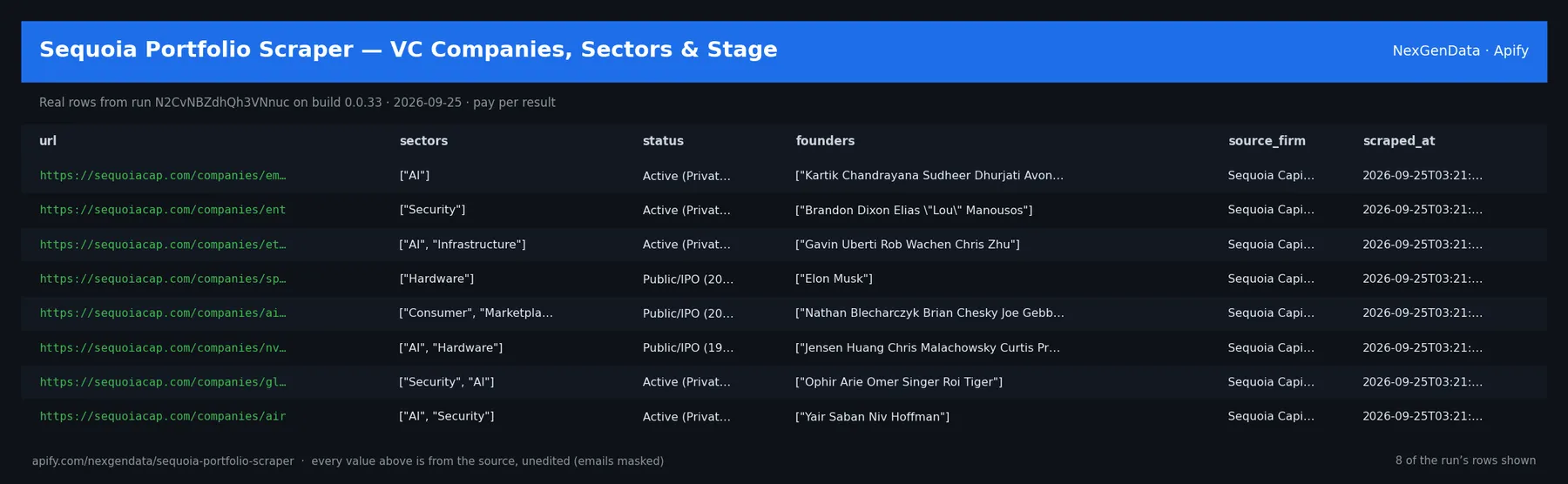
url | sectors | status | founders | source_firm | scraped_at |
|---|---|---|---|---|---|
| https://sequoiacap.com/companies/empirik | ['AI'] | Active (Private) | ['Kartik Chandrayana Sudheer Dhurjati Avon Puri'] | Sequoia Capital | 2026-09-25T03:21:11Z |
| https://sequoiacap.com/companies/ent | ['Security'] | Active (Private) | ['Brandon Dixon Elias "Lou" Manousos'] | Sequoia Capital | 2026-09-25T03:21:11Z |
| https://sequoiacap.com/companies/etched | ['AI', 'Infrastructure'] | Active (Private) | ['Gavin Uberti Rob Wachen Chris Zhu'] | Sequoia Capital | 2026-09-25T03:21:11Z |
| https://sequoiacap.com/companies/spacex | ['Hardware'] | Public/IPO (2026) | ['Elon Musk'] | Sequoia Capital | 2026-09-25T03:21:11Z |
| https://sequoiacap.com/companies/airbnb | ['Consumer', 'Marketplace'] | Public/IPO (2020) | ['Nathan Blecharczyk Brian Chesky Joe Gebbia'] | Sequoia Capital | 2026-09-25T03:21:11Z |
| https://sequoiacap.com/companies/nvidia | ['AI', 'Hardware'] | Public/IPO (1999) | ['Jensen Huang Chris Malachowsky Curtis Priem'] | Sequoia Capital | 2026-09-25T03:21:11Z |
Real rows from run N2CvNBZdhQh3VNnuc on build 0.0.33 (2026-09-25), unedited apart from masked emails/phones and shortened long text; fields the source does not publish are empty.
🔧 Input reference
| Field | Type | Default | What it does |
|---|---|---|---|
geographyFilter | string (Global, US, India, SEA) | "Global" | Which Sequoia portfolio to scrape. 'US' = Sequoia Capital (sequoiacap.com, ~406 companies). 'India' or 'SEA' = Peak XV Partners, the former Sequoia India/SEA (peakxv.com, ~304 com… |
sectorFilter | array of string | [] | Restrict to portfolio companies whose Sequoia sector pill matches any of these strings (case-insensitive substring). Common Sequoia sector tags: 'Consumer', 'Enterprise', 'Financi… |
stageFilter | array of string | [] | Restrict by current company status (case-insensitive substring match against derived status string). Useful values: 'Active' (still private), 'Acquired' (M&A exit), 'Public' or 'I… |
yearFromTo | object | {"from": null, "to": null} | Restrict to portfolio companies whose 'Partnered' year (year of first Sequoia investment) falls within this inclusive range. Sequoia's portfolio spans 1972 (Atari) through present… |
maxResults | integer | 100 | Maximum number of portfolio companies to return (1–1000). Each company is one dataset row. The full combined catalog currently holds ~710 entries (406 Sequoia US + 304 Peak XV Ind… |
🧾 JSON sample record
One real record from run N2CvNBZdhQh3VNnuc (emails/phones masked, long text shortened):
💰 Pricing
| Event | Price (USD) | When it is charged |
|---|---|---|
Actor Start (apify-actor-start) | $5e-05 | Charged when the Actor starts running. Number of events charged depends on Actor memory (one event per GB, minimum one event). |
Portfolio company (apify-default-dataset-item) | $0.1 | Charged per Sequoia portfolio company with name, sector, stage, year, partner, founder, website, status, geography. |
Pay-per-event: you pay only for what the run delivers. A run that delivers nothing bills no result events (only the actor-start event, when the actor defines one). Example: a run that delivers 100 results costs 100 × $0.1 = $10.00 plus the start fee.
🔗 Related Actors
More from the NexGenData Startup, VC & funding family:
- Pre-IPO Secondary Prices — Late-Stage Startup API
- Private Funding Intelligence — Form D Raises API
- Product Hunt Launches Scraper — New Launch Feed API
- Sovereign Wealth Fund Tracker — Holdings & Profiles
- Startup Funding Tracker — SEC Form D, TechCrunch & YC
- VC Portfolio Change Monitor — What Changed Since Last Run
10 more in this family on the NexGenData Store page.
⏰ Run this as a portfolio watch (recommended)
Every IP registry actor is a monitoring subscription, not a one-shot lookup. Schedule a weekly sweep and catch new filings as they land:
Weekly cron (0 8 * * 1) turns this into an always-on portfolio watch.
📊 What you get
Clean JSON, one record per company (full output has 23 fields):
acquired_year— Acquired yeardescription— Descriptionfounded_year— Founded yearfounders— Foundersgeography— Geographyipo_year— Ipo yearlinkedin_url— Linkedin urlname— Namepartner— Partnerpartnered_year— Partnered year
Pricing: $0.10 per company (Pay-Per-Event) — about 10 companies per $1. Cut from $0.50–0.75 for directory-class parity.
🤖 Use with AI agents
Point Claude, the OpenAI Agents SDK, an n8n flow or any MCP-aware client at it and run Sequoia portfolio company data on demand.
Sample agent prompt:
Agentic payments (x402): Supports agentic payment via x402 — agents can call this actor with USDC, no API key required.
🔗 Related funding actors
Watch this portfolio for changes: VC Portfolio Page Monitor — get alerted on new additions and exits.
Track every major fund's portfolio: a16z, Founders Fund, Greylock, Bessemer, Index Ventures, Lightspeed
Startup funding & deal-sourcing web: Startup Funding Tracker, Form D Scraper, Form D Tracker, Private Funding Intelligence, Pre-IPO Secondary Prices
Funding → outreach chain (a funding event is a lead): Company Enrichment, Email/Contact Extractor, B2B Leads Finder
Data from public funding, filing and directory sources.


