

VC Portfolio Change Monitor — What Changed Since Last Run
Pricing
from $50.00 / 1,000 portfolio change records
VC Portfolio Change Monitor — What Changed Since Last Run
Monitors VC firm portfolio pages and returns what changed since the last run — companies added, removed, or edited — for a16z, Sequoia, Founders Fund, Greylock, Bessemer, Index, Lightspeed, or any portfolio URL. Schedule it and get a clean change feed.
Pricing
from $50.00 / 1,000 portfolio change records
Rating
0.0
(0)
Developer
NexGenData
Maintained by CommunityActor stats
0
Bookmarked
2
Total users
1
Monthly active users
14 days ago
Last modified
Categories
Share
Stop re-scraping whole VC portfolios to find the handful of changes. This monitor diffs each firm's portfolio page against its previous run and returns only the delta — companies added, removed, or edited — as clean change records you can schedule, pipe into a CRM, or hand to an AI agent.
Point it at a16z, Sequoia, Founders Fund, Greylock, Bessemer, Index, Lightspeed, or any portfolio URL. portfolioUrls is required — an empty input returns 0 records and charges nothing. Built for VC associates, competitive-intelligence teams, biz-dev, and recruiters who need to know the moment a fund's book moves — not to re-read 800 companies every week.
📊 Sample Output
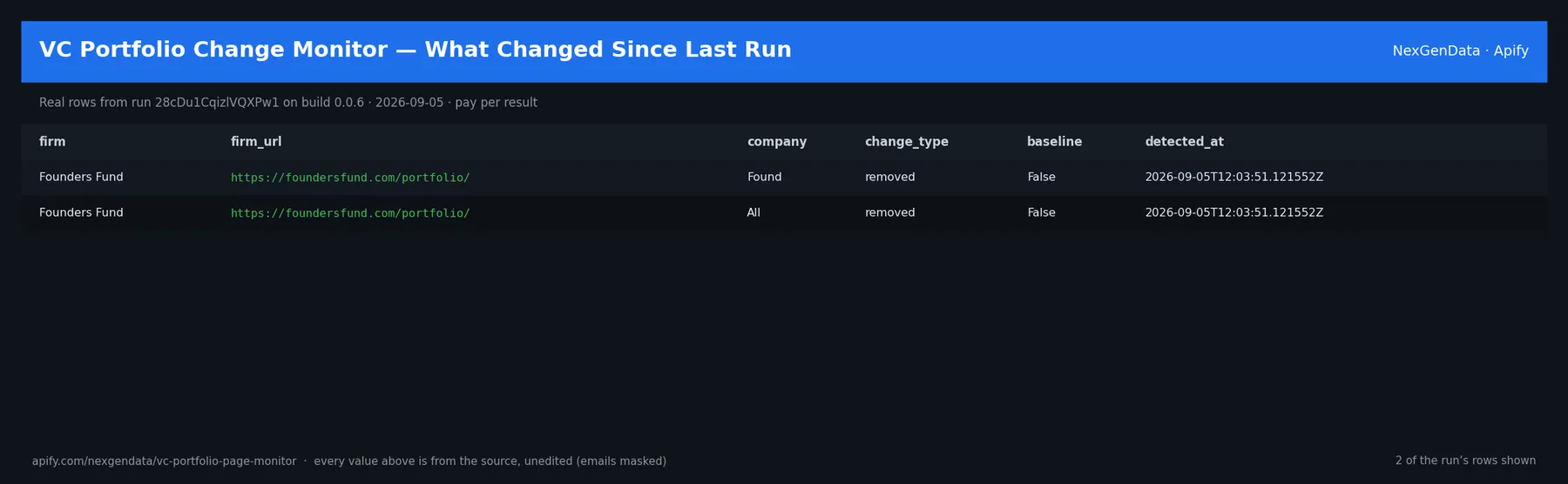
firm | firm_url | company | change_type | baseline | detected_at |
|---|---|---|---|---|---|
| Founders Fund | https://foundersfund.com/portfolio/ | Found | removed | False | 2026-09-05T12:03:51.121552Z |
| Founders Fund | https://foundersfund.com/portfolio/ | All | removed | False | 2026-09-05T12:03:51.121552Z |
Real rows from run 28cDu1CqizlVQXPw1 on build 0.0.6 (2026-09-05), unedited apart from masked emails/phones and shortened long text; fields the source does not publish are empty.
⚙️ Sample inputs
This is the Store example input — the same input Apify's automated check runs — so it is proven to return rows on the current build. Paste it into the input form, or send it through the API, CLI or a schedule:
🔧 Input reference
| Field | Type | Default | What it does |
|---|---|---|---|
portfolioUrls | array | ["https://foundersfund.com/portfolio/"] | VC firm portfolio pages to monitor. Each URL is diffed against its own snapshot from the previous run. Required — an empty input returns 0 records and charges nothing. Pages that… |
useProxy | boolean | true | Route fetches through Apify RESIDENTIAL (US) proxy for reliability against anti-bot. Recommended on. |
🧾 JSON sample record
One real record from run 28cDu1CqizlVQXPw1 (emails/phones masked, long text shortened):
💰 Pricing
| Event | Price (USD) | When it is charged |
|---|---|---|
Actor Start (apify-actor-start) | $5e-05 | Charged when the Actor starts running. Number of events charged depends on Actor memory (one event per GB, minimum one event). |
Portfolio change record (apify-default-dataset-item) | $0.05 | Per portfolio change record — one company added, removed, or modified |
Pay-per-event: you pay only for what the run delivers. A run that delivers nothing bills no result events (only the actor-start event, when the actor defines one). Example: a run that delivers 100 results costs 100 × $0.05 = $5.00 plus the start fee.
🔗 Related Actors
More from the NexGenData Startup, VC & funding family:
- Sequoia Portfolio Scraper — VC Companies, Sectors & Stage
- Sovereign Wealth Fund Tracker — Holdings & Profiles
- Startup Funding Tracker — SEC Form D, TechCrunch & YC
13 more in this family on the NexGenData Store page.
⏱ Made to run on a schedule
The core value is "what changed since last run." Each run stores a per-URL snapshot; the next run compares against it and emits only the differences. Put it on an Apify schedule (daily/weekly) and each run is a tidy change feed. The first run on each firm is a baseline capture — it stores the current portfolio and emits every company as added (this is expected and honest; deltas start from run two).
💵 Pricing — pay per change record
- Portfolio change record — $0.05 (the value event: one added/removed/modified company).
- Actor start — $0.00005 (nominal).
- $1 ≈ 20 change records. On steady-state runs a portfolio moves by a few companies, so ongoing runs are cheap; the one-time baseline run emits more (one record per current company) — budget for it on the first run of each firm.
📦 Output — field table (from a real run on Founders Fund)
| field | example | notes |
|---|---|---|
firm | Founders Fund | firm name derived from the URL |
firm_url | https://foundersfund.com/portfolio/ | the page monitored |
company | SpaceX | portfolio company name |
change_type | added | added · removed · modified |
baseline | true | true on a URL's first (baseline) run |
before | null | prior state (null for added/baseline) |
after | {"name":"SpaceX","url":null,"description":null} | new state (null for removed) |
detected_at | 2026-07-06T06:20:00Z | UTC run timestamp |
Real companies captured on the Founders Fund baseline run include SpaceX, Palantir, Anduril, and Stripe.
🤖 Use with AI agents
The change feed is agent-ready. Example prompts:
- "Run vc-portfolio-page-monitor on my 7 seeded funds and tell me which companies were added this week."
- "Diff today's run against last week and draft an outreach note for each newly-added Founders Fund company."
- "Watch these 3 competitor VC portfolios daily and alert me when any company is removed (a possible exit or failure signal to research)."
Pair it with an LLM step to summarize the delta into a Slack digest, or push added records straight into your CRM.
🔗 Related NexGenData actors
Portfolio scrapers (full snapshot of one firm): a16z · Sequoia · Founders Fund · Greylock · Bessemer · Index · Lightspeed Funding cluster: Startup Funding Tracker — new funding rounds across the market. Use the portfolio scrapers for a full company list; use this monitor to track how that list changes over time.
⚠️ Honest capability & coverage caps
- This is a records / monitoring tool. It reports observed changes to public portfolio pages. It does not provide investment signals, alpha, edge, or recommendations, and change records are not predictions.
- Coverage depends on how a firm publishes its portfolio. Firms that render their portfolio in server HTML are fully captured (verified live 2026-09-05: Founders Fund 64 companies, Index Ventures 321). Pure client-side (JavaScript-only) portfolios — currently Sequoia, Bessemer, Greylock — return only their static shell to a plain HTTP fetch, so those runs return no companies until a browser-rendered variant is enabled; the run says so in its status message and charges nothing. Pages behind anti-bot protection (currently Lightspeed) make the run FAIL rather than report a false empty. Extraction is deterministic run-to-run, so it never invents false changes; it can only miss ones on JS-only pages.
description/statusedit detection is best-effort and depends on the field being present in the page markup.


