

USPTO Patent Search — US Prior Art via Google Patents Index
Pricing
from $100.00 / 1,000 patent records
USPTO Patent Search — US Prior Art via Google Patents Index
Patent research for due diligence and competitor research: search US patents (USPTO grants and published applications) for prior art by keyword, assignee or inventor, via the Google Patents index. Not an official USPTO API. Clean JSON with claims, CPC classes and citations.
Pricing
from $100.00 / 1,000 patent records
Rating
0.0
(0)
Developer
NexGenData
Maintained by CommunityActor stats
0
Bookmarked
14
Total users
2
Monthly active users
2 days ago
Last modified
Categories
Share
Use it for patent due diligence and competitor research (prior art, freedom-to-operate, assignee portfolios) — output is patent search results with claims, CPC classes and citations.
Data source: this actor queries the Google Patents index (patents.google.com) filtered to US publications. It does not call USPTO's Patent Public Search or PatentsView APIs.
Search USPTO patents for prior-art and patent research. Built for IP counsel, brand teams, researchers and AI agents.
📊 Sample Output
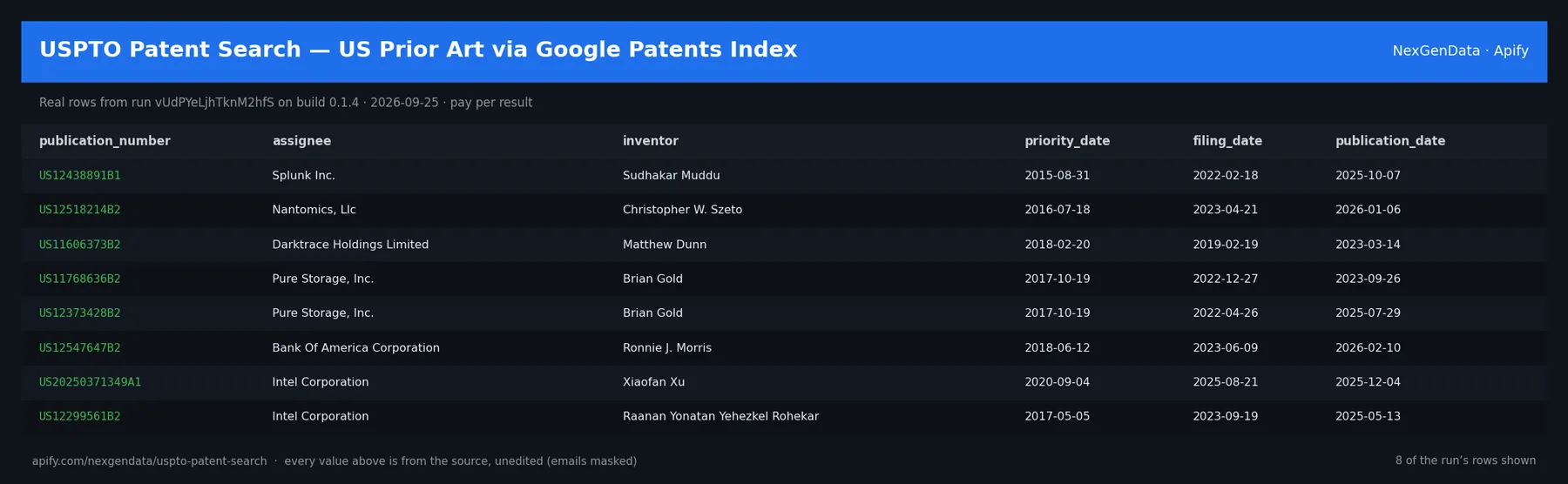
publication_number | assignee | inventor | priority_date | filing_date | grant_date |
|---|---|---|---|---|---|
| US12438891B1 | Splunk Inc. | Sudhakar Muddu | 2015-08-31 | 2022-02-18 | 2025-10-07 |
| US12518214B2 | Nantomics, Llc | Christopher W. Szeto | 2016-07-18 | 2023-04-21 | 2026-01-06 |
| US11606373B2 | Darktrace Holdings Limited | Matthew Dunn | 2018-02-20 | 2019-02-19 | 2023-03-14 |
| US11768636B2 | Pure Storage, Inc. | Brian Gold | 2017-10-19 | 2022-12-27 | 2023-09-26 |
| US12373428B2 | Pure Storage, Inc. | Brian Gold | 2017-10-19 | 2022-04-26 | 2025-07-29 |
| US12547647B2 | Bank Of America Corporation | Ronnie J. Morris | 2018-06-12 | 2023-06-09 | 2026-02-10 |
Real rows from run vUdPYeLjhTknM2hfS on build 0.1.4 (2026-09-25), unedited apart from masked emails/phones and shortened long text; fields the source does not publish are empty.
🔧 Input reference
| Field | Type | Default | What it does |
|---|---|---|---|
query | string | "machine learning" | Keywords or Google Patents query syntax (e.g. 'solid state battery', 'machine learning'). |
assignee | string | Filter by patent owner/company (e.g. Apple, Tesla). | |
inventor | string | Filter by inventor name. | |
country | string | Patent office country code. Defaults to US (USPTO). Set EP, CN, JP, etc. for other offices, or empty string for worldwide. | |
status | string | GRANT or APPLICATION. Empty = both. | |
after | string | Only patents with priority date on/after this. | |
before | string | Only patents with priority date on/before this. | |
fetchDetails | boolean | true | Fetch each patent's detail page to add full abstract, claims text, CPC classifications, backward citations (prior art), cited-by count, and patent family size. Adds time per resul… |
maxResults | integer | 50 | Maximum patents to return. |
include_raw | boolean | false | Attach the raw Google Patents search record to each item. |
🧾 JSON sample record
One real record from run vUdPYeLjhTknM2hfS (emails/phones masked, long text shortened):
💰 Pricing
| Event | Price (USD) | When it is charged |
|---|---|---|
Actor Start (apify-actor-start) | $0.00005 | Charged when the Actor starts running. Number of events charged depends on Actor memory (one event per GB, minimum one event). |
Patent record (apify-default-dataset-item) | $0.1 | Single result in the default dataset. |
Pay-per-event: you pay only for what the run delivers. A run that delivers nothing bills no result events (only the actor-start event, when the actor defines one). Example: a run that delivers 100 results costs 100 × $0.1 = $10.00 plus the start fee.
⏰ Run this as a prior-art watch (recommended)
Every IP registry actor is a monitoring subscription, not a one-shot lookup. Schedule a weekly sweep and catch new filings as they land:
Weekly cron (0 8 * * 1) turns this into an always-on prior-art watch.
📊 What you get
Clean JSON, one record per patent (full output has 22 fields):
abstract— Abstractabstract_snippet— Abstract snippetassignee— Assigneecited_by_count— Cited by countcited_patents— Cited patentscited_patents_count— Cited patents countclaims_count— Claims countclaims_text— Claims textcpc_classifications— Cpc classificationsdetected_at— Detected at
Pricing: $0.10 per patent (Pay-Per-Event) — about 10 patents per $1.
🤖 Use with AI agents
Point Claude, the OpenAI Agents SDK, an n8n flow or any MCP-aware client at it and run USPTO prior-art and patent searches on demand.
Sample agent prompt:
Agentic payments (x402): Supports agentic payment via x402 — agents can call this actor with USDC, no API key required.
Run it on a schedule
A weekly run fits this source, because new US patent grants and published applications come out in weekly batches. Each run returns the patents that best match your query, assignee or inventor at that moment, so new publications show up next to ones you have already seen. Values on older patents can also change between runs, such as cited_by_count and family_size. The actor has no new-only mode, so compare publication_number against your last run to pick out the new patents. Send each run's results onward with a webhook, Google Sheets, Zapier, Make or the Apify API.
Video guides from Apify: Schedule your Actor · Integrations
FAQ
Why use this instead of the official USPTO search or Google Patents?
This actor does not call USPTO's Patent Public Search or PatentsView. It queries the Google Patents index, filtered to US publications by default. What it adds is structure: one clean JSON record per patent with claims text, CPC classes, cited patents, cited-by count and family size, ready for a spreadsheet, a database or an AI agent. You can run it from the API or on a schedule, and you pay per patent returned.
What does a typical run cost?
You pay per result, not for run time: $0.10 for each row in the results, plus $0.00005 per run start (charged per GB of run memory, minimum one). A run that returns 20 patents costs about $2.00. Live prices are always shown in the Pricing tab.
How do I get the full claims text of a US patent as JSON?
Leave fetchDetails on (it is on by default). The actor then opens each patent's detail page and adds the full abstract, claims_text, claims_count, CPC classifications, backward citations, cited-by count and family size. This makes each result slower to fetch. Very long claims text may be shortened in the output.
Can I search patents by company or inventor?
Yes. Use assignee for the patent owner (for example Apple or Tesla) and inventor for a person's name. You can combine them with a keyword query, a status of GRANT or APPLICATION, and a priority-date window with after and before.
Does it cover patents outside the US?
It defaults to US publications. Set country to another office code such as EP, CN or JP, or to an empty string for a worldwide search. Some fields may be empty where the source does not publish them, for example pdf_url or cited_by_count.
Related actors
- USPTO Patent Grant Alerts — New Grants Since Your Last Run — get only newly granted patents on each scheduled run.
- USPTO Patent Grant Search — Bulk by Keyword, Assignee & CPC — pull granted patents in bulk by CPC class or assignee.
- Google Patents Scraper — Global Prior-Art Search API — one prior-art search across every jurisdiction.
- PCT / WO Patent Search — via Google Patents Index — add international PCT filings to a prior-art sweep.
- Patent Inventor Network — Google Patents Index — map the inventors behind the patents you find.


