

EU Protected Site Positive Impact Records — EEA BISE
Pricing
from $33.50 / 1,000 protected-site positive-impact records
EU Protected Site Positive Impact Records — EEA BISE
Keyless pay-per-record EEA BISE Natura 2000 positive-impact records — site code, coded beneficial practice and recorded intensity, as filed. Site grain, no person data. Gold $0.0335/record.
Pricing
from $33.50 / 1,000 protected-site positive-impact records
Rating
0.0
(0)
Developer
NexGen Signal
Maintained by CommunityActor stats
0
Bookmarked
2
Total users
1
Monthly active users
17 days ago
Last modified
Categories
Share
Keyless. Pay per record. The beneficial management practices recorded at Europe's Natura 2000 protected sites.
This actor turns the European Environment Agency (EEA) Biodiversity Information System for Europe (BISE) into clean, per-record data — the POSITIVE impacts and beneficial management practices recorded at Natura 2000 protected sites, with their intensity. Each run reads the EEA's keyless DiscoData SQL service and delivers one row per positive impact, structured for conservation and land-management analysis, reusable with acknowledgement of the EEA, with no personal data of any kind.
What this is, in one paragraph
Alongside the threats and pressures that harm protected sites, member states record the beneficial activities that help them — extensive grazing, mowing, restoration, and the like — each with an intensity. This actor reads the BISE positive-impact table and delivers one record per entry: the Natura 2000 SITE CODE, the coded positive impact / management PRACTICE, and its recorded INTENSITY (as a label and a number) — all carried as filed. It is the beneficial-management layer of Europe's protected-site reporting, the positive counterpart to the negative-impact cell.
Who buys this and for what job
- Conservation NGOs and site managers benchmarking which beneficial practices are recorded across the network.
- Agri-environment programme designers linking supportive land-use to protected-site outcomes.
- Biodiversity researchers analysing beneficial-management intensity by practice and site.
- Data engineers who want the BISE positive-impact table as clean rows from a keyless source.
EEA licence — reuse with acknowledgement
One licence rider travels on every record. EEA data may be reused, including commercially, provided the source is acknowledged: "Source: European Environment Agency (EEA)." Where third-party content is marked, it keeps its own terms. These are reported classifications as filed — not an assessment of this actor's making.
Site grain — no person data
The unit of every record is a positive impact at a protected site — a site code, a practice, and an intensity, never a person. BISE reporting is at site level: there is no contact, site-manager, or named-individual field in the source table, and none is selected or emitted. A person-key guard runs on every record as a backstop. The site code identifies a place in the Natura 2000 network, never a person.
A note on scale, honestly
The source table holds 27,455 rows as verified by an exact COUNT(*) at build time, which matches the planning index for this category. It spans the protected sites and beneficial practices reported across the network. The live count above is authoritative.
Sample output
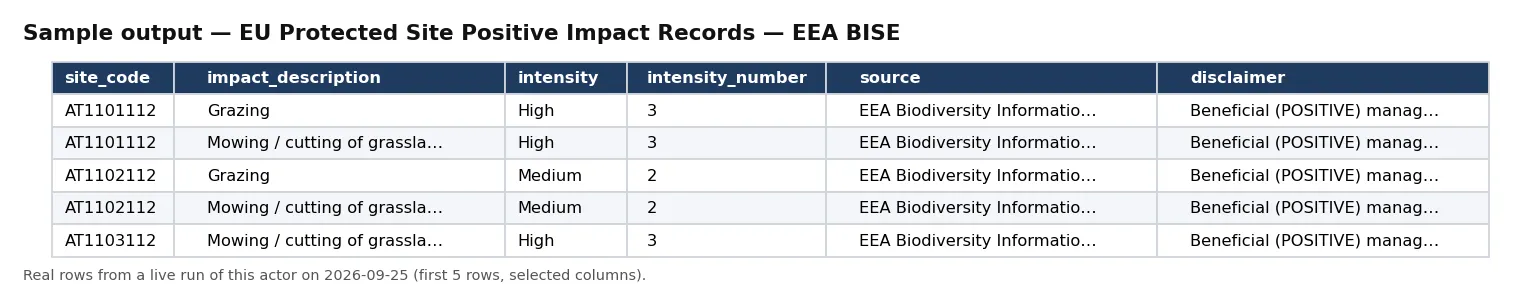
Real rows from a live run of this actor (first 5 rows, selected columns).
One full record from the same run, exactly as delivered:
Pricing
| Event | Free plan | Bronze | Silver | Gold / Platinum / Diamond |
|---|---|---|---|---|
protected_site_positive_impact_record | $0.05 | $0.045 | $0.04 | $0.0335 |
Delivered before charged. Blocked runs and empty results cost nothing.
Input
| Field | Type | Default | Description |
|---|---|---|---|
maxRecords | integer | 500 | Ceiling on records delivered and billed. |
Output
One JSON object per positive impact. Representative example (values as reported):
An unbilled RUN_RECEIPT records the robots check, the filters, rows seen and delivered, and whether charged equals delivered.
Field reference
Each record is one positive impact at a protected site. Identity: record_id and site_code. Impact: impact_description (the coded beneficial practice), intensity (the label), and intensity_number (the numeric intensity). Provenance travels on every record: source, source_url, licence, attribution, disclaimer, and observed_at.
How a run works
A run first re-reads the source host's robots posture from your runtime — the EEA DiscoData host — and stops at the door if that ever changes. It pages the BISE positive-impact table, ordered by the high-cardinality site code, and flattens each row to one record — carrying every coded label and value verbatim, never anything person-shaped — delivered before it is charged, so a blocked or empty run costs you nothing. The actor stops at your maxRecords ceiling and records charge_equals_delivered in the receipt.
Coverage and scope
The table holds 27,455 rows across protected sites and beneficial practices. Because each record carries the site_code, the impact_description, and the intensity, segmenting by site or practice is straightforward. Pull the whole table to seed a conservation warehouse, or a slice by site code.
Working with the data
The positive impacts are a stewardship layer, and the fields make them actionable. Because every record pairs a site_code with an impact_description and an intensity_number, an analyst can rank the most common beneficial practices across the network, find the sites with the most intensive positive management, and — joined to the negative-impact cell on the site code — weigh beneficial against harmful activity for any site.
Reading the intensity scale
Every positive impact carries both a text intensity label (intensity) and a numeric intensity (intensity_number), so the data works for both human reading and machine aggregation. The numeric scale lets you compute an intensity-weighted count of beneficial practices per site — a simple proxy for how actively a site is being managed for conservation — without parsing the label text. Because the label and number travel together, you can also validate one against the other, and pivot the whole table into a site-by-practice matrix where each cell is the recorded intensity. Practices that recur at high intensity across many sites point to the management interventions member states lean on most; practices that appear rarely, or only at low intensity, mark where beneficial management is thin.
The Natura 2000 context
Natura 2000 is the EU's network of protected areas established under the Birds and Habitats Directives, and the beneficial-impact reporting sits inside the six-yearly Article 17 / standard-data-form reporting that member states file for each site. The positive impacts recorded here are drawn from the same controlled activity vocabulary as the threats and pressures, which is what makes the positive and negative cells directly comparable on a shared code. Because the vocabulary is standardised across all reporting countries, a beneficial practice such as extensive grazing is coded the same way in Austria as in Portugal — so cross-country comparison needs no translation layer. This actor delivers the beneficial half of that picture as clean rows, ready to join to the species, habitat, and negative-impact cells for a full view of any site.
Cost guidance
One protected_site_positive_impact_record per delivered row: cost = rows delivered × your plan's per-record price. 1,000 rows is $50 (Free) / $33.50 (Gold).
Honest limitations
- As reported. Practices and intensities are as filed by member states; this actor reformats, it does not audit or recompute.
- Coded practices. The
impact_descriptionis a controlled-vocabulary label (e.g. "Grazing"), not free narrative. - Site grain only. This is the beneficial-impact record; site names and geometries live in the companion protected-site cells.
- Acknowledge the EEA, and note there is no person data of any kind.
Differentiation
It is the POSITIVE counterpart to eu-protected-site-negative-impact-records (the threats and pressures) — a distinct source table — and complements the protected-site species and habitat inventory cells. Its specific job is the BISE Natura 2000 beneficial-impact records.
The NexGen Signal family
Part of the NexGen Signal family of pay-per-record data products:
- EU Waterbody Quality Records — EEA
- EU Nitrate Monitoring Records — EEA
- EU Bathing Water Quality Records — EEA
- EU Industrial Emissions Records — EEA
- EU Surface Water Priority Substance Records — EEA
Source: European Environment Agency (EEA), Biodiversity Information System for Europe (BISE) / Natura 2000 (discodata.eea.europa.eu). EEA data may be reused, including commercially, provided the source is acknowledged: "Source: European Environment Agency (EEA)"; marked third-party content keeps its own terms. Site grain; no contact, site-manager, or responsible-person field is selected or emitted, no natural-person data of any kind. Reported classifications as filed, not an assessment.


