

EU Protected Site Species Inventory Records — EEA BISE
Pricing
from $33.50 / 1,000 protected-site species records
EU Protected Site Species Inventory Records — EEA BISE
Per-record inventory of which protected species occur at each EU protected site (Natura 2000 / Emerald Standard Data Form) from EEA BISE. Keyless, pay per record, site and species, no person data.
Pricing
from $33.50 / 1,000 protected-site species records
Rating
0.0
(0)
Developer
NexGen Signal
Maintained by CommunityActor stats
0
Bookmarked
2
Total users
1
Monthly active users
15 hours ago
Last modified
Categories
Share
Keyless. Pay per record. Which protected species occur at each of Europe's protected sites — site and species, from the Standard Data Form.
This actor turns the European Environment Agency (EEA) Biodiversity Information System for Europe (BISE) site-species inventory into clean, per-record data — which protected species occur at each of Europe's official protected sites. Each run reads the EEA's keyless DiscoData SQL service and delivers one row per site-species listing, structured for conservation and site-assessment analysis, reusable with acknowledgement of the EEA, with no personal data of any kind.
What this is, in one paragraph
Europe's Natura 2000 and Emerald protected sites each publish a Standard Data Form listing the species of Union interest that occur there. The EEA's Biodiversity Information System for Europe (BISE) compiles those listings into a site-species inventory. This actor reads that table and delivers one record per site / species: the protected site code, the species group (mammals, birds, amphibians, and so on), the EUNIS species id, and the scientific and common names — all carried as filed. It is the species side of the protected-site inventory, the companion to the habitat inventory.
Who buys this and for what job
- Conservation analysts mapping which protected species occur at which sites
- Site-assessment and impact-review teams checking the species listed for a protected site
- Researchers studying species distribution across Europe's protected-site network
- Data engineers who want the BISE site-species table as clean rows from a keyless source.
EEA licence — reuse with acknowledgement
One licence rider travels on every record. EEA data may be reused, including commercially, provided the source is acknowledged: "Source: European Environment Agency (EEA)." Where third-party content is marked, it keeps its own terms. These are reported values and labels as filed — not a compliance verdict.
Site / species grain — no person data
The unit of every record is a species listed at a protected site — an organism at a place, never a person. The site is a location code and the species are wildlife; there is no contact, operator, or responsible-person field in the source, and none is emitted. Species-sensitivity note: the source's site-species inventory table carries NO sensitivity or confidentiality flag on its rows (unlike the separate Article-12 bird-reporting table, which flags sensitive species with fine-grained locations); accordingly no rows are suppressed here, and the fleet respects such flags where they exist. A person-key guard runs on every record as a backstop.
Sample output
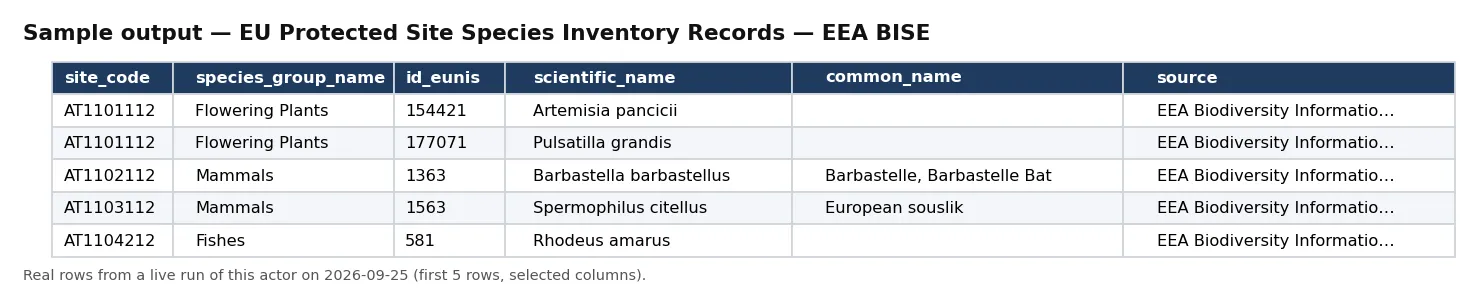
Real rows from a live run of this actor (first 5 rows, selected columns).
One full record from the same run, exactly as delivered:
Pricing
| Event | Free plan | Bronze | Silver | Gold / Platinum / Diamond |
|---|---|---|---|---|
site_species_record | $0.05 | $0.045 | $0.04 | $0.0335 |
Delivered before charged. Blocked runs and empty results cost nothing.
Input
| Field | Type | Default | Description |
|---|---|---|---|
countryCode | string | — | Optional 2-letter country code (e.g. DE, FR) — matched against the site-code prefix. |
maxRecords | integer | 500 | Ceiling on records delivered and billed. |
Output
One JSON object per site-species listing. Real example (values as reported):
An unbilled RUN_RECEIPT records the robots check, the filters, rows seen and delivered, and whether charged equals delivered.
Field reference
Each record is one site-species listing. Identity: record_id (site code : EUNIS species id) and site_code. Species: species_group_name, id_eunis, scientific_name, and common_name. Provenance travels on every record: source, source_url, licence, attribution, disclaimer, and observed_at.
How a run works
A run first re-reads the source host's robots posture from your runtime — the EEA DiscoData host — and stops at the door if that ever changes. It pages the BISE site-species table (filtered to your optional countryCode), and flattens each row to one record — carrying every value and label verbatim, never anything person-shaped — delivered before it is charged, so a blocked or empty run costs you nothing. The actor stops at your maxRecords ceiling and records charge_equals_delivered in the receipt.
Coverage and scope
The table holds on the order of 303,178 rows. Because each record carries the site_code (whose prefix is the country) and the species group and identity, segmenting is straightforward. Pull one slice, or the whole table to seed a warehouse.
Working with the data
The inventory is a presence map, and the fields make it queryable. Because every record pairs a site_code with a species scientific_name and species_group_name, an analyst can list every species reported at a site, or every site where a species occurs, and roll up presence by species group across a country's protected network. The id_eunis gives a stable species key for joining to reference taxonomies rather than matching on names.
Identifiers and joins
Every record carries the site_code, keying each species listing to the site register (eu-natura2000-site-records) for the same site and to the companion habitat-inventory cell for the same site — so a buyer can assemble the full Standard Data Form picture (the site, its habitats, and its species) on one shared identifier. The id_eunis keys species to EUNIS reference taxonomies.
Species versus the site register
The site register describes the site itself — its code, name, area, and designation. This cell describes what LIVES there: the species of Union interest listed on the site's Standard Data Form. Keeping the species inventory separate from the site register means a buyer studying biodiversity pulls the species rows directly, at species grain, without carrying the whole site record on every line — and joins back to the register on the site_code only when the site's own attributes are needed.
Cost guidance
One site_species_record per delivered row: cost = rows delivered × your plan's per-record price. Scope with countryCode to keep runs bounded. 1,000 rows is $50 (Free) / $33.50 (Gold).
Honest limitations
- As reported. Values, labels, and flags are as filed; this actor reformats, it does not audit or recompute.
- A label, not a verdict. These are reported values and classifications, not an independent compliance or conservation assessment.
- Acknowledge the EEA. The acknowledgement travels on every record.
- No person data of any kind.
Differentiation
It is distinct from eu-natura2000-site-records (the site REGISTER — one row per site, its code, name, and area) and from the companion eu-protected-site-habitat-inventory-records (which lists HABITATS per site) — this cell lists the SPECIES per site; species inventory vs site register vs habitat inventory. Its specific job is the BISE protected-site species inventory.
The NexGen Signal family
Part of the NexGen Signal family of pay-per-record data products:
- EU Protected Site Habitat Inventory Records — EEA BISE
- EU Protected Site Species Inventory Records — EEA BISE
- EU Natura 2000 Site Records — EEA
- EU Water Abstraction Records — EEA WISE
- EU Reservoir Storage Records — EEA WISE
Source: European Environment Agency (EEA), Biodiversity Information System for Europe (BISE) (discodata.eea.europa.eu). EEA data may be reused, including commercially, provided the source is acknowledged: "Source: European Environment Agency (EEA)"; marked third-party content keeps its own terms. Site / species grain; the site is a location code and species are wildlife; no sensitivity flag exists on this table so no rows are suppressed; no contact/operator/responsible-person field selected or emitted. No natural-person data of any kind. Values and labels as filed, not a compliance verdict.


