

France BOAMP Procurement Notices - eForms
Pricing
from $33.50 / 1,000 boamp notice records
France BOAMP Procurement Notices - eForms
France BOAMP procurement notices (DILA eForms XML) as clean per-notice records - publication number, date, buyer, project title, procedure, contract nature and CPV, by month. Contacts/free-text dropped. Licence Ouverte 2.0. $0.05 per record.
Pricing
from $33.50 / 1,000 boamp notice records
Rating
0.0
(0)
Developer
NexGen Signal
Maintained by CommunityActor stats
0
Bookmarked
2
Total users
1
Monthly active users
11 days ago
Last modified
Categories
Share
France's official public-procurement notices - BOAMP eForms - as clean, per-notice records, for the month you choose. Publication number, notice id, date, subtype, procedure, contract nature, CPV code, project title and buyer organisation. Contact persons, emails, phones and free-text are dropped.
What one record represents
The source is BOAMP (Bulletin officiel des annonces de marches publics), published by DILA as daily eForms
XML on echanges.dila.gouv.fr. Each record is one notice: its BOAMP publication number, eForms notice id,
issue date, notice type and subtype, procurement procedure, contract nature (works/supplies/services), the main
CPV classification code, the project title and the buyer organisation.
Sample output
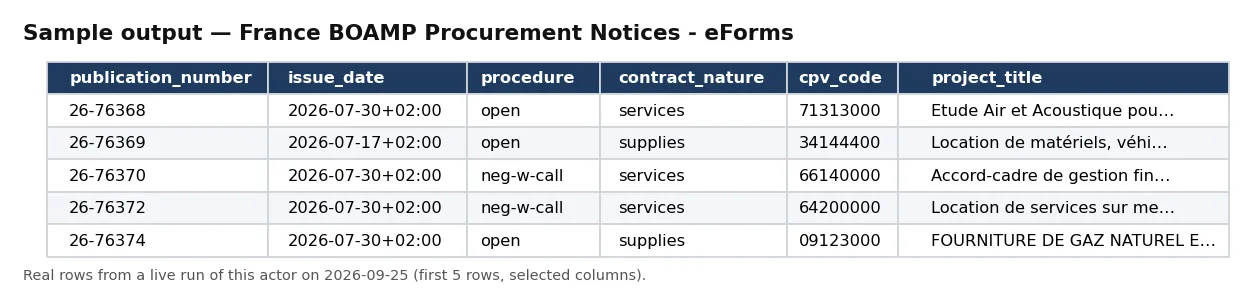
Real rows from a live run of this actor (first 5 rows, selected columns).
One full record from the same run, exactly as delivered:
Coverage and volume
For month 2026/08 the archive holds 7,596 notices across its daily directories - measured live at build time.
Sol's Wave-4 index put this door at 7,596 EXACT for Aug-2026; measured live at build time the month holds 7,596 notices - matching the index.
Each month is one partition: set the Month input (YYYY/MM) to pull that month. The Actor lists the month's
daily directories, reads each notice's eForms XML, and delivers a record per notice, stopping as soon as your
Maximum records cap is met.
Licence and attribution
BOAMP is published under the Licence Ouverte 2.0 (Etalab / data.gouv.fr). The full notice travels on every record:
BOAMP (DILA), France. Published under the Licence Ouverte 2.0 (Etalab / data.gouv.fr fr-lo): free to reproduce, redistribute and adapt, including for commercial use, provided the source and date are acknowledged.
Person-data policy
eForms notices carry contact blocks with a contact person, email and phone, and a free-text description. This
Actor extracts only the structured notice fields listed above; the contact blocks (cac:Contact,
cbc:Telephone, cbc:ElectronicMail) and the free-text cbc:Description are never extracted. A per-record
assertion rejects any contact/description/person field, and a value-level guard rejects any field that contains
an email address (verified with a planted-field test). The buyer is delivered as an organisation name. No
natural-person data is processed.
Interpretation caveat
One record per BOAMP procurement notice (eForms XML) for the selected month: publication number, notice id, issue date, notice subtype, procedure, contract nature, main CPV code, project title and buyer organisation. Contact person/email/phone blocks and the free-text description are never extracted or delivered.
Values are reproduced verbatim from the eForms XML; the Actor never rewrites a field. The CPV code is the main classification; the procedure and contract-nature codes are the eForms code values.
Provenance and compliance
Every run reads the door host's robots.txt at runtime; the gate result (URL, status, byte length and, where a
policy is served, its SHA-256) is written to the run's RUN_RECEIPT. Where the host serves no robots.txt, the
gate records that fact (flagged) and proceeds on the licence, which expressly grants re-use. The endpoint is
keyless. The Actor never bypasses a block or fetches through a mirror.
Data quality and freshness
Boolean columns are delivered as real booleans and numeric columns as real numbers. Delivery is keyed on a
stable id, so the dataset is safe to diff, deduplicate or upsert. Every run re-reads the live door, so the data
is as fresh as the source publishes, and each record's observed_at stamp dates the snapshot. The run's
RUN_RECEIPT records the source URL and how many records were delivered and charged, and confirms
charge_equals_delivered.
Billing and delivery
Pricing is per record: you are billed only for records the Actor actually delivers, with the charge raised after each record is pushed (push-then-charge), so a failed or empty run costs nothing. The Maximum records cap bounds every run, so you control spend precisely - sample cheaply, then raise it. Because delivery is keyed on a stable id, re-running and upserting keeps a downstream table current without re-paying for rows you already hold; only new and changed records add cost, and every receipt reconciles delivered against charged.
Schema, typing and joins
Every record is a flat object with a fixed, typed schema: strings stay strings, numbers are parsed to real
numbers, and booleans to real booleans, so the data loads into a warehouse or a dataframe without a cleaning
pass. The record_id is a stable composite key, which means the dataset is safe to diff between runs, to
deduplicate, and to upsert into a table you maintain over time. Because the identifiers the source uses are
preserved verbatim, the dataset joins cleanly onto other sources keyed on the same identifier, and a scheduled
run keeps the downstream copy current with no manual reconciliation - the new and changed rows simply upsert
over the old ones, and the observed_at stamp on every record tells you when each was last seen live.
Inputs
Default changed on 30 Sep 2026: if you leave maxRecords out, a run now returns up to 10 records (it was 500). Set maxRecords yourself to get more — the maximum is unchanged.
- Month (
month, required) - the month to pull, asYYYY/MM. Prefilled with2026/08. - Maximum records (
maxRecords) - hard cap on notices delivered and billed within the month.
Output
Records land in the Actor's default dataset and export as JSON, CSV, Excel or via the Apify API. A tabular overview surfaces publication number, issue date, buyer, project title, procedure, contract nature and CPV.
Fields in detail
The record leads with publication_number, notice_id, issue_date, notice_type, notice_subtype,
procedure, contract_nature, cpv_code, project_title, buyer_name and version. The provenance block
closes every record.
Typical uses
French bid teams use this cell to track BOAMP notices daily - who is buying what, under which procedure and CPV
- as a flat, queryable table without parsing eForms UBL themselves. Because the CPV, procedure and buyer are first-class fields, a filter gives every services tender in a CPV family this month without cleaning. To build a history, run once per month and concatenate. A scheduled monthly run keeps a downstream tender feed current.
Parsing eForms without the pain
eForms is the EU's standard procurement-notice format, published as deeply nested UBL XML - powerful but awkward to work with. This cell does the parsing for you, pulling the notice-level fields most teams query - publication number, dates, procedure, contract nature, CPV and buyer - into a flat record, and deliberately leaving the contact blocks and free-text untouched. You get a clean row per notice without writing a single XPath, and without any of the personal contact data the raw XML carries.
Why the monthly partition
BOAMP publishes notices as daily XML directories, and the month is the natural pull unit: one month gives the complete set (about 7,596 for 2026/08) across its daily folders. Making the month a required input keeps each run bounded and reproducible; the archive spans years, so to build a longer history you run once per month and concatenate. The publication number and notice id key each record, so the dataset is safe to diff and upsert run to run.
Reading the fields
contract_nature separates works, supplies and services; procedure names the procurement procedure;
cpv_code is the main Common Procurement Vocabulary classification, the standard way to filter procurement by
subject; and buyer_name is the contracting authority. A filter on CPV family and contract nature gives, for
example, every services tender in a sector this month, and because the buyer is a clean organisation name,
aggregation by authority needs no cleaning. The project title is the notice's own subject line, reproduced
verbatim.
Sibling Actors
It shares its XML-directory engineering with the fleet's other records Actors.


