

US Exports by Destination & Mode — CFS Export Freight
Pricing
from $33.50 / 1,000 export lane records
US Exports by Destination & Mode — CFS Export Freight
US export shipments by commodity, export mode (water, air, truck...) and destination region (Canada, Mexico, Asia and Oceania...) for 2012-2022, from the Commodity Flow Survey. Mostly national totals; few state rows. Public-domain, pay per record.
Pricing
from $33.50 / 1,000 export lane records
Rating
0.0
(0)
Developer
NexGen Signal
Maintained by CommunityActor stats
0
Bookmarked
3
Total users
2
Monthly active users
12 days ago
Last modified
Categories
Share
US Export Freight by Exit Mode — Lane Records
Turn the U.S. Commodity Flow Survey Export file into clean, per-record outbound-lane benchmarks - one row per origin zone x commodity x export exit mode x destination x year, with shipped tons and value, ready to compare outbound export lanes.
Each source row becomes one clean, flat record with numeric fields coerced to real numbers, a stable
source-native record_id, and provenance stamped on every row: source, resource id, the licence notice,
the required attribution, a UTC retrieval timestamp and an interpretation caveat.
What one record represents
The source is qq62-cjjy — CFS Export File 2012-2022 on the U.S. DOT open-data portal (data.transportation.gov). Each record is one export lane: a domestic origin zone, a commodity, the export exit mode (how goods leave the country), the domestic mode, the export destination and the year, with shipped tons and value.
For each record you get a composite record_id built from the source-native key, the analytic columns
listed below (reproduced verbatim, numbers as numbers), and the provenance block. Columns include origin (geotype, st, geo_id, geo_ttl), naics/comm with titles, xmode/xmode_ttl (exit mode), dmode/dmode_ttl (domestic mode), xdestgeo/xdestgeo_ttl (export destination), year, ton and val.
Coverage and volume
The live Export file holds 11,182 export-lane records across the 2012-2022 Commodity Flow Survey - that is the record capacity of a full pull.
Live count: 11,182 records - matches the Wave-3 index figure exactly.
The Actor pages the source with keyless SODA $query requests ordered by the source-native key for a
stable total order, and stops as soon as your Maximum records cap is met. The Actor names every wanted column explicitly in a SoQL $query so no column hidden by a default view is lost.
Licence and attribution
This is a public-domain U.S. Government work (17 U.S.C. §105) — free to use, redistribute and build on. The full notice travels on every record:
U.S. DOT / Bureau of Transportation Statistics. Public-domain U.S. Government work (17 U.S.C. 105). Reproduced verbatim; no third-party content or logos.
The required attribution — U.S. DOT / Bureau of Transportation Statistics (Commodity Flow Survey) — travels on every record.
Interpretation caveat
Each record is a CFS survey estimate for an export lane by exit mode. This is the CFS Export file (qq62-cjjy), distinct from the hazmat, temperature-control and historical CFS files, each a separate published dataset.
Values are reproduced verbatim: the Actor never rescales, re-derives or editorialises a number.
Person-data policy
Origins, destinations, ports and commodities are geographies and goods classes — there are no name, email, phone, personal-address or personal-identifier fields. A per-record assertion enforces the person-field allow-list at write time.
Data quality and freshness
Numeric fields are coerced from the source's string encoding into real numbers (integers where whole,
floats otherwise); genuinely missing cells are delivered as null, never as zero. Text is passed
through verbatim. Every run re-reads the live source, so the data is as fresh as the portal itself, and
each record's observed_at stamp records exactly when the row was retrieved. Delivery order is fixed by
the source-native key, so a capped sample and a later full pull agree on their overlap and a repeated
run returns rows in the same order. The RUN_RECEIPT reports source rows scanned and records delivered
and charged for a per-run reconciliation.
Provenance, licensing and compliance
Every run begins with a live source-preflight: the Actor reads the exact host's robots.txt at runtime
and refuses to proceed if the crawl policy disallows the data path. The gate result — URL, HTTP status,
byte length and a SHA-256 of the policy — is written to the run's RUN_RECEIPT, so each run carries its
own audit trail. The Actor identifies itself with a transparent, non-impersonating User-Agent and never
bypasses a block, solves a challenge, or fetches through a cache or mirror. When the door is genuinely
unavailable the run fails loudly and bills nothing.
Inputs
Default changed on 30 Sep 2026: if you leave maxRecords out, a run now returns up to 10 records (it was 500). Set maxRecords yourself to get more — the maximum is unchanged.
Search options (all optional; they filter on the source's own query, so you are billed only for matching records). Several values in one field match any of them; different fields must all match. With no search option set, the actor returns exactly the same records in the same order as before.
- Origin (contains) (
origins) — State or metro, e.g.Texas. Most rows in this file are national totals (United States); states appear on few rows. - Commodity (contains) (
commodities) — e.g.Electronic,Machinery. - Export mode (contains) (
exportModes) — e.g.Water,Air,Truck. - Export destination (
exitDestinations) — Exact:Canada,Mexico,Asia and Oceania,Europe and Africa,Rest of Americas,All countries other than Canada and Mexico,Total. - From year (
yearFrom) — Survey years 2012, 2017, 2022. - Newest first (
newestFirst) — return the most recent records first.
Example:
- Maximum records (
maxRecords) — hard cap on records delivered and billed. Raise it to pull the full set; lower it to sample cheaply. Records arrive in a stable, source-native order.
Output
Records land in the Actor's default dataset and export as JSON, CSV, Excel or via the Apify API. A tabular overview view surfaces the most useful columns for quick inspection while the full record retains every selected field and provenance stamp.
Fields in detail
The record leads with record_id — a stable composite key drawn from the source's own grain — followed
by the analytic columns described above and closed by a provenance block: source, source_dataset
(the Socrata resource id), licence, attribution, caveat and observed_at. Every one of those
provenance fields is present on every record, so a single row is self-describing: hand it to a colleague
or a downstream system and it carries its own origin, licence and retrieval time without reference back
to this page. Because delivery is ordered by the source-native key, the same record always carries the
same record_id across runs, which makes the dataset safe to diff, deduplicate, or upsert into a
warehouse. Nothing in the record is computed or inferred beyond the explicit count where one is stated —
every other value is the source's own, reproduced byte-for-byte.
Sibling Actors
This Actor is the export-by-exit-mode cut of the Commodity Flow Survey. Its FAF-family siblings are separate CFS datasets: us-hazardous-freight-flow-records (hazmat lanes), us-cold-chain-freight-records (temperature-controlled lanes) and us-historical-freight-flow-records (1997-2017 lanes). It also complements the owned Supply Chain MCP tool (bulk lane benchmarks vs an interactive per-call tool). This Actor also shares its engineering — the runtime robots gate, push-then-charge
billing and verbatim-value discipline — with the fleet's other public-data records Actors.
Sample output
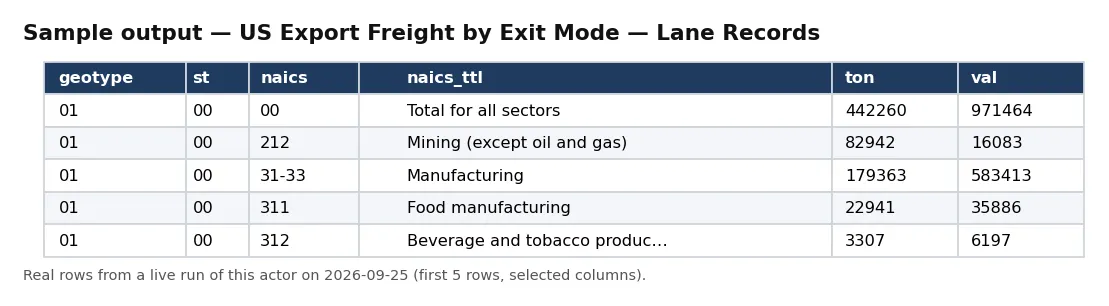
Real rows from a live run of this actor (first 5 rows, selected columns).
One full record from the same run, exactly as delivered:
Pricing
This Actor uses Apify's pay-per-event model: a flat $0.05 per record actually delivered to the dataset, and nothing else — no monthly rental, no per-run base fee, no compute charge. Deliver 40 records and you pay $2.00; deliver 10,000 and you pay $500.00. Billing is wired after delivery — each record is pushed first and only then does the per-record event fire — so a mid-run failure can only ever under-charge you, never over-charge. Use Maximum records to cap spend precisely.
Scaling and limits
Set Maximum records low to sample the leading slice cheaply, or high to pull the full set. The Actor
paginates server-side and delivers incrementally, so memory stays flat regardless of how many records
you request, and you are billed only for what is actually delivered. Because the source is a live public
API, extremely deep pagination is ultimately bounded by the source's own paging behaviour; for the vast
majority of uses — sampling, a full refresh, or a scheduled top-up — the default paging is more than
sufficient. Schedule the Actor on Apify to keep a downstream table current: each run re-reads the live
source and re-stamps observed_at, so a nightly or weekly run gives you a dated, reproducible snapshot.
Typical uses
Compare outbound export lanes by exit mode; size which commodities leave by which mode and to where; benchmark export tonnage and value by origin zone; or feed a trade-planning or logistics model with clean export-lane records.
What this Actor does not do
It does not forecast or model, does not merge multiple source tables into one record, and it contains no personal data — only geographies, commodities and freight metrics. It gives you faithful, analysis-ready records — with a provenance trail you can audit on every run.


