

Ireland House Prices — Property Price Register Sales Search
Pricing
from $33.50 / 1,000 property sale records
Ireland House Prices — Property Price Register Sales Search
Every residential sale in Ireland since 2010 from the Property Price Register: search by county, area or street, dates, price range and new or second-hand, newest first. Date, address, price, Eircode where given. No buyer or seller names. PSRA re-use, pay per record.
Pricing
from $33.50 / 1,000 property sale records
Rating
0.0
(0)
Developer

NexGen Signal
Maintained by CommunityActor stats
0
Bookmarked
3
Total users
2
Monthly active users
15 days ago
Last modified
Categories
Share
Ireland Residential Property Price Register
Every residential property sale on Ireland's Residential Property Price Register (2010 to date) as one clean, flat record - date, address, county, Eircode, price, and the not-full-market and VAT-exclusive flags, plus the property description and size band. No buyer or seller name is in the source.
What one record represents
The source is the Property Services Regulatory Authority (PSRA) Residential Property Price Register, the official Irish register of residential sales, downloaded as the authority's own all-years ZIP. Each record is one sale: date of sale, property address, county, Eircode (where present), the price in euro, a flag for not-full-market price, a flag for VAT-exclusive, the property description (new or second-hand dwelling) and the property-size band.
Sample output
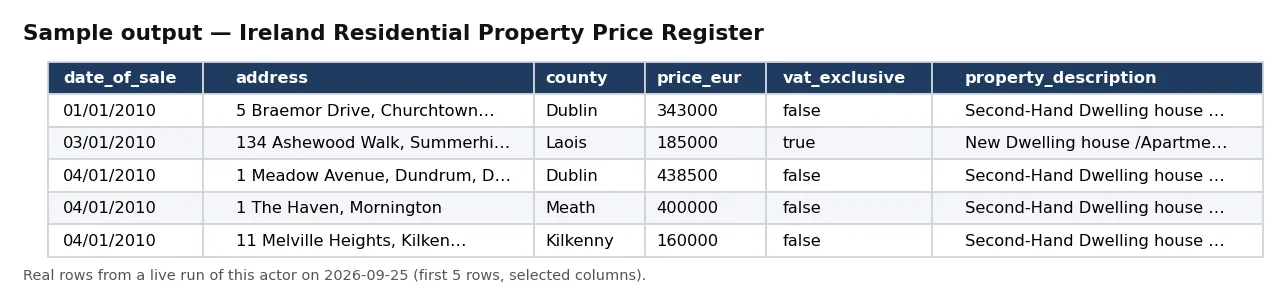
Real rows from a live run of this actor (first 5 rows, selected columns).
One full record from the same run, exactly as delivered:
Coverage and volume
The register holds 803,904 sales from 2010 to date - measured at build time from the downloaded file.
Sol's Wave-4 index put this door at 803,904 EXACT; measured live at build time the all-years file holds exactly 803,904 sales - matching the index.
The Actor downloads the ZIP, reads the single CSV inside it (correctly handling quoted, comma-containing addresses), and delivers each sale, stopping as soon as your Maximum records cap is met.
Licence and attribution
The register is re-usable under the PSRA's terms. The full notice travels on every record:
Property Services Regulatory Authority (PSRA), Ireland. The data may be freely reproduced and re-used in any format, including for commercial purposes, provided the PSRA is acknowledged as the source.
Person-data policy
The Residential Property Price Register carries no buyer or seller name - it records the property, not the parties. The address is a property address, not a person. A per-record assertion rejects any buyer/seller/person field (verified with a planted-field test). No natural-person data is processed.
Interpretation caveat
One record per residential property sale on the Irish Residential Property Price Register (2010 to date): date of sale, address, county, Eircode, price (EUR), and flags for not-full-market price and VAT-exclusive, plus the property description and size band. No buyer or seller name is in the source.
Values are reproduced verbatim from the register; the Actor never rewrites a field. price_eur is delivered as
a real number and the two flags as real booleans. The register serves no robots.txt (HTTP 404); a 404
means there are no crawl rules, and the PSRA licence expressly grants free re-use - the runtime gate records
the 404 in the receipt and proceeds on the licence.
Provenance and compliance
Every run reads the door host's robots.txt at runtime; the gate result (URL, status, byte length, SHA-256
of the policy) is written to the run's RUN_RECEIPT, and the data path is confirmed permitted before any
fetch. The endpoint is keyless. The Actor never bypasses a block or fetches through a mirror.
Data quality and freshness
Boolean columns are delivered as real booleans and numeric columns as real numbers. Delivery is keyed on a
stable composite id, so the dataset is safe to diff, deduplicate or upsert. Every run re-reads the live door,
so the data is as fresh as the source publishes, and each record's observed_at stamp dates the snapshot. The
run's RUN_RECEIPT records the source URL and how many records were delivered and charged, and confirms
charge_equals_delivered.
Billing and delivery
Pricing is per record: you are billed only for records the Actor actually delivers, at a flat rate, with the charge raised after each record is pushed (push-then-charge), so a failed or empty run costs nothing. There is no subscription and no minimum. The Maximum records cap bounds every run, so you control the spend precisely - set it low to sample the shape of the data cheaply, then raise it once you have confirmed the cell fits your use. Because delivery is incremental and keyed on a stable id, re-running against the same door and upserting on that id keeps a downstream table current without re-paying for rows you already hold; only the new and changed records add cost. Every run's receipt reconciles delivered against charged, so the billing is auditable against the data you received.
Inputs
Default changed on 30 Sep 2026: if you leave maxRecords out, a run now returns up to 10 records (it was 500). Set maxRecords yourself to get more — the maximum is unchanged.
Search options (all optional). Records are tested as the source file is read, and only matching records are delivered and billed. Several values in one field match any of them; different fields must all match. With no search option set, the actor returns exactly the same records in the same order as before. A chosen order reads the whole file and keeps the best maxRecords.
- Counties (
counties) — e.g.Dublin,Cork,Galway. - Address contains (
addressContains) — Area, town or street, e.g.Rathmines,Salthill. - Property type (contains) (
propertyTypes) —New DwellingorSecond-Hand. - Sold from (
fromDate) — e.g. 2025-01-01. - Sold to (
toDate) — e.g. 2025-12-31. - Minimum price (EUR) (
minPrice) — e.g. 300000. - Maximum price (EUR) (
maxPrice) — e.g. 600000. - Full market price only (
fullMarketPriceOnly) — Drop sales flagged as not at full market price. - Order (
sortBy) —newest(newest first). Empty = the file's own order. The register has no time of day: sales on the same date come in the reverse of the order they appear in the PPR file (the later-listed sale first). The source does not define an order within a day, so do not rely on it.
Example:
- Maximum records (
maxRecords) - hard cap on sale records delivered and billed.
Output
Records land in the Actor's default dataset and export as JSON, CSV, Excel or via the Apify API. A tabular overview surfaces date of sale, address, county, price, and the not-full-market and VAT-exclusive flags.
Fields in detail
The record leads with date_of_sale, address, county, eircode, price_eur, the booleans
not_full_market_price and vat_exclusive, property_description and property_size. The provenance block
closes every record. Because the composite key combines date, address and price, the dataset is safe to diff,
deduplicate or upsert.
Typical uses
Property-analytics and valuation teams use this cell as the authoritative Irish residential-sales series - 803,000 sales keyed and typed, ready to chart price trends by county, filter by property type, or feed a valuation model. Because the price is a real number and the county and description are clean fields, a single group-by gives median price by county and year without cleaning. A scheduled run keeps a downstream table current as the PSRA republishes.
Scaling and limits
Set Maximum records low to sample or high to pull the whole 2010-to-date register. The Actor streams the
CSV inside the ZIP and delivers incrementally, so memory stays flat and you are billed only for what is
delivered. The register is republished continuously, so a scheduled run keeps a downstream table current; each
record's observed_at stamp dates the snapshot.
How the all-years file is delivered
The PSRA publishes the register both as per-year CSVs and as a single all-years ZIP; this cell downloads the all-years ZIP and reads the one CSV inside it, so a single run captures the entire 2010-to-date history rather than one year at a time. Irish addresses contain commas, so the file is a properly quoted CSV; the Actor parses it with a real CSV reader rather than a naive split, which keeps a comma inside an address from spilling into the next column. The file is Windows-encoded (the price header carries a euro sign), and the Actor decodes it accordingly so that field names and values come through intact.
Reading the flags and the price
price_eur is the sale price in euro as a real number - the euro sign and thousands separators are stripped so
the value is ready to sum or average. not_full_market_price flags sales the register marks as not at full
market value (for example a transfer between related parties), and vat_exclusive flags prices recorded net of
VAT, typically on new dwellings; both are real booleans so you can include or exclude them from a market
analysis with a simple filter. property_description separates new from second-hand dwellings, and
property_size gives the size band where the register records one.
Building analyses
Because the county, price and property type are clean fields, common analyses need no preparation: a group-by
on county and year gives median or mean price over time, a filter on not_full_market_price isolates
arms-length sales, and the property description splits new-build from resale. The composite key (date, address,
price) makes the dataset safe to diff run-to-run, so a scheduled run surfaces exactly the new sales the PSRA
added since the last pull.
Sibling Actors
It shares its zip/CSV engineering with the fleet's other records Actors.


