
UK Tariff Commodity Records — HS Codes & Taxonomy
Pricing
from $33.50 / 1,000 commodity records
UK Tariff Commodity Records — HS Codes & Taxonomy
Keyless, pay-per-record UK tariff commodity taxonomy — one row per commodity code with description, validity dates and parent-code hierarchy. Open Government Licence v3.0; no person data.
Pricing
from $33.50 / 1,000 commodity records
Rating
0.0
(0)
Developer
NexGen Signal
Maintained by CommunityActor stats
0
Bookmarked
2
Total users
1
Monthly active users
12 days ago
Last modified
Categories
Share
Keyless. Pay per record. The full UK commodity-code taxonomy, ready to join.
This actor turns the UK Integrated Online Tariff into clean, per-commodity records — the complete classification tree of goods for UK imports and exports. Each run reads the official keyless tariff API and delivers one row per commodity code: the 10-digit code and its product-line suffix, the description, the validity dates, and the parent code that places it in the hierarchy. Commodity-taxonomy grain, structured for engineering use, under the Open Government Licence, with no personal data of any kind.
What this is, in one paragraph
Every good crossing the UK border is classified by a commodity code — a hierarchy that starts at two-digit chapters (live animals, machinery, textiles) and descends to ten-digit lines. This actor reads the official tariff's commodities table and flattens each node into a single analysis-ready record: code, suffix, description, when it became valid and when (if ever) it ended, and the parent code above it. It is the reference taxonomy that classification, customs, and trade-analytics systems build on. Values are exactly as published. You are billed only for records actually delivered.
Who buys this and for what job
- Customs, freight, and trade-compliance software that needs the current UK commodity-code tree as clean rows to power classification and validation.
- Cross-border e-commerce and ERP integrations mapping products to HS/commodity codes for duty and documentation.
- Trade-data and analytics teams joining shipment or product data to the official code descriptions and hierarchy.
- Data engineers who want the taxonomy without paging the tariff API and reshaping it by hand.
Open Government Licence — free commercial reuse
One licence rider travels on every record. UK Integrated Online Tariff data is published under the Open Government Licence v3.0 (OGL v3.0) — free to copy, publish, distribute, and adapt, including commercially, provided the required attribution is given: "Contains public sector information licensed under the Open Government Licence v3.0." This is reference taxonomy, not tariff/duty-rate advice or a customs classification ruling — verify the live tariff before any customs decision.
Commodity grain — no person data
This actor works at commodity-taxonomy grain: codes, descriptions, and the hierarchy between them. There are no natural-person fields in this data, and this actor emits none.
Sample output
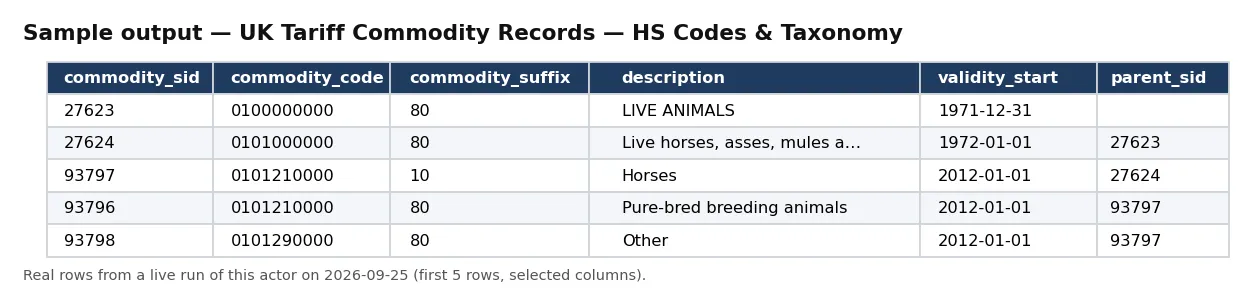
Real rows from a live run of this actor (first 5 rows, selected columns).
One full record from the same run, exactly as delivered:
Pricing
| Event | Free plan | Bronze | Silver | Gold / Platinum / Diamond |
|---|---|---|---|---|
commodity_record | $0.05 | $0.045 | $0.04 | $0.0335 |
Delivered before charged. Blocked runs and empty results cost nothing.
Input
| Field | Type | Default | Description |
|---|---|---|---|
codePrefix | string | — | Optional. Keep only commodity codes starting with these digits (e.g. 01, 8471). |
descriptionContains | string | — | Optional. Keep only commodities whose description contains this text. |
maxRecords | integer | 10 | Ceiling on records delivered and billed. |
Default changed on 30 Sep 2026: if you leave maxRecords out, a run now returns up to 10 records (it was 500). Set maxRecords yourself to get more — the maximum is unchanged.
Output
One JSON object per commodity node. Real example (values as published):
An unbilled RUN_RECEIPT records the robots check, the filters, rows seen and delivered, and whether charged equals delivered.
Field reference
Each record is one commodity node. Identity: record_id / commodity_sid, commodity_code, and commodity_suffix. Content: description. Change metadata (carried verbatim): validity_start and validity_end. Hierarchy: parent_sid, parent_code, and parent_suffix — join parent_code to commodity_code to walk up the tree. Provenance: source, source_url, licence, attribution, disclaimer, and observed_at.
How a run works
A run first re-reads the source host's robots posture from your runtime — the tariff API host serves no robots file, a no-policy posture — and stops at the door if that ever changes. It then streams the official commodities table from the tariff's latest version, applies your optional codePrefix and descriptionContains filters, and flattens each matching node to one record — carrying the validity dates verbatim as change metadata — delivered before it is charged, so a blocked or empty run costs you nothing. The actor stops at your maxRecords ceiling and records charge_equals_delivered in the receipt.
Coverage and scope
The tariff's commodities table holds on the order of 70,000+ nodes spanning the full classification tree — chapters, headings, subheadings, and ten-digit lines. Because each record carries its parent_code, the hierarchy reconstructs by a simple self-join, and the validity dates let you distinguish current lines from historical ones. Pass a codePrefix to pull a single chapter or heading (say, 8471 for automatic data-processing machines), or a descriptionContains to find every line mentioning a term.
Working with the hierarchy
The commodity tree is self-describing: every node carries the parent_code of the node above it, so the full ancestry of any ten-digit line reconstructs with a simple recursive self-join on commodity_code = parent_code. That lets you roll a specific product line up to its heading and chapter for aggregation, or expand a chapter down to all of its lines for coverage. The commodity_suffix distinguishes the declarable product line (suffix 80) from intermediate grouping nodes (suffix 10), so a classification system can pick exactly the level it needs. And because validity_start and validity_end travel on every record verbatim, two pulls taken weeks apart can be diffed to see which codes were introduced, retired, or re-parented between tariff versions — the change signal that keeps a downstream classification table current without re-ingesting the whole tree each time.
Cost guidance
One commodity_record per delivered node: cost = nodes delivered × your plan's per-record price. Scope with codePrefix to keep runs bounded — a single chapter is typically a few hundred to a few thousand lines, so a targeted pull of one product area costs a few dollars rather than the whole tree. Pull the full taxonomy once to seed a table, then take small codePrefix pulls to keep the areas you care about fresh. 1,000 nodes is $50 (Free) / $33.50 (Gold), and the whole ~70,000-node tree is well under $2,400 at Gold if you ever need the complete snapshot in one run.
Honest limitations
- Reference, not advice. This is the classification taxonomy, not duty rates, measures, or a customs classification ruling. Consult the live tariff for those.
- As published. Codes, descriptions, hierarchy, and validity dates are exactly as the tariff distributes them; this actor reformats, it does not interpret.
- Latest version. Records come from the tariff's latest published version at run time.
- No person data of any kind.
Differentiation
It is distinct from the fleet's trade and customs cells for other countries (which carry trade flows, not the UK classification tree) and from the fleet's UK company and regulatory cells. Its specific job is the UK tariff commodity taxonomy — the reference code tree, with hierarchy and validity — that classification and customs systems join against.
The NexGen Signal family
Part of the NexGen Signal family of pay-per-record data products:
- US Treasury Fiscal Records — Rates & Debt
- ECB Bank Lending & Deposit Rate Records — Euro Area MIR
- National Macro Indicator Records — World Bank
- EU Regulatory Change Records — CELLAR
- UK Contract Opportunity Records
Source: UK Integrated Online Tariff (data.api.trade.gov.uk). Contains public sector information licensed under the Open Government Licence v3.0 — free to reuse, including commercially, with attribution. Reference taxonomy only, not tariff/duty-rate advice or a customs classification ruling. No person data.


