

US Treasury Fiscal Records — Rates & Debt
Pricing
from $33.50 / 1,000 fiscal records
US Treasury Fiscal Records — Rates & Debt
Per-record US Treasury fiscal data from the official keyless Fiscal Data API. Average interest rates by security and total public debt, with record dates and units. Public domain, commercial reuse, no personal data.
Pricing
from $33.50 / 1,000 fiscal records
Rating
0.0
(0)
Developer
NexGen Signal
Maintained by CommunityActor stats
0
Bookmarked
1
Total users
0
Monthly active users
12 days ago
Last modified
Categories
Share
Official source. No API key. Pay per record.
This actor turns the U.S. Treasury's Fiscal Data into clean, per-observation records — the official numbers on what the federal government pays to borrow and how much it owes. Each run reads the keyless Fiscal Data API and delivers one row per observation: the average interest rate on each class of Treasury security, and the total public debt outstanding, with the record date, the fiscal year, the value, and the unit on every record. Fiscal / statistical grain, public-domain and open for commercial reuse, no person fields.
What this is, in one paragraph
The Bureau of the Fiscal Service publishes the government's own fiscal numbers as a keyless API. This actor reads the datasets you choose — average interest rates by security class, and the debt to the penny — paginates every record newest-first, and flattens each into a single analysis-ready row: which dataset, which date, which series, the value, and the unit. Values are delivered unmodified. You are billed only for records actually delivered.
Who buys this and for what job
- Fixed-income desks and macro analysts tracking the average interest rate the Treasury pays across bills, notes, bonds, and the total debt trajectory.
- Fintech, research, and dashboard products displaying official U.S. debt and Treasury-rate series with a clean per-record shape.
- Economists and journalists who need the authoritative federal fiscal numbers, dated and sourced.
- Data engineers who want a keyless, one-call feed of U.S. Treasury fiscal data reduced to one row per observation.
Datasets — and what is deliberately excluded
This actor serves two non-FX Fiscal Data datasets:
avg_interest_rates— the average interest rate the Treasury pays on each class of security (Treasury Bills, Notes, Bonds, TIPS, and more), monthly.debt_to_penny— the total public debt outstanding, daily, split into debt held by the public and intragovernmental holdings.
It deliberately does not serve Fiscal Data's rates_of_exchange (Treasury Reporting Rates of Exchange) — that is FX data and out of scope for this actor. That exclusion ships in every run's receipt.
Licence — open data, commercial reuse permitted
The Bureau of the Fiscal Service is explicit: "The U.S. Department of the Treasury's Bureau of the Fiscal Service is committed to providing open data. The data on this site is available to copy, adapt, redistribute, or otherwise use for non-commercial and commercial purposes." As a U.S. Government work it is public domain. Every record carries the required attribution: "Source: U.S. Department of the Treasury, Bureau of the Fiscal Service (Fiscal Data)." These are observation records for analysis — not investment or financial advice.
Fiscal / statistical grain — no person data
This actor works at fiscal / statistical grain — dated national aggregates. There are no natural-person fields in this data, and this actor emits none, with a person-key guard on every record as a backstop.
Sample output
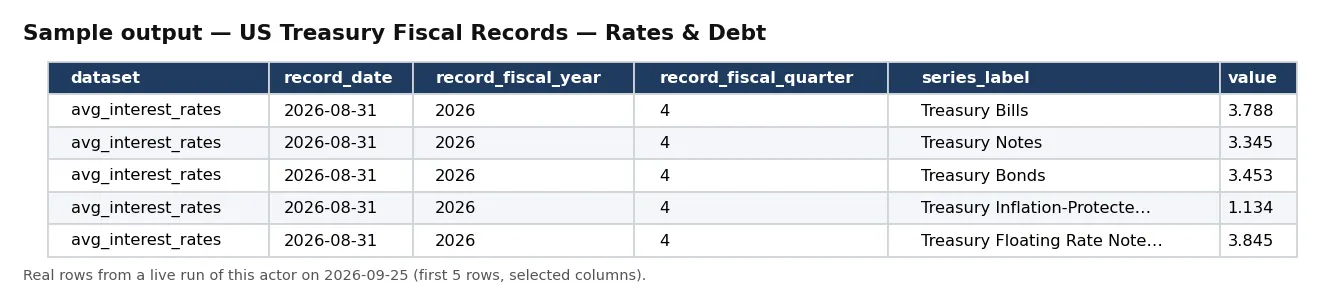
Real rows from a live run of this actor (first 5 rows, selected columns).
One full record from the same run, exactly as delivered:
Pricing
| Event | Free plan | Bronze | Silver | Gold / Platinum / Diamond |
|---|---|---|---|---|
fiscal_record | $0.05 | $0.045 | $0.04 | $0.0335 |
Delivered before charged. Blocked runs and empty results cost nothing.
Input
| Field | Type | Default | Description |
|---|---|---|---|
datasets | string list | avg_interest_rates, debt_to_penny | Which Fiscal Data datasets to pull. |
dateFrom | string (YYYY-MM-DD) | — | Optional. Keep only records with a record_date on or after this date. |
maxRecords | integer | 10 | Ceiling on records delivered and billed. |
Default changed on 30 Sep 2026: if you leave maxRecords out, a run now returns up to 10 records (it was 500). Set maxRecords yourself to get more — the maximum is unchanged.
Output
One JSON object per observation. Real examples (values verbatim):
An unbilled RUN_RECEIPT records the robots check, the datasets and filters, the excluded FX dataset, rows seen and delivered, and whether charged equals delivered.
Field reference
Each record is one observation, normalized across datasets. Identity: record_id (dataset:record_date:src_line), dataset, and the dates record_date, record_fiscal_year, record_fiscal_quarter, record_calendar_year. The series: series_label (the security class or measure) and series_type (e.g. Marketable). The data point: value, value_field (which source field the value came from, so a mixed pull stays self-describing), and unit (percent per annum or USD). Provenance: source, source_url, licence, attribution, disclaimer, and observed_at.
How a run works
A run first re-reads the source's robots posture from your runtime — the Fiscal Data API host serves no robots file, a no-policy posture — and stops at the door if that ever changes. For each dataset you requested, it reads records newest-first, page by page, applying your dateFrom filter server-side. Each observation is normalized to one record — the value coerced to a number, the series labelled, the unit attached — and delivered before it is charged, so a blocked or empty run costs you nothing. The actor paces between pages, stops at your maxRecords ceiling, and records charge_equals_delivered in the receipt so you can confirm you were billed for exactly what you received.
Cost guidance
One fiscal_record per delivered observation: cost = observations delivered × your plan's per-record price. avg_interest_rates holds about 4,993 records and debt_to_penny about 8,375, so a full pull of both is roughly $670 (Free) / $447 (Gold). Scope with dateFrom (e.g. only the last few years) or a single dataset to keep runs small; 1,000 records is $50 (Free) / $33.50 (Gold).
Why these two series together
Average interest rates and total debt are the two halves of the same fiscal story: avg_interest_rates tells you the price the government pays to borrow across each class of security, and debt_to_penny tells you the quantity it owes. Pulled together and keyed on record_date, they let you track the cost of federal borrowing over time — rising rates against a rising debt stock — without stitching two separate feeds. Because both are normalized into the same record shape with a value and a value_field, a mixed pull drops straight into one table and pivots cleanly by dataset, series, and date. Both series update on the official Treasury cadence (monthly for average rates, daily for the debt), so a small newest-first run always returns the current fiscal picture, and diffing runs by record_date surfaces each new release.
Honest limitations
- Two fiscal datasets (average interest rates and total debt) — not the entire Fiscal Data catalogue, and by design not FX.
- Normalized shape. One
valueper record with avalue_fieldlabel; dataset-specific extra columns (e.g. the public/intragovernmental debt split) are not broken out into separate fields. - Values are unmodified as published; read
unitandvalue_fieldto interpret a record. - Point-in-time. Figures are periodically revised; re-run to refresh.
- No person data is emitted.
Differentiation
Distinct from the other macro cells in this fleet: national-macro-indicator-records is World Bank global country statistics, and ecb-bank-interest-rate-records is euro-area bank rates — this is the U.S. Treasury's own fiscal numbers (US Treasury ≠ World Bank ≠ ECB). It deliberately excludes Treasury FX (rates_of_exchange).
The NexGen Signal family
Part of the NexGen Signal family of official-source, pay-per-record products:
- National Macro Indicator Records — World Bank
- ECB Bank Interest Rate Records — Euro Area MFI
- Federal Rulemaking Records — US Federal Register
- World Bank Project Records — Development Pipeline
- Organization Sanctions & LEI Risk
Source: U.S. Department of the Treasury, Bureau of the Fiscal Service (Fiscal Data). Public-domain U.S. Government data, available to copy, adapt, and redistribute for commercial and non-commercial purposes. Reformatted to fiscal records; values unmodified; FX (rates_of_exchange) deliberately excluded; no person data emitted.


