

UniProt Enzyme Function Records - EC & Catalysis
Pricing
from $33.50 / 1,000 enzyme function records
UniProt Enzyme Function Records - EC & Catalysis
UniProtKB enzyme entries (ec:*) as clean per-record data - EC number, catalytic activity, cofactors, pathway, gene, organism and review status. ~26.6M total, partition required. No author fields. CC BY 4.0, $0.05 per record.
Pricing
from $33.50 / 1,000 enzyme function records
Rating
0.0
(0)
Developer
NexGen Signal
Maintained by CommunityActor stats
0
Bookmarked
2
Total users
1
Monthly active users
10 hours ago
Last modified
Categories
Share
Every enzyme in UniProtKB - each UniProtKB entry that carries an Enzyme Commission (EC) number - as one clean, flat record, with the EC number and catalytic activity as the grain, plus cofactors, pathway, gene, organism and review status. Reproduced verbatim from the UniProt REST API, values unmodified, no literature-author or contact field ever read.
What one record represents
The source is UniProt (the UniProtKB REST API), filtered to ec:* - entries with at least one EC
number. Each record is one enzyme entry: its primary accession and entry name, the recommended protein
name, the EC number(s) (gathered from the protein-name annotation and from the catalytic-activity
reactions), the catalytic activity reaction description(s) verbatim, the cofactor(s), the pathway
comment, gene name(s), organism and NCBI taxonomy id, whether the entry is reviewed (Swiss-Prot) or
unreviewed (TrEMBL), and the protein-existence evidence level.
This is deliberately a different grain from the fleet's reviewed-protein and human-proteome cells: those emit accession/protein/gene/organism/function/status and no EC or catalytic-activity field. This cell leads with the enzymology - the EC classification and the reaction the enzyme catalyses.
Sample output
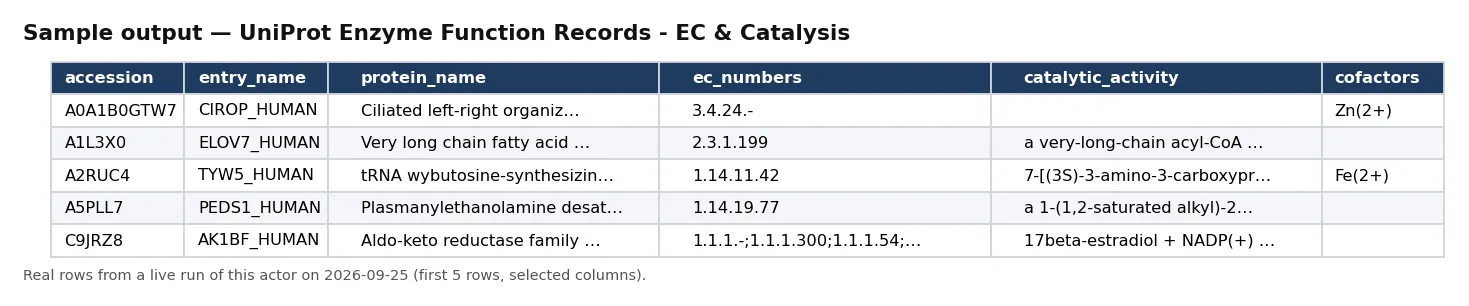
Real rows from a live run of this actor (first 5 rows, selected columns).
One full record from the same run, exactly as delivered:
Coverage and volume
The live ec:* set is 26,622,093 UniProtKB entries (measured at build time from the API's
x-total-results). Because that is far too large for a single pull, a partition is required: you supply
a UniProt query fragment - organism_id:9606 (human), ec:3.* (hydrolases), taxonomy_id:2 (Bacteria),
reviewed:true (Swiss-Prot enzymes) and so on - and the Actor AND-s it onto ec:*. The full-set figure is
the capacity line; you always work within a partition.
Sol's Wave-3 index put this door at about 24,964,845 records; measured live at build time the ec:* set
is 26,622,093 - the larger, current figure is what this listing quotes.
The Actor pages the UniProt REST API using its cursor (the Link header's rel="next"), 500 entries at a
time, and stops as soon as your Maximum records cap is met.
Distinctness from the reviewed and human cells
Measured live against the door: 279,671 of these enzyme records are also reviewed (Swiss-Prot) entries - about 1.1% of the enzyme set - and 35,916 are human (organism 9606), about 0.13%. The overwhelming majority are unreviewed enzyme entries that appear in neither of the other cells. Because the overlap is tiny and the emitted core (EC number, catalytic activity, cofactor, pathway) does not exist in the other two cells, this Actor is a distinct product, not a re-filtering of an existing one. Stating the overlap here means you can combine the cells without double-counting.
Licence and attribution
UniProt data is released under Creative Commons Attribution 4.0 (CC BY 4.0) - free to use and redistribute with attribution. The full notice travels on every record:
UniProt (UniProtKB), CC BY 4.0. Attribution required; reproduced from the UniProt REST API, values unmodified. No literature-author, submitter or contact field is read.
The required attribution - UniProt Consortium (https://www.uniprot.org) - is present on every record, and the UniProt licence page
is the governing reference.
Person-data policy
This Actor requests only enzymology, protein, gene and organism fields. UniProt entries carry a literature-references section with author and submitter names; that section is never requested and never delivered, and a per-record assertion rejects any author, submitter or contact field (verified with a planted-field test). No natural-person data is processed.
Interpretation caveat
UniProtKB entries carrying an Enzyme Commission (EC) number, with the EC number and catalytic activity as the grain (plus cofactors, pathway, organism and review status). The full ec:* set is ~26.6M entries, so a partition (e.g. organism_id:9606, ec:3.) is required and AND-ed onto ec:. Distinct from the reviewed-protein and human-proteome cells, which emit no EC/catalytic-activity fields.
Values are reproduced verbatim from the API; the Actor never rewrites a field. catalytic_activity is the
reaction description exactly as UniProt records it (it may cite ChEBI or Rhea identifiers); an entry that
carries an EC number but no annotated reaction leaves catalytic_activity null, which is faithful to the
source rather than invented.
Data quality and freshness
reviewed is delivered as a real boolean; organism_id as a real number; EC numbers, catalytic activities
and cofactors are semicolon- or pipe-joined strings preserving every value. Delivery is keyed on the stable
accession, so the dataset is safe to diff, deduplicate or upsert. Every run re-reads the live API, so the
data is as fresh as UniProt publishes (on their release cycle), and each record's observed_at stamp dates
the snapshot. The run's RUN_RECEIPT records the partition, the API's total result count, and how many
records were delivered and charged.
Provenance and compliance
Every run reads rest.uniprot.org/robots.txt at runtime; the gate result (URL, status, byte length,
SHA-256 of the policy) is written to the run's RUN_RECEIPT, and the search path is confirmed crawlable
before any data request. The API is keyless. The Actor never bypasses a block or fetches through a mirror.
Inputs
- Partition (
partition, required) - a UniProt query fragment AND-ed ontoec:*to keep the slice tractable. Prefilled withorganism_id:9606. - Maximum records (
maxRecords) - hard cap on enzyme records delivered and billed within the partition.
Output
Records land in the Actor's default dataset and export as JSON, CSV, Excel or via the Apify API. A tabular overview view surfaces accession, EC number(s), protein name, catalytic activity, organism, review status and gene names.
Fields in detail
The record leads with accession and entry_name, then protein_name, the enzymology core -
ec_numbers, catalytic_activity, cofactors, pathway - followed by gene_names, organism,
organism_id, the boolean reviewed (and the verbatim entry_type) and protein_existence. The
provenance block closes every record. Because the accession is UniProt's stable primary key, this dataset
joins cleanly onto any system that references UniProt accessions, and onto the fleet's other UniProt cells.
Scaling and limits
Set Maximum records low to sample cheaply or high to pull a full partition. The Actor pages the API with
its cursor (500 entries per request) and delivers incrementally, so memory stays flat regardless of how many
records you request, and you are billed only for what is delivered. The cursor is stable across a run, so
even a large partition proceeds without gaps or duplicates. Choose the partition to match your question - a
single EC class, a single organism, or reviewed-only - and re-run to keep a downstream enzymology reference
current; each record's observed_at stamp dates the snapshot.
Choosing a partition
The partition is the one required input, and it is what makes a 26-million-entry door tractable. Pick it to
match your question. organism_id:9606 gives every human enzyme; taxonomy_id:2 every bacterial enzyme;
ec:3.* every hydrolase across all organisms; ec:1.1.1.* a single enzyme sub-subclass; reviewed:true
the ~280,000 manually curated Swiss-Prot enzymes. You can combine fragments in the fragment itself
(organism_id:9606 AND reviewed:true) because it is passed to UniProt's own query parser. If a partition
still exceeds what you want to pull, the Maximum records cap bounds the run; you are billed only for
what is delivered. The RUN_RECEIPT records the partition and the live total for that partition, so you
always know what fraction of the slice you took.
Typical uses
Drug-discovery and bioinformatics teams use this cell to assemble an enzyme reference for a target organism or EC class - accession, EC number and the catalytic reaction in one flat table - without parsing UniProt's nested JSON themselves. Because the EC number and reaction text are first-class fields, the dataset joins directly onto pathway models, ChEBI/Rhea reaction references and gene panels. A scheduled run per partition keeps a downstream enzymology table current with UniProt's release cycle, and the stable accession key makes the dataset safe to upsert.
Sibling Actors
It sits beside the fleet's UniProt reviewed-protein and human-proteome records, which draw the same door at a different grain. It shares its engineering - the runtime robots gate, cursor paging, push-then-charge billing and verbatim-value discipline - with the fleet's other UniProt records Actors, from which it stays distinct by leading with the EC number and the catalytic reaction rather than the protein summary.


