

US Committee Finance Records — FEC Summaries
Pricing
from $33.50 / 1,000 committee summary records
US Committee Finance Records — FEC Summaries
Keyless, pay-per-record FEC committee-summary data. One row per committee — id, name, type, receipts, disbursements, contributions by source, cash on hand, expenditures. Committee summaries ONLY (no contributor files); public domain; no person data.
Pricing
from $33.50 / 1,000 committee summary records
Rating
0.0
(0)
Developer
NexGen Signal
Maintained by CommunityActor stats
0
Bookmarked
2
Total users
1
Monthly active users
12 days ago
Last modified
Categories
Share
Keyless. Pay per record. Every federal political committee's filed financial position — committee summaries only, no donors.
This actor turns the US Federal Election Commission (FEC) bulk committee-summary file into clean, per-committee records — the official filed financial position of every federal political committee. Each run reads the FEC's keyless bulk download and delivers one row per committee: its ID, name, and type, and its aggregate financial figures — total receipts and disbursements, contributions by source, loans, cash on hand, debts, and independent and coordinated expenditures. Committee grain, structured for engineering use, in the public domain, with a hard scope: only the committee-summary file is read — the individual-contribution files are never fetched, joined, or emitted, and no donor, treasurer, address, or contact data appears.
What this is, in one paragraph
Federal political committees file periodic reports with the FEC, and the FEC publishes committee-level financial summaries as a bulk file. This actor reads that file and flattens each committee into a single analysis-ready record: the committee ID, name, type, and designation, the filing frequency, and the aggregate financial figures for the cycle — total receipts, transfers from affiliates, individual and other-committee and candidate contributions, loans, total disbursements, refunds, cash on hand at the beginning and close, debts owed, non-federal transfers, contributions to other committees, and independent and party-coordinated expenditures. It is the financial-health layer of federal committees. Values are exactly as filed. You are billed only for records actually delivered.
Who buys this and for what job
- Political-finance analysts, compliance teams, and researchers tracking committee financial positions and money flows at the committee level.
- Journalism and watchdog products surfacing committee receipts, spending, and cash on hand as clean rows.
- Data and civic-tech teams building committee-finance dashboards without a person-level contributions dump.
- Data engineers who want the FEC committee summaries parsed and labelled without handling the pipe-delimited bulk file by hand.
Public-domain data — public-inspection posture
Two riders travel on every record. First, licensing: FEC bulk data is public-inspection disclosure data of the US federal government — no copyright, public domain — free to reuse, including commercially, with attribution to the FEC. One important FEC rule is stated plainly: contributor information may not be used to solicit contributions or for commercial purposes — which is exactly why this actor emits committee summaries only and never touches the contributor files. Second, fitness: these are filed financial positions as disclosed by the committee — not a political characterization and not an audit. The listing and the records carry no political framing in either direction.
Hard scope — committee summaries only, never contributions
This is the defining property of this actor. The FEC publishes many bulk files; this actor reads only the committee-summary ("webk") file and has no code path to the itemized individual-contribution, other-transaction, or operating-expenditure files. The committee-summary file carries no person field — the committee name is an organisation, and there is no treasurer, donor, address, or contact column in it. A person-key guard runs on every record as a backstop, and the acceptance suite asserts that even a treasurer or street field injected into a row can never appear in output. The result is aggregate committee financials with no person-level data by construction.
Sample output
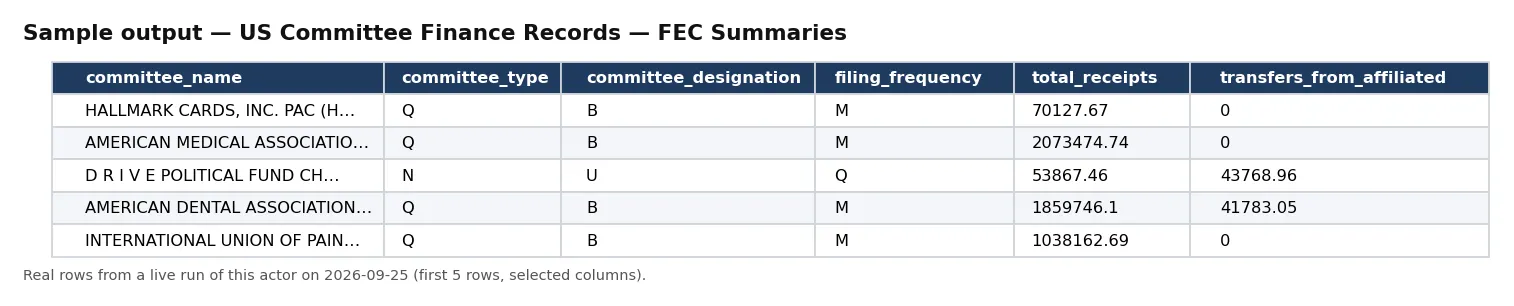
Real rows from a live run of this actor (first 5 rows, selected columns).
One full record from the same run, exactly as delivered:
Pricing
| Event | Free plan | Bronze | Silver | Gold / Platinum / Diamond |
|---|---|---|---|---|
committee_summary_record | $0.05 | $0.045 | $0.04 | $0.0335 |
Delivered before charged. Blocked runs and empty results cost nothing.
Input
| Field | Type | Default | Description |
|---|---|---|---|
committeeType | string | — | Optional. Keep only committees of this FEC type code (e.g. Q qualified PAC, N non-qualified PAC, P presidential, H house, S senate). |
nameContains | string | — | Optional. Keep only committees whose name contains this text. |
maxRecords | integer | 10 | Ceiling on records delivered and billed. |
Default changed on 30 Sep 2026: if you leave maxRecords out, a run now returns up to 10 records (it was 500). Set maxRecords yourself to get more — the maximum is unchanged.
Output
One JSON object per committee. Real example (values as filed):
An unbilled RUN_RECEIPT records the robots check, the resolved cycle file, the filters, rows seen and delivered, and whether charged equals delivered — plus a notice that only the committee-summary file is read.
Field reference
Each record is one committee. Identity: record_id (committee id + coverage date), committee_id, committee_name, committee_type, committee_designation, filing_frequency, and cycle. Receipts: total_receipts, transfers_from_affiliated, individual_contributions, other_committee_contributions, candidate_contributions, candidate_loans, and total_loans_received. Disbursements: total_disbursements, transfers_to_affiliated, individual_refunds, other_committee_refunds, candidate_loan_repayments, loan_repayments, contributions_to_other_committees, independent_expenditures, and party_coordinated_expenditures. Position: cash_on_hand_beginning, cash_on_hand_close, debts_owed_by, and nonfederal_transfers_received. Coverage: coverage_end_date. Provenance: source, source_url, licence, attribution, disclaimer, and observed_at.
How a run works
A run first re-reads the source host's robots posture from your runtime — the FEC host, whose Disallows scope only its /data/ web pages, leaving the /files/bulk-downloads/ path clear — and stops at the door if that ever changes. It resolves the committee-summary file for the current two-year cycle, downloads it once, parses the pipe-delimited rows (which have no header) against the documented committee-summary layout, applies your optional type and name filters, and flattens each committee to one record — reading only committee-summary fields, never a contributor or contact field — delivered before it is charged, so a blocked or empty run costs you nothing. The actor stops at your maxRecords ceiling and records charge_equals_delivered in the receipt.
Coverage and scope
The committee-summary file holds on the order of 12,500+ committees for the current cycle. Because each record carries the committee_type and cycle, segmenting by committee type and comparing across cycles is straightforward, and the aggregate figures support money-flow analysis at the committee level. Pull one committee type, or the whole file to seed a committee-finance table.
Cost guidance
One committee_summary_record per delivered committee: cost = committees delivered × your plan's per-record price. Scope with committeeType or nameContains to keep runs bounded. The whole file is ~12,500 committees; 1,000 committees is $50 (Free) / $33.50 (Gold).
Honest limitations
- Committee summaries only. By design, this actor reads only the committee-summary file; the itemized individual-contribution files are never fetched, joined, or emitted.
- As filed. Figures are as disclosed by the committee for the coverage period; this actor reformats and labels, it does not audit.
- Not a characterization. The data carries no political framing; it is filed financial facts.
- No person data of any kind.
Differentiation
This actor is a distinct FEC job: the committee-level financial summaries — a committee's total receipts, disbursements, and cash position — with no person-level data at all. It answers "what is this committee's overall financial position," not "who gave" (individual contributions) or "who spent for or against a candidate" (independent expenditures).
The NexGen Signal family
Part of the NexGen Signal family of pay-per-record data products:
- US Credit Union Financial Records — NCUA Call Report
- US Hospital Ownership Records — CMS Owner Edges
- Treasury Fiscal Records — Rates & Debt
- Grant Opportunity Records — US Grants.gov
- Organization Sanctions & LEI Risk
Source: US Federal Election Commission (FEC) bulk downloads (fec.gov). Public-inspection disclosure data of the US federal government, no copyright, public domain; free to reuse, including commercially, with attribution to the FEC. Committee summaries only; the individual-contribution files are never fetched, joined, or emitted, and no donor, treasurer, address, or contact data is present. Filed financial positions as disclosed, not a political characterization or an audit.


