

🇦🇺 AusTender Award Watch — Who Won Which Federal Contract
Pricing
from $13.40 / 1,000 procedure deltas
🇦🇺 AusTender Award Watch — Who Won Which Federal Contract
Watch Australian federal contract awards from the official AusTender OCDS API: who won which contract, for how much, and when an incumbent is replaced. Deduplicated delta-only events, seed-zero watch mode, and a source receipt on every run.
Pricing
from $13.40 / 1,000 procedure deltas
Rating
0.0
(0)
Developer
NexGen Watch
Maintained by CommunityActor stats
0
Bookmarked
2
Total users
1
Monthly active users
4 days ago
Last modified
Categories
Share
📜 🇦🇺 AusTender Award Watch — Who Won Which Federal Contract
Australian federal contract awards are published, but not watchable. This turns the official AusTender OCDS API into a deduplicated, delta-only feed of who won what, for how much, and when an incumbent gets replaced.
Output is one award_notice row per result; billing is pay-per-event, the value event being one procedure delta (a $0.02 start fee per run, then $0.02 per procedure delta plus one $0.10 source check per run that reads the source). Source: api.tenders.gov.au, www.tenders.gov.au.
Use cases by team
- Incumbency & market analysts: See who is actually winning Commonwealth contracts and quantify incumbent turnover.
- Suppliers & bid teams: Learn which agencies buy your category, and at what contract values, before you bid.
- Competitive intelligence: Track a named competitor's federal wins as they publish.
- Procurement-intelligence vendors: License a bounded, deduplicated Australian award feed with an auditable receipt.
📊 Sample Output
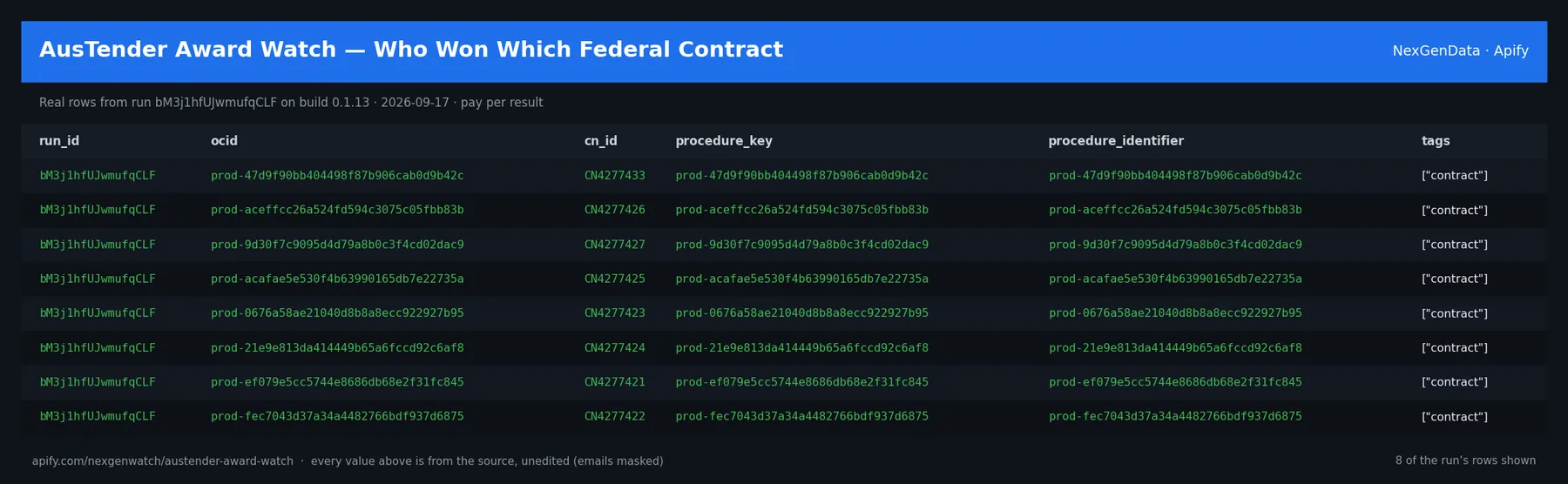
Real rows from run bM3j1hfUJwmufqCLF on build 0.1.13 (2026-09-17), the same input as the Quick start below — every value is as the source published it (emails masked, long text shortened):
| run_id | ocid | cn_id | procedure_key | procedure_identifier | tags |
|---|---|---|---|---|---|
| bM3j1hfUJwmufqCLF | prod-47d9f90bb404498f87b906cab0d9b42c | CN4277433 | prod-47d9f90bb404498f87b906cab0d9b42c | prod-47d9f90bb404498f87b906cab0d9b42c | ["contract"] |
| bM3j1hfUJwmufqCLF | prod-aceffcc26a524fd594c3075c05fbb83b | CN4277426 | prod-aceffcc26a524fd594c3075c05fbb83b | prod-aceffcc26a524fd594c3075c05fbb83b | ["contract"] |
| bM3j1hfUJwmufqCLF | prod-9d30f7c9095d4d79a8b0c3f4cd02dac9 | CN4277427 | prod-9d30f7c9095d4d79a8b0c3f4cd02dac9 | prod-9d30f7c9095d4d79a8b0c3f4cd02dac9 | ["contract"] |
| bM3j1hfUJwmufqCLF | prod-acafae5e530f4b63990165db7e22735a | CN4277425 | prod-acafae5e530f4b63990165db7e22735a | prod-acafae5e530f4b63990165db7e22735a | ["contract"] |
| bM3j1hfUJwmufqCLF | prod-0676a58ae21040d8b8a8ecc922927b95 | CN4277423 | prod-0676a58ae21040d8b8a8ecc922927b95 | prod-0676a58ae21040d8b8a8ecc922927b95 | ["contract"] |
| bM3j1hfUJwmufqCLF | prod-21e9e813da414449b65a6fccd92c6af8 | CN4277424 | prod-21e9e813da414449b65a6fccd92c6af8 | prod-21e9e813da414449b65a6fccd92c6af8 | ["contract"] |
| bM3j1hfUJwmufqCLF | prod-ef079e5cc5744e8686db68e2f31fc845 | CN4277421 | prod-ef079e5cc5744e8686db68e2f31fc845 | prod-ef079e5cc5744e8686db68e2f31fc845 | ["contract"] |
| bM3j1hfUJwmufqCLF | prod-fec7043d37a34a4482766bdf937d6875 | CN4277422 | prod-fec7043d37a34a4482766bdf937d6875 | prod-fec7043d37a34a4482766bdf937d6875 | ["contract"] |
The run finished with the status message: CAPPED: reason=CAPPED_MAX_ITEMS; pages=1/1; records=10
✅ What you get
One of four record types, discriminated by record_type: tender_notice, award_notice, procedure_delta, or source_receipt.
Each row is flat JSON with these fields (from the dataset schema and the sample run; a field the source does not publish for a given row is null):
record_type(string) — Discriminator.run_id(string) — Apify run id that produced this item.jurisdiction(string/null) — Source jurisdiction code.source_url(string) — Exact public request URL or endpoint supporting this item.observed_at(string) — RFC3339 UTC time after shape validation.source_id(string/null) — Source-native composite identity for notice/delta records.ocid— e.g.prod-47d9f90bb404498f87b906cab0d9b42ccn_id— e.g.CN4277433procedure_key(string/null) — Official procedure grouping key (e.g. OCID) when the source publishes it.procedure_identifier(string/null) — Official procedure identifier when published.tags— e.g.["contract"]notice_title(string/null) — Notice title.status(string/null) — Source status value.publication_date(string/null) — ISO publication/updated date.notice_type— e.g.tenderprocedure_type— e.g.limitedprocedure_type_detail— e.g.Limited tendercontract_period_start— e.g.2027-02-25contract_period_end— e.g.2027-02-25buyer_names(array/null) — Buyer names (may be empty).buyer_countries(array/null) — Buyer country codes.cpv_codes(array/null) — Classification codes.main_cpv_code— e.g.93131703estimated_value(number/null) — Estimated procedure value in source currency.estimated_currency(string/null) — Estimated value currency.notice_url(string/null) — Public notice detail URL.content_hash(string/null) — 64-char SHA-256 over canonical mutable fields.raw— null in every sample rowraw_truncated— e.g.Falsewinner_names(array/null) — Award winner names (award_notice only; may be empty).winner_identifiers(array/null) — Award winner identifiers (award_notice only).incumbent_keys(array/null) — Deterministic incumbent keys derived from winner identifier or casefolded name.award_value(number/null) — Award value in source currency (award_notice only).award_currency(string/null) — Award currency (award_notice only).tender_values— e.g.[681993.4]tender_currencies— e.g.["AUD"]contract_conclusion_dates— e.g.["2026-09-17"]linked_tender_source_ids(array/null) — Prior baseline notices under the same procedure key (award_notice only).deadline(string/null) — Closing/deadline date when published.delta_type(string/null) — procedure_delta only.prior_source_ids(array/null) — procedure_delta: prior notices under the same procedure.changed_fields(array/null) — procedure_delta: sorted changed field names.winner_after(array/null) — procedure_delta: incumbent keys after the change.terminal(string/null) — source_receipt only.reason_code(string/null) — Stable terminal reason code.api_total(integer/null) — source_receipt: source total for the query when published.shape_canary_passed(boolean/null) — source_receipt: whether the source-shape canary passed.
What you get
award_notice— contract-award records with winner names/ids, incumbent keys, award value, and the linked tendertender_notice— the opportunity records behind those awards, with buyer, UNSPSC, value and deadlineprocedure_delta— watch-mode change events: new opportunity, notice updated, tender-to-award, incumbent change- Selectable date semantics via
dateType, so you can watch by contract-published date rather than one fixed field source_receipton every run — terminal state, counts, and a source-shape canary result, never billed
Every run also writes a RUN_RECEIPT record to its key-value store with the source checks it made and the counts it charged — diagnostics never land in the paid dataset.
⚙️ Sample inputs
1. Quick start — the Store example (this is what the sample above came from)
The sample run charged exactly: 1 × $0.02 apify-actor-start + 0 × $0.004 tender_notice + 10 × $0.006 award_notice + 0 × $0.02 procedure_delta + 1 × $0.10 source_check = $0.18 on the Free tier — snapshot preview rows are delivered unbilled; only the source check and the start fee were charged.
2. A smaller, narrowed run
Caps the run at 5 rows; same billing shape as the sample run above.
3. Watch mode on a schedule
The first run seeds a private baseline and emits zero deltas; every later run emits one row per change, billed at $0.02 each plus the $0.10 source check.
🧾 JSON sample record
One real record from run bM3j1hfUJwmufqCLF, exactly as it lands in the dataset (emails masked, long text shortened):
🔧 How it works
Source. The actor reads api.tenders.gov.au, www.tenders.gov.au — endpoints: https://api.tenders.gov.au/ocds/findByDates, https://www.tenders.gov.au/Cn/Show. Public pages and feeds only; nothing behind a login.
Transport. Plain HTTPS from the Apify platform, no proxy.
Watch semantics. Snapshot mode (watch_mode: false) returns a preview. Watch mode keys every record on a source-native id, stores a private baseline in a named key-value store, and on each later run emits one delta row per change (new / changed / removed). A blocked fetch is never diffed, so a source outage cannot show up as a mass removal.
Terminal states. A run ends NORMAL, CAPPED (your cap was reached), PARTIAL (something was withheld and the message says what), GENUINE_EMPTY (the source was read and truly had nothing in scope) or BLOCKED (the source refused or changed shape — the run FAILS loud and bills nothing). A zero-row run is never reported as a silent success.
Charging. Each procedure delta is charged at the moment it is pushed (procedure_delta); a row that fails to charge is not delivered, so the dataset count always equals the charged count. One source_check is charged per run that actually read the source.
How it works
Give it a date window, a dateType, and optional buyer / UNSPSC / keyword filters. It reads the AusTender OCDS API (api.tenders.gov.au/ocds/findByDates) as an anonymous public client, normalizes each release into award_notice and tender_notice records, links awards back to their originating tender when linkAwards is on, and — in watch mode — diffs against a private baseline to emit only procedure_delta events. Every run closes with a source_receipt carrying the terminal state and a canary check on the source shape.
Compliance & honest limits
- Public, logged-out official source only — no API key, login, cookie, CAPTCHA, or access-control defeating.
- Client-side targeting: filters are applied to the bounded window this actor fetched, not pushed into the upstream query.
- Watch mode's first run seeds a private baseline and emits zero deltas by design — deltas start on the second run.
- A source-confirmed empty window is
SUCCEEDED-0: GENUINE_EMPTY; truncated runs arePARTIAL; exhausted retries areBLOCKED. source_receiptrecords are always emitted and are never billed.
About
Part of the NexGenData procurement-watch family — one honest, deterministic contract across UK, EU, Canadian, Australian and Singaporean public procurement. Built by NexGenData. Questions or need a custom feed? Open an issue on the Actor page.
Preview vs Watch mode
- Preview (watchMode = false): a one-shot snapshot — the actor emits the current
tender_notice/award_noticerecords for your query and charges per record. Use it to see what the query returns right now; it keeps no baseline. - Watch (watchMode = true): change detection — the actor keeps a private baseline and emits only
procedure_deltarows for what changed since the last run under the same baseline key, plus onesource_checkper run. Use it on a schedule to be told only what moved.
What is not done. No login, no cookie or CAPTCHA bypass, no private or personal-account data, no browser automation.
⏰ Set it on a schedule
A single run is a snapshot. The value is the feed: open the actor in Apify Console → Schedules → Create new, add this actor with input 3 above (watch_mode: true), and pick a cadence:
- Daily —
0 7 * * *(07:00 UTC): catch changes within a day. - Weekly —
0 7 * * 1: a Monday digest.
Each run is independent; keep the same input on the schedule so the results stay comparable. Schedules can also POST results to a webhook (Console → Integrations).
💰 Pricing example
| Event | Free | Bronze | Silver | Gold |
|---|---|---|---|---|
Actor Start (apify-actor-start) | $0.02 | $0.02 | $0.02 | $0.02 |
Tender notice (tender_notice) | $0.004 | $0.0036 | $0.0032 | $0.0027 |
Award notice (award_notice) | $0.006 | $0.0054 | $0.0048 | $0.004 |
Procedure delta (procedure_delta) | $0.02 | $0.02 | $0.02 | $0.01 |
Source check (source_check) | $0.10 | $0.09 | $0.08 | $0.07 |
Worked at the live Free-tier price (watch mode, one delta per change):
- 8 procedure deltas: $0.02 start + $0.10 source check + 8 × $0.02 = $0.28
- 25 procedure deltas: $0.02 start + $0.10 source check + 25 × $0.02 = $0.62
- 500 procedure deltas: $0.02 start + $0.10 source check + 500 × $0.02 = $10.12
A run that delivers zero rows charges the $0.02 start fee plus the $0.10 source check (the source was read and reported empty). A BLOCKED run (source refused) fails loud and charges no value event. The start fee is charged once per GB of run memory; the default run memory is 512 MB.
Yield on the sample run: CAPPED: reason=CAPPED_MAX_ITEMS; pages=1/1; records=10. maxItems is a hard ceiling on what is delivered and billed, never a target.
⚖️ Legal & ToS
This actor reads public, logged-out pages and feeds published by api.tenders.gov.au, www.tenders.gov.au. It collects only what the source publishes to any visitor, identifies itself, and does not access accounts, private data or anything behind authentication. Use the output in line with the source's terms and your local law; the intended use is B2B research and monitoring.
❓ FAQ
Q: Do I need an API key or a login?
A: No. The source (api.tenders.gov.au, www.tenders.gov.au) is read logged-out; the input schema has no key field and the actor carries no secrets.
Q: Why did my run return 0 rows?
A: Read the run's status message. GENUINE_EMPTY means the source was read and had nothing in scope for your input (in watch mode the first run always seeds the baseline and returns zero deltas); BLOCKED means the source refused and the run failed without billing a value event — retry later or narrow the input. A zero-row run bills the start fee plus one source check.
Q: How many rows can one run return?
A: Up to maxItems (default 500). Raise the cap for a bigger run; you pay per delivered row.
Q: What does watch mode remember between runs?
A: A private baseline of source-native record ids in a named key-value store. Each later run diffs the live source against it and emits only changes.
Q: How fresh is the data?
A: Every run reads the source live at run time; nothing is cached between runs except the watch baseline. Put it on a schedule for a continuous feed.
Q: What formats can I export?
A: The dataset downloads as JSON, CSV, Excel, XML or RSS from the run's Dataset tab or the Apify API, and any run can push to a webhook or integration.
Q: How is this different from the other public procurement watches actors?
A: Same output shape and billing model; this one covers api.tenders.gov.au, www.tenders.gov.au. The siblings under Related Actors cover the other sources or slices — run several on one schedule for a combined feed.
🆘 Troubleshooting
- Run FAILED with BLOCKED → the source refused the request or changed its page shape → nothing was billed beyond the start fee; retry after a while, and if it persists open an Issue with the run id.
- Status says CAPPED → your cap (
maxItems) was reached → raise it for a bigger run. - Input validation error on start → a field is outside the schema's allowed values → start from the Quick start block and change one field at a time.
- Run TIMED-OUT → a very wide request on a slow day → raise the run timeout in Run options or narrow the input; what was delivered before the timeout is still in the dataset.
- First watch run shows no deltas → expected: it seeds the baseline; changes appear from the second run.
🔗 Related Actors
- 🇨🇦 CanadaBuys Tender Watch — Federal Opportunities & Awards — Watch Government of Canada procurement from the official CanadaBuys open data: new and amended tender opportunities and awards by buyer, province and…
- 🇪🇺 EU TED Tender & Award Delta Feed — Procurement Watch — EU TED tender & award delta feed — new tenders, awards, and procedure deltas across all member states; watch mode, honest terminals
- 🇸🇬 Singapore GeBIZ Tender & Award Change Watch — Monitor public Singapore GeBIZ listings and get structured, seed-zero deltas when tenders open, change, close, are cancelled, or publish an award sta…
- Japan Government Procurement Notice Watch (Procurement Portal) — Japanese central-government procurement notices from the government's own Procurement Portal (調達ポータル), read through its English WTO-covered search: c…
- 🏢 About NexGenData — NexGen Watch is NexGenData's fleet of 256 public monitoring and lookup actors built on official sources, pay-per-result. Browse the catalog at apify.com/nexgenwatch.
⭐ Found this useful?
If this actor saved you a manual check, a quick review on the Apify Store helps other teams find it. Feature request or a source that changed? Open it from the Issues tab — every one is read.


