

Federal Rule Impact MCP Server
Pricing
from $50.00 / 1,000 tool calls
Federal Rule Impact MCP Server
Answer 'what regulations changed for this industry' from the US Federal Register: search and retrieve rules, proposed rules and notices by CFR title, agency, keyword and date.
Pricing
from $50.00 / 1,000 tool calls
Rating
0.0
(0)
Developer
NexGen Watch
Maintained by CommunityActor stats
0
Bookmarked
1
Total users
0
Monthly active users
2 days ago
Last modified
Share
🧰 Federal Rule Impact MCP Server
Answer "what regulations changed for this industry" from the US Federal Register — final rules, proposed rules and notices, searched by CFR title, agency, keyword and date, live.
Built for policy and compliance teams.
This is a standby MCP server: it stays warm on Apify and answers tool calls from any MCP client (Claude Desktop, Cursor, an agent framework) at https://nexgenwatch--federal-rule-impact-mcp.apify.actor/mcp. Billing is pay-per-event: $0.05 when the server starts, then $0.05 per tool call (mcp-tool-call). Source: www.federalregister.gov.
No login, no source API key and no CAPTCHA solving are involved: the source is read logged-out.
📊 Sample Output
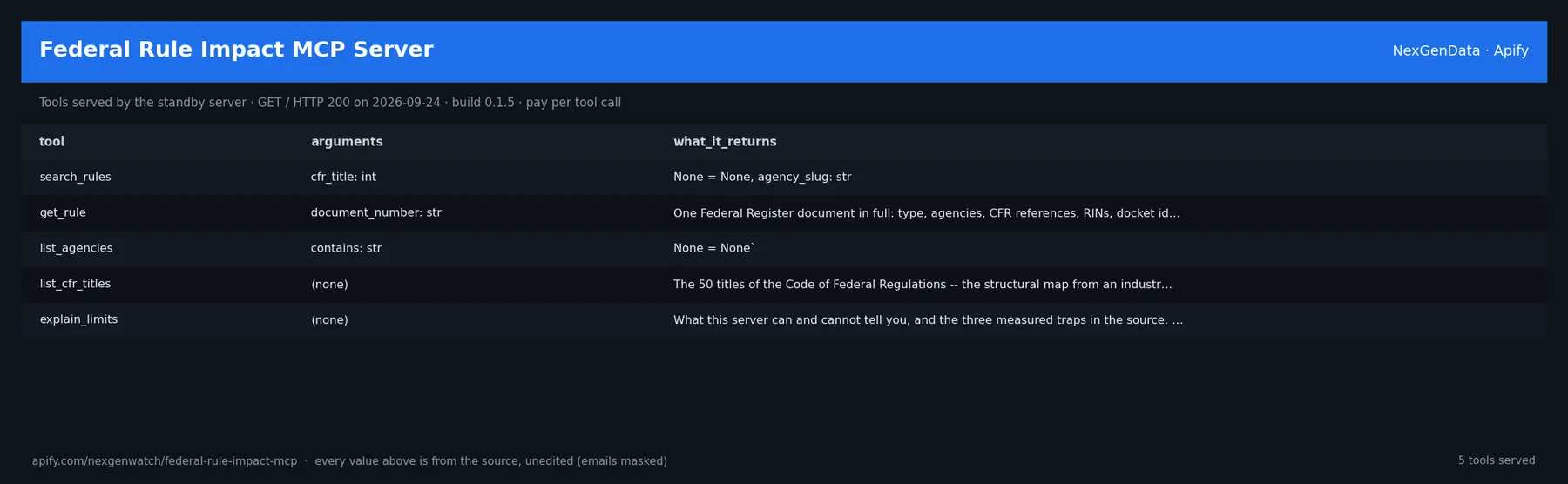
A standby server answers tool calls rather than writing a dataset, so the sample is the server's own live health answer (GET https://nexgenwatch--federal-rule-impact-mcp.apify.actor/, HTTP 200, read on 2026-09-17) followed by its tool table:
| Tool | Arguments | What it returns |
|---|---|---|
search_rules | `cfr_title: int | None = None, agency_slug: str |
get_rule | document_number: str | One Federal Register document in full: type, agencies, CFR references, RINs, docket ids, publication and effective dates, abstract and a citable URL. |
list_agencies | `contains: str | None = None` |
list_cfr_titles | `` | The 50 titles of the Code of Federal Regulations -- the structural map from an industry to a filter. Use the number as cfr_title in search_rules. |
explain_limits | `` | What this server can and cannot tell you, and the three measured traps in the source. Read this before acting on any answer above. |
✅ What you get
5 tools, each returning a JSON object built only from what the source answered, with a scope and note field stating what the source does and does not cover. A lookup the source answers with 'not found' is a sourced answer (charged); malformed input or a source failure returns a notice that is NOT charged; nothing is ever fabricated.
Three things this server gets right that a naive read gets wrong
Every one measured live against the source on 2026-07-30.
1. Keyword search is full-text over the whole document — it is not a topic filter
A 90-day search for cybersecurity returned 10 documents, and 10 of 10 had the word
in neither the title nor the abstract. Among the hits:
That is correct API behaviour — the term is matched somewhere in the document body — and it is useless as an industry filter if you assume otherwise. So every keyword answer reports how many hits actually carry the term where a human can see it, and points you at the structural filters instead.
The honest way to ask "what changed for my industry" is cfr_title or agency_slug. A
CFR-title-21 query returned 54 final rules in 90 days, every one a drug or medical-device
rule.
2. A bad agency slug is an HTTP 400, not an empty result
One careless except away, that reads as "nothing changed for your industry" — the worst
possible wrong answer for a compliance team. So slugs are validated against the API's own
472-agency list before the query is sent, an unrecognised slug comes back as a free notice
with near-matches, and any non-200 raises rather than returning an empty list.
3. Effective dates are often missing, including on final rules
Measured: of 20 consecutive published rules, one carried no effective date, and a rule
fetched individually also had effective_on: null. Publication date is always there;
effective date is not. This server reports effective_date_known and never backfills one
date from the other.
Tools
| tool | what it answers |
|---|---|
search_rules | What was published in a trailing window, filtered by CFR title, agency, type or keyword |
get_rule | One document in full: agencies, CFR references, RINs, dockets, dates, abstract, URL |
list_agencies | All 472 agency slugs the Register recognises, filterable |
list_cfr_titles | The 50 CFR titles — the structural map from an industry to a filter |
explain_limits | What this server will and will not say, and the three traps above. Read before acting. |
Document types: rule, proposed_rule, notice, presidential_document. The default is
rules plus proposed rules. An unrecognised type is refused, never silently defaulted.
Scope and compliance
US Federal Register only. State registers, agency guidance published outside the Register, and the text of the CFR itself are not covered.
federalregister.gov/robots.txt disallows the HTML search pages —
/documents/search, /articles/search, /regulations/search,
/public-inspection/search — and does not disallow /api/. This server uses the JSON
API only; a test asserts no disallowed path can be built into a request URL. No
Crawl-delay is stated and the API returns no rate-limit header, so pacing is our own
choice: every call goes through one shared strict-pacing bucket at 5 requests/second.
This server reports what the Federal Register published. It does not determine that a rule applies to you, does not compute compliance deadlines, and is not legal advice.
⚙️ Sample inputs
1. Connect an MCP client (Claude Desktop / Cursor style config; your Apify API token goes in the header):
2. One tool call over JSON-RPC (what the client sends to /mcp; each call is one mcp-tool-call event):
3. Health check from a shell (free — no tool call is charged):
🧾 JSON sample record
The live health record above is the server's own answer; a tool result carries the fields listed in the tool table plus scope and note.
🔧 How it works
Source. www.federalregister.gov — endpoints: https://www.federalregister.gov/api/v1. Public, logged-out reads only.
Standby. Apify keeps one server process warm; each MCP session is served by that process and idle servers are stopped by the platform. Nothing is cached between calls except what the source itself caches.
Charging. Every tool call charges one mcp-tool-call at $0.05 through Apify's pay-per-event billing before the answer is returned; the declared events are asserted against the live pricing at startup (billing_gate in the health answer).
What is not done. No login, no CAPTCHA bypass, no private data, no scraping of pages the source does not publish to any visitor.
💰 Pricing example
| Event | Free | Bronze | Silver | Gold |
|---|---|---|---|---|
Actor Start (apify-actor-start) | $0.05 | $0.05 | $0.05 | $0.05 |
Tool call (mcp-tool-call) | $0.05 | $0.05 | $0.05 | $0.05 |
- 10 tool calls in one session: $0.05 start + 10 × $0.05 = $0.55
- 100 tool calls in one session: $0.05 start + 100 × $0.05 = $5.05
- 1000 tool calls in one session: $0.05 start + 1000 × $0.05 = $50.05
A health check or a connection that makes no tool call charges only the $0.05 start fee. A sourced 'not found' answer is a completed tool call and is charged; a notice for malformed input or a source failure is not charged (settle() charges only chargeable outcomes).
⚖️ Legal & ToS
The server reads public data published by www.federalregister.gov to any visitor, identifies itself, and does not access accounts or private data. Use the answers in line with the source's terms and your local law; the intended use is B2B research and agent tooling.
❓ FAQ
Q: Do I need a source API key?
A: No. www.federalregister.gov is read logged-out. You need only your Apify API token to connect to the server.
Q: Which MCP clients work?
A: Any client that speaks the MCP HTTP transport: Claude Desktop, Cursor, Windsurf, LangChain/LlamaIndex MCP adapters and Apify's own MCP client. Point it at the /mcp URL above.
Q: What happens when the source has no answer?
A: A sourced 'not found' (for example a 404 for an unknown identifier) comes back as an answer with scope and note explaining what was checked (where the server carries those fields), and is charged as a completed call; malformed input or a source outage returns a notice that is not charged. Nothing is invented.
Q: How is a call billed?
A: One mcp-tool-call event per tool call at $0.05, plus $0.05 when the server starts. Idle time is not billed to you.
Q: Is it rate limited?
A: The server paces requests to the source (RATE_PER_SEC=5.0) and answers calls in the order they arrive.
Q: Can I call it without an MCP client?
A: Yes — the /mcp endpoint is plain JSON-RPC over HTTP (sample input 2), and GET / is a free health check.
🆘 Troubleshooting
- 401 / 403 from the server → the Authorization header is missing or the token is wrong → use
Bearer <your Apify API token>. - 400
Missing session ID→ the client hit/mcpwithout initialising an MCP session → let the MCP client connect (it performs the handshake); raw JSON-RPC needs the session header the initialise call returns. - Tool returns a notice instead of data → the input was malformed or empty, or the source failed → the call was not charged; check the
note/reasonfield, fix the input and call again. - First call is slow → the standby server was cold and Apify started it → later calls in the same session are fast.
🔗 Related Actors
- Eurostat Labor Stats MCP Server — An MCP server over the official Eurostat dissemination API (ec.europa.eu/eurostat) — EU
- FDIC Bank Diligence MCP Server — Answer questions about US banks from the FDIC's public data: institution details, structural history, current status, closures and failures - for vet…
- Federal Award Counterparty MCP Server — Answer questions about US federal award recipients from USAspending.gov: who won awards from an agency, one organisation's award history, and who tha…
- Grants Qualification MCP Server — Report what a US federal grant agency actually states about who may apply, and screen an applicant type against it. Three outcomes, and 'qualified' i…
- Official Travel Advice MCP Server — MCP server for UK FCDO foreign travel advice from the official GOV.UK Content API — safety warnings, entry and health requirements, and update histor…
- Procurement Evidence MCP Server — Locate the public procurement record behind a claim across the UK, EU and US. Every row carries the awarding body's own record id and a direct public…
- 🏢 About NexGenData — NexGen Watch is NexGenData's fleet of 256 public monitoring and lookup actors built on official sources, pay-per-result. Browse the catalog at apify.com/nexgenwatch.
⭐ Found this useful?
If this server answered a question your agent could not, a quick review on the Apify Store helps other teams find it. Feature request or a source that changed? Open it from the Issues tab — every one is read.


