

NY OCM Licence Registry
Pricing
from $13.40 / 1,000 registry records
NY OCM Licence Registry
One ocm_licence_record per licence or application: entity name, DBA, licence type, status (label AND source status code preserved verbatim), see-category, dates, and full address/county/region.
Pricing
from $13.40 / 1,000 registry records
Rating
0.0
(0)
Developer
NexGen Watch
Maintained by CommunityActor stats
0
Bookmarked
2
Total users
1
Monthly active users
2 days ago
Last modified
Categories
Share
🔔 NY OCM Licence Registry
One ocm_licence_record per licence or application: entity name, DBA, licence type, status (label AND source status code preserved verbatim), see-category, dates, and full address/county/region. Both applicants (In-Process / Under Review) and active licences are emitted — nothing is silently dropped.
One structured registry_record per record from the New York Office of Cannabis Management licence dataset (keyless NY Socrata jskf-tt3q, ~2,927 rows). Public, logged-out, robots-honoured.
Output is one ocm_licence_record row per result; billing is pay-per-event, the value event being one registry record (a $0.02 start fee per run, then $0.02 per registry record). Source: data.ny.gov.
No login, no API key and no CAPTCHA solving are involved: the source is read logged-out with an identified contact User-Agent.
📊 Sample Output
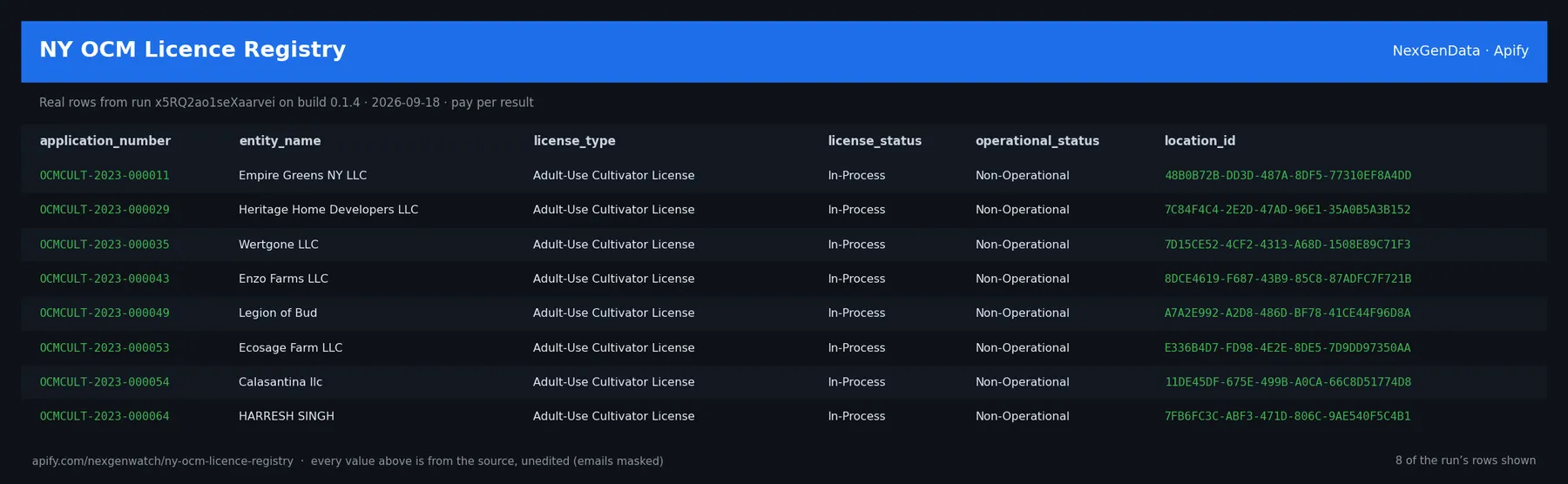
Real rows from run x5RQ2ao1seXaarvei on build 0.1.4 (2026-09-18), the same input as the Quick start below — every value is as the source published it (emails masked, long text shortened):
| application_number | entity_name | license_type | license_status | operational_status | location_id |
|---|---|---|---|---|---|
| OCMCULT-2023-000011 | Empire Greens NY LLC | Adult-Use Cultivator License | In-Process | Non-Operational | 48B0B72B-DD3D-487A-8DF5-77310EF8A4DD |
| OCMCULT-2023-000029 | Heritage Home Developers LLC | Adult-Use Cultivator License | In-Process | Non-Operational | 7C84F4C4-2E2D-47AD-96E1-35A0B5A3B152 |
| OCMCULT-2023-000035 | Wertgone LLC | Adult-Use Cultivator License | In-Process | Non-Operational | 7D15CE52-4CF2-4313-A68D-1508E89C71F3 |
| OCMCULT-2023-000043 | Enzo Farms LLC | Adult-Use Cultivator License | In-Process | Non-Operational | 8DCE4619-F687-43B9-85C8-87ADFC7F721B |
| OCMCULT-2023-000049 | Legion of Bud | Adult-Use Cultivator License | In-Process | Non-Operational | A7A2E992-A2D8-486D-BF78-41CE44F96D8A |
| OCMCULT-2023-000053 | Ecosage Farm LLC | Adult-Use Cultivator License | In-Process | Non-Operational | E336B4D7-FD98-4E2E-8DE5-7D9DD97350AA |
| OCMCULT-2023-000054 | Calasantina llc | Adult-Use Cultivator License | In-Process | Non-Operational | 11DE45DF-675E-499B-A0CA-66C8D51774D8 |
| OCMCULT-2023-000064 | HARRESH SINGH | Adult-Use Cultivator License | In-Process | Non-Operational | 7FB6FC3C-ABF3-471D-806C-9AE540F5C4B1 |
The run finished with the status message: CAPPED: delivered 50 of 51 unique rows (maxRecords=50). billable=50
✅ What you get
Each row is flat JSON with these fields (from the dataset schema and the sample run; a field the source does not publish for a given row is null):
record_type(string) — e.g.ocm_licence_recordlicense_number(string/null) — null in every sample rowapplication_number(string/null) — e.g.OCMCULT-2023-000011entity_name(string/null) — e.g.Empire Greens NY LLCdba(string/null) — null in every sample rowlicense_type(string/null) — e.g.Adult-Use Cultivator Licenselicense_type_code(string/null) — e.g.OCMCULTlicense_status(string/null) — e.g.In-Processlicense_status_code(string/null) — e.g.Pendingoperational_status(string/null) — e.g.Non-Operationalsee_category(string/null) — null in every sample rowlocation_id(string/null) — e.g.48B0B72B-DD3D-487A-8DF5-77310EF8A4DDissued_date(string/null) — null in every sample roweffective_date(string/null) — null in every sample rowexpiration_date(string/null) — null in every sample rowaddress(string/null) — null in every sample rowcity(string/null) — null in every sample rowstate(string/null) — null in every sample rowzip(string/null) — null in every sample rowcounty(string/null) — e.g.Chenangoregion(string/null) — e.g.Southern Tiersource(string/null) — e.g.ny-ocm-licence-registryrelease_date(string/null) — null in every sample rowsource_url(string/null) — e.g.https://data.ny.gov/resource/jskf-tt3q.jsonobserved_at(string/null) — e.g.2026-09-18T05:52:02Zterminal(string/integer/null) — null in every sample rowreported_total(string/integer/null) — null in every sample rowraw_seen(string/integer/null) — null in every sample rowduplicates(string/integer/null) — null in every sample rowunique_found(string/integer/null) — null in every sample rowdelivered(string/integer/null) — null in every sample rowscope(string/integer/null) — null in every sample rownote(string/integer/null) — null in every sample row
What you get
One registry_record per entity, deduplicated on the source-native id. Fields the source does not publish are honest null. A run_receipt row carries the source URL, any reported total, and the delivered/duplicate counts.
⚙️ Sample inputs
1. Quick start — the Store example (this is what the sample above came from)
The sample run charged exactly: 1 × $0.02 apify-actor-start + 50 × $0.02 registry_record = $1.02 on the Free tier — every delivered row was billed.
2. A smaller, narrowed run
Caps the run at 5 rows — about $0.12 on the Free tier ($0.02 start + 5 × $0.02).
3. A full-size run
Up to 5000 rows (the schema default for maxRecords) — about $100.02 on the Free tier ($0.02 start + 5000 × $0.02) if the source has that many.
🧾 JSON sample record
One real record from run x5RQ2ao1seXaarvei, exactly as it lands in the dataset (emails masked, long text shortened):
🔧 How it works
Source. The actor reads data.ny.gov — endpoints: https://data.ny.gov/resource/jskf-tt3q.json. Public pages and feeds only; nothing behind a login.
Transport. Plain HTTPS from the Apify platform, no proxy. robots.txt is read first and a disallowed path is never fetched. Every request carries an identified contact User-Agent.
Charging. Each registry record is charged at the moment it is pushed (registry_record); a row that fails to charge is not delivered, so the dataset count always equals the charged count.
How it behaves
Keyless Socrata $limit/$offset pagination. maxRecords caps the count; raise it for the full register. Duplicates, outages, and schema drift charge nothing.
What is not done. No login, no cookie or CAPTCHA bypass, no private or personal-account data, no browser automation.
💰 Pricing example
| Event | Free | Bronze | Silver | Gold |
|---|---|---|---|---|
Actor Start (apify-actor-start) | $0.02 | $0.02 | $0.02 | $0.02 |
Registry Record (registry_record) | $0.02 | $0.02 | $0.02 | $0.01 |
Worked at the live Free-tier price:
- 8 registry records: $0.02 start + 8 × $0.02 = $0.18
- 25 registry records: $0.02 start + 25 × $0.02 = $0.52
- 5000 registry records: $0.02 start + 5000 × $0.02 = $100.02
A run that delivers zero rows charges the $0.02 start fee only. A BLOCKED run (source refused) fails loud and charges no value event. The start fee is charged once per GB of run memory; the default run memory is 4096 MB.
Yield on the sample run: CAPPED: delivered 50 of 51 unique rows (maxRecords=50). billable=50. maxRecords is a hard ceiling on what is delivered and billed, never a target.
⚖️ Legal & ToS
This actor reads public, logged-out pages and feeds published by data.ny.gov. It collects only what the source publishes to any visitor, keeps to the source's robots rules (checked on every run), identifies itself with a contact User-Agent, and does not access accounts, private data or anything behind authentication. Use the output in line with the source's terms and your local law; the intended use is B2B research and monitoring.
❓ FAQ
Q: Do I need an API key or a login?
A: No. The source (data.ny.gov) is read logged-out; the input schema has no key field and the actor carries no secrets.
Q: Why did my run return 0 rows?
A: Read the run's status message. GENUINE_EMPTY means the source was read and had nothing in scope for your input; BLOCKED means the source refused and the run failed without billing a value event — retry later or narrow the input. A zero-row run bills the start fee only.
Q: How many rows can one run return?
A: Up to maxRecords (default 5000). Raise the cap for a bigger run; you pay per delivered row.
Q: How fresh is the data?
A: Every run reads the source live at run time; nothing is cached between runs. Put it on a schedule for a continuous feed.
Q: What formats can I export?
A: The dataset downloads as JSON, CSV, Excel, XML or RSS from the run's Dataset tab or the Apify API, and any run can push to a webhook or integration.
Q: How is this different from the other NexGen Watch actors actors?
A: Same output shape and billing model; this one covers data.ny.gov. The siblings under Related Actors cover the other sources or slices — run several on one schedule for a combined feed.
Q: Are there rate limits?
A: The actor paces itself against the source and honours its robots rules; there is no per-buyer limit beyond your Apify plan's concurrency.
🆘 Troubleshooting
- Run FAILED with BLOCKED → the source refused the request or changed its page shape → nothing was billed beyond the start fee; retry after a while, and if it persists open an Issue with the run id.
- Status says CAPPED → your cap (
maxRecords) was reached → raise it for a bigger run. - Input validation error on start → a field is outside the schema's allowed values → start from the Quick start block and change one field at a time.
- Run TIMED-OUT → a very wide request on a slow day → raise the run timeout in Run options or narrow the input; what was delivered before the timeout is still in the dataset.
🔗 Related Actors
- Estonia Company Registry (bulk) — One structured registryrecord per record from the official public source, logged-out. Public, robots-honoured, keyless
- Latvia Company Registry (bulk) — One structured registryrecord per record from the official public source, logged-out. Public, robots-honoured, keyless
- Latvia Annual-Report Financial Statements — Latvia Annual-Report Financial Statements
- NYC DCWP Business Licence Registry — One structured registryrecord per record from the NYC Open Data DCWP licences resource (Socrata w7w3-xahh, ~69,885 rows). Public, logged-out, robots-…
- Poland KRS Company Registry — One structured registryrecord per record from the keyless api-krs.ms.gov.pl current-extract JSON (OdpisAktualny), logged-out. Public, logged-out, rob…
- Slovakia Public-Sector Partners Register — Slovakia Public-Sector Partners Register
- 🏢 About NexGenData — NexGen Watch is NexGenData's fleet of 256 public monitoring and lookup actors built on official sources, pay-per-result. Browse the catalog at apify.com/nexgenwatch.
⭐ Found this useful?
If this actor saved you a manual check, a quick review on the Apify Store helps other teams find it. Feature request or a source that changed? Open it from the Issues tab — every one is read.


