

SEC Filing Evidence MCP Server
Pricing
from $50.00 / 1,000 tool calls
SEC Filing Evidence MCP Server
Locate the SEC filing behind a claim. Every answer carries the accession number, the filing date and a direct SEC URL, so an agent's claim about a public company is checkable at source.
Pricing
from $50.00 / 1,000 tool calls
Rating
0.0
(0)
Developer
NexGen Watch
Maintained by CommunityActor stats
0
Bookmarked
1
Total users
0
Monthly active users
3 days ago
Last modified
Share
🧰 SEC Filing Evidence MCP Server
Locate the SEC filing behind a claim. Every answer carries the accession number, the filing date and a direct SEC URL, so anything an agent says about a public company can be checked at source by a human afterwards.
This is an evidence locator, not a summariser. It does not paraphrase filings and it does not give financial advice — it tells you exactly which document to open.
This is a standby MCP server: it stays warm on Apify and answers tool calls from any MCP client (Claude Desktop, Cursor, an agent framework) at https://nexgenwatch--sec-filing-evidence-mcp.apify.actor/mcp. Billing is pay-per-event: $0.05 when the server starts, then $0.05 per tool call (mcp-tool-call). Source: data.sec.gov, efts.sec.gov, www.sec.gov.
No login, no source API key and no CAPTCHA solving are involved: the source is read logged-out.
📊 Sample Output
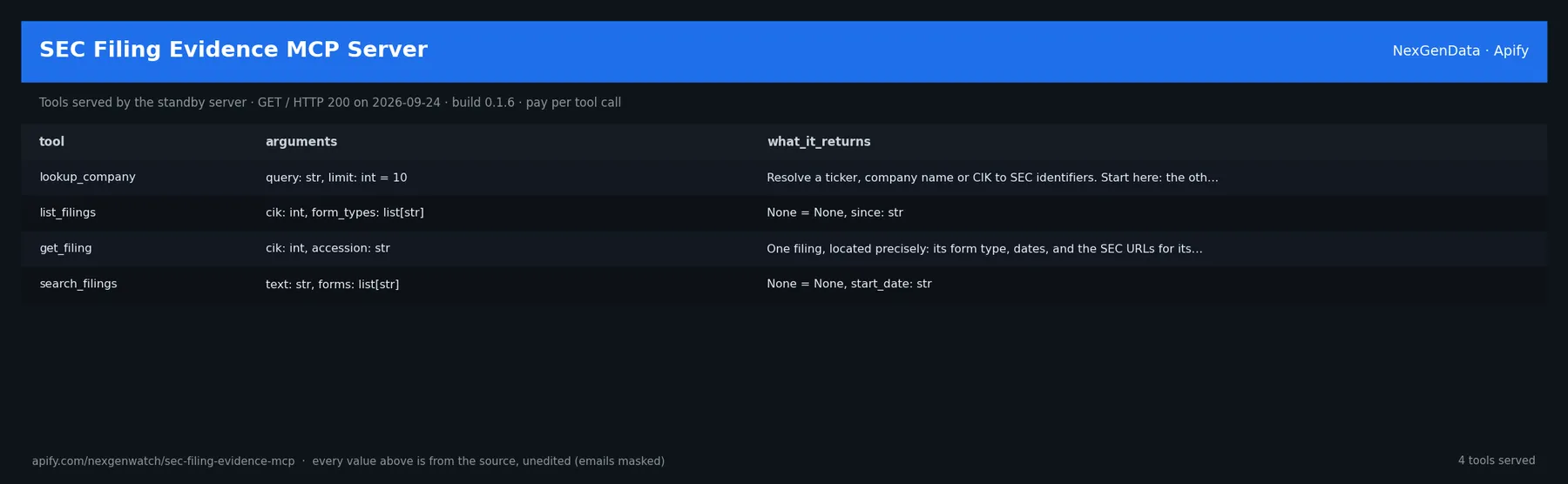
A standby server answers tool calls rather than writing a dataset, so the sample is the server's own live health answer (GET https://nexgenwatch--sec-filing-evidence-mcp.apify.actor/, HTTP 200, read on 2026-09-17) followed by its tool table:
| Tool | Arguments | What it returns |
|---|---|---|
lookup_company | query: str, limit: int = 10 | Resolve a ticker, company name or CIK to SEC identifiers. Start here: the other tools take a CIK, and this is what turns 'Apple' or 'AAPL' into one. |
list_filings | `cik: int, form_types: list[str] | None = None, since: str |
get_filing | cik: int, accession: str | One filing, located precisely: its form type, dates, and the SEC URLs for its index page and primary document. Use the accession number from list_filings. |
search_filings | `text: str, forms: list[str] | None = None, start_date: str |
✅ What you get
4 tools, each returning a JSON object built only from what the source answered. A lookup the source answers with 'not found' is a sourced answer (charged); malformed input or a source failure returns a notice that is NOT charged; nothing is ever fabricated.
Tools
| tool | what it answers |
|---|---|
lookup_company | Turn a ticker, name or CIK into SEC identifiers. Start here. |
list_filings | Recent filings for a company, filterable by form and date, each with a document URL |
get_filing | One filing, located precisely, by accession number |
search_filings | Full-text search across filings; returns documents containing your phrase |
Sources — public, logged-out, no key
| what | endpoint |
|---|---|
| company index (10,432 companies) | www.sec.gov/files/company_tickers.json |
| filing history | data.sec.gov/submissions/CIK##########.json |
| full-text search | efts.sec.gov/LATEST/search-index |
SEC fair access
SEC asks automated clients for a declarative User-Agent with a contact address and a ceiling of 10 requests per second. This server sends the User-Agent and paces every outbound call through one shared token bucket at 8 requests per second.
That limiter is load-bearing, not decorative: measured on the build runtime, five sequential unpaced calls ran at about 12 requests a second — already over the cap with no concurrency at all. A standby server answering several agents at once would be far over it.
Honest limits
- The submissions feed carries the most recent 1,000 filings inline. Responses report
older_files_available, so an empty result for an old date range reads as a window limit, not an absence. get_filingsays when an accession is outside that window rather than implying it does not exist.- Full-text search covers 2001 onward and indexes filing documents, not every exhibit format.
⚙️ Sample inputs
1. Connect an MCP client (Claude Desktop / Cursor style config; your Apify API token goes in the header):
2. One tool call over JSON-RPC (what the client sends to /mcp; each call is one mcp-tool-call event):
3. Health check from a shell (free — no tool call is charged):
🧾 JSON sample record
The live health record above is the server's own answer; a tool result carries the fields listed in the tool table plus scope and note.
🔧 How it works
Source. data.sec.gov, efts.sec.gov, www.sec.gov — endpoints: https://data.sec.gov/api/xbrl/companyconcept/, https://data.sec.gov/submissions/CIK, https://efts.sec.gov/LATEST/search-index, https://www.sec.gov/files/company_tickers.json. Public, logged-out reads only.
Standby. Apify keeps one server process warm; each MCP session is served by that process and idle servers are stopped by the platform. Nothing is cached between calls except what the source itself caches.
Charging. Every tool call charges one mcp-tool-call at $0.05 through Apify's pay-per-event billing before the answer is returned; the declared events are asserted against the live pricing at startup (billing_gate in the health answer).
What is not done. No login, no CAPTCHA bypass, no private data, no scraping of pages the source does not publish to any visitor.
💰 Pricing example
| Event | Free | Bronze | Silver | Gold |
|---|---|---|---|---|
Actor Start (apify-actor-start) | $0.05 | $0.05 | $0.05 | $0.05 |
Tool call (mcp-tool-call) | $0.05 | $0.05 | $0.05 | $0.05 |
- 10 tool calls in one session: $0.05 start + 10 × $0.05 = $0.55
- 100 tool calls in one session: $0.05 start + 100 × $0.05 = $5.05
- 1000 tool calls in one session: $0.05 start + 1000 × $0.05 = $50.05
A health check or a connection that makes no tool call charges only the $0.05 start fee. A sourced 'not found' answer is a completed tool call and is charged; a notice for malformed input or a source failure is not charged (settle() charges only chargeable outcomes).
⚖️ Legal & ToS
The server reads public data published by data.sec.gov, efts.sec.gov, www.sec.gov to any visitor, identifies itself, and does not access accounts or private data. Use the answers in line with the source's terms and your local law; the intended use is B2B research and agent tooling.
❓ FAQ
Q: Do I need a source API key?
A: No. data.sec.gov, efts.sec.gov, www.sec.gov is read logged-out. You need only your Apify API token to connect to the server.
Q: Which MCP clients work?
A: Any client that speaks the MCP HTTP transport: Claude Desktop, Cursor, Windsurf, LangChain/LlamaIndex MCP adapters and Apify's own MCP client. Point it at the /mcp URL above.
Q: What happens when the source has no answer?
A: A sourced 'not found' (for example a 404 for an unknown identifier) comes back as an answer with scope and note explaining what was checked (where the server carries those fields), and is charged as a completed call; malformed input or a source outage returns a notice that is not charged. Nothing is invented.
Q: How is a call billed?
A: One mcp-tool-call event per tool call at $0.05, plus $0.05 when the server starts. Idle time is not billed to you.
Q: Is it rate limited?
A: The server paces requests to the source and answers calls in the order they arrive.
Q: Can I call it without an MCP client?
A: Yes — the /mcp endpoint is plain JSON-RPC over HTTP (sample input 2), and GET / is a free health check.
🆘 Troubleshooting
- 401 / 403 from the server → the Authorization header is missing or the token is wrong → use
Bearer <your Apify API token>. - 400
Missing session ID→ the client hit/mcpwithout initialising an MCP session → let the MCP client connect (it performs the handshake); raw JSON-RPC needs the session header the initialise call returns. - Tool returns a notice instead of data → the input was malformed or empty, or the source failed → the call was not charged; check the
note/reasonfield, fix the input and call again. - First call is slow → the standby server was cold and Apify started it → later calls in the same session are fast.
🔗 Related Actors
- Official Travel Advice MCP Server — MCP server for UK FCDO foreign travel advice from the official GOV.UK Content API — safety warnings, entry and health requirements, and update histor…
- Procurement Evidence MCP Server — Locate the public procurement record behind a claim across the UK, EU and US. Every row carries the awarding body's own record id and a direct public…
- Research Funding Landscape MCP Server — Answer 'who funds research on this topic' across two public government registers: US National Science Foundation awards and UK Research and Innovatio…
- Trademark Dispute MCP Server — Answer 'has anyone contested a mark like this' across the USPTO Trademark Trial and Appeal Board and the Canadian Trademarks Opposition Board. Report…
- UK Competition Case MCP Server — Answer 'is there a UK competition case touching these companies or this market' from the Competition and Markets Authority case register, with an exp…
- UK Parliament Stakeholder MCP Server — An MCP server over the official UK Parliament Members API (members-api.parliament.uk) —
- 🏢 About NexGenData — NexGen Watch is NexGenData's fleet of 256 public monitoring and lookup actors built on official sources, pay-per-result. Browse the catalog at apify.com/nexgenwatch.
⭐ Found this useful?
If this server answered a question your agent could not, a quick review on the Apify Store helps other teams find it. Feature request or a source that changed? Open it from the Issues tab — every one is read.


