
US Grants.gov Award Amount Changes Scraper
Pricing
from $335.00 / 1,000 grant opportunity deltas
US Grants.gov Award Amount Changes Scraper
Scrape US Grants.gov award funding range changes: opportunity, agency, old and new award floor and ceiling. Every run returns the current records as a dataset. Optional watch mode returns only what changed since your last run. Pay per result.
Pricing
from $335.00 / 1,000 grant opportunity deltas
Rating
0.0
(0)
Developer
NexGen Watch
Maintained by CommunityActor stats
0
Bookmarked
3
Total users
2
Monthly active users
11 days ago
Last modified
Categories
Share
🎓 US Grants.gov Award Amount Changes Scraper
Scrape US Grants.gov award funding range changes: opportunity, agency, old and new award floor and ceiling. Run it once and you get the current records as a dataset — that is the default. Turn on watch mode and a scheduled run returns only what changed since the last run (see Optional: run it on a schedule).
Changes to award ceiling, floor, or total program funding on posted opportunities.
Output is one grant_opportunity_record row per result; billing is pay-per-event, the value event being one grant opportunity delta (a $0.02 start fee per run, then $0.50 per grant opportunity delta plus one $0.10 source check per run that reads the source). Source: api.grants.gov.
Who buys this
Buyers usually search for grants.gov award amounts or federal grant funding.
- Grant consultants and research-development offices tracking grants.gov award amounts.
- Universities, nonprofits and companies watching federal grant funding relevant to their field.
- Analysts and journalists following where public funding goes.
📊 Sample Output
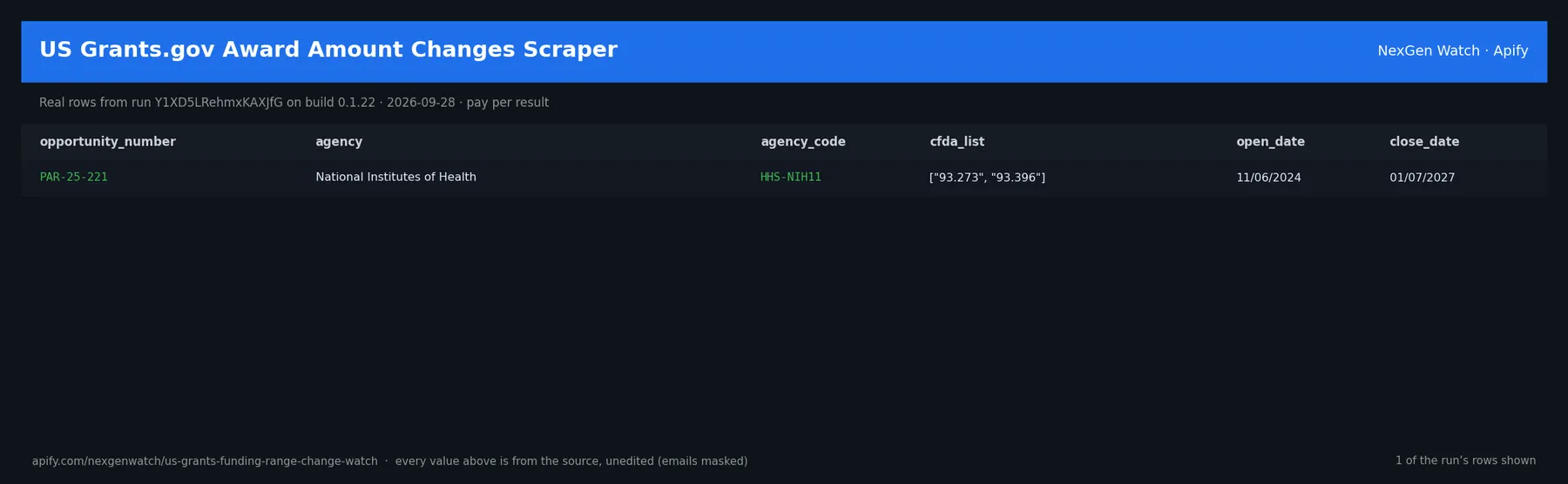
Real rows from run Y1XD5LRehmxKAXJfG on build 0.1.22 (2026-09-28), the same input as the Quick start below — every value is as the source published it (emails masked, long text shortened):
| opportunity_number | agency | agency_code | cfda_list | open_date | close_date |
|---|---|---|---|---|---|
| PAR-25-221 | National Institutes of Health | HHS-NIH11 | ["93.273", "93.396"] | 11/06/2024 | 01/07/2027 |
The run finished with the status message: NORMAL: emitted 1 item(s)
✅ What you get
Each row is flat JSON with these fields (from the dataset schema and the sample run; a field the source does not publish for a given row is null):
record_key(string/null) — e.g.grants:357021opportunity_id— e.g.357021opportunity_number— e.g.PAR-25-221title— e.g.Population Approaches to Reducing Alcohol-related Cancer Risk (R01 Clinical Triaagency— e.g.National Institutes of Healthagency_code— e.g.HHS-NIH11cfda_list— e.g.["93.273", "93.396"]open_date— e.g.11/06/2024close_date— e.g.01/07/2027opp_status— e.g.posteddoc_type— e.g.synopsisdetail_read— e.g.Trueopportunity_url— e.g.https://www.grants.gov/search-results-detail/357021award_ceiling— e.g.noneaward_floor— e.g.noneestimated_funding— null in every sample rownumber_of_awards— null in every sample rowcost_sharing— e.g.Falseapplicant_types— e.g.["00", "01", "02", "04", "05", "06", "07", "08", "11", "12", "13", "20", "22", "response_date— e.g.2027-01-07-00-00-00posting_date— e.g.2024-11-06-00-00-00attachment_count— e.g.1document_urls— null in every sample rowsynopsis_version— e.g.2modified_fields— e.g.["agencyContactDesc", "applicantEligibilityDesc", "createTimeStamp", "revision",opportunity_category— e.g.Discretionaryrecord_type(string) — e.g.grant_opportunity_recorddelta_type(string/null) — null in every sample rowdelta_kinds(array/null) — null in every sample row
✅ What you get
✅ What you get
Every run also writes a RUN_RECEIPT record to its key-value store with the source checks it made and the counts it charged — diagnostics never land in the paid dataset.
⚙️ Sample inputs
1. Quick start — the Store example (this is what the sample above came from)
The sample run charged exactly: 1 × $0.02 apify-actor-start + 1 × $0.10 source-check + 0 × $0.50 grant-opportunity-delta = $0.12 on the Free tier — snapshot preview rows are delivered unbilled; only the source check and the start fee were charged.
2. A smaller, narrowed run
Caps the run at 5 rows; same billing shape as the sample run above. opp_statuses narrows what the source is asked for.
3. Optional watch mode (changes only, for a schedule)
The first run seeds a private baseline and emits zero deltas; every later run emits one row per change, billed at $0.50 each plus the $0.10 source check; billed deltas are capped at 500 per run.
🧾 JSON sample record
One real record from run Y1XD5LRehmxKAXJfG, exactly as it lands in the dataset (emails masked, long text shortened):
🔧 How it works
Source. The actor reads api.grants.gov — endpoints: https://api.grants.gov/v1/api/fetchOpportunity, https://api.grants.gov/v1/api/search2. Public pages and feeds only; nothing behind a login.
Transport. Plain HTTPS from the Apify platform, no proxy. robots.txt is read first and a disallowed path is never fetched. Every request carries an identified contact User-Agent.
Watch semantics. Snapshot mode (watch_mode: false) returns a preview capped at 25 records. Watch mode keys every record on a source-native id, stores a private baseline in a named key-value store, and on each later run emits one delta row per change (new / changed / removed). A blocked fetch is never diffed, so a source outage cannot show up as a mass removal.
Terminal states. A run ends NORMAL, CAPPED (your cap was reached), PARTIAL (something was withheld and the message says what), GENUINE_EMPTY (the source was read and truly had nothing in scope) or BLOCKED (the source refused or changed shape — the run FAILS loud and bills nothing). A zero-row run is never reported as a silent success.
Charging. Each grant opportunity delta is charged at the moment it is pushed (grant-opportunity-delta); a row that fails to charge is not delivered, so the dataset count always equals the charged count. One source-check is charged per run that actually read the source.
🔧 How it works
🔧 How it works
You name what this Actor watches
This Actor reads fields that only exist on the per-opportunity detail record, so it must issue one request per opportunity. It will not do that across the whole live set — instead it watches exactly what you name:
opportunity_numbers— e.g.PAR-25-221. One bounded lookup each, exact-number match.agency_codes— e.g.DOI-NPS. Every live opportunity for that agency.
At least one is required. A run with neither fails immediately and says why, rather than quietly watching an arbitrary slice of the corpus and looking healthy.
Both bounds were proven to actually filter, control-vs-test on 2026-07-27 — oppNum takes
1,224 live opportunities to 1, agencies=DOI-NPS takes it to 16. A named opportunity that
resolves to nothing is reported as NOT FOUND, never dropped in silence.
Why this matters for what you pay. Pool-wide, this field family changes on the order of a dozen times a year across all 1,224 live opportunities. Watching 40 opportunities you actually care about turns that into a signal; watching 150 arbitrary ones turns it into nothing.
One delta type per Actor
This Actor watches funding-range-change and nothing else. The other delta types in this family are separate Actors, each with its own price and its own baseline — so you pay for the feed you want and no other.
Run it WEEKLY, not daily
Schedule this Actor once a week. That is a recommendation about your bill, not about coverage — a weekly run reads the same opportunities and misses nothing.
This is a bounded, low-frequency feed by construction. Measured on 2026-07-27 across 200 of the 1,234 live posted opportunities, through this Actor's own classifier: 3.00 of this Actor's events per 100 watched opportunities per year. At the maximum bound this Actor accepts — 300 opportunities — that is about 9 deltas a year, or 0.17 a week.
A daily schedule pays seven source-check events a week to re-read a set that changes a few
times a year: the check would be roughly 90% of your bill and buy no extra signal. On a weekly
schedule the per-delta event carries about 42% of the bill and you see exactly the same
changes. Override the cadence if you have a reason to.
What is not done. No login, no cookie or CAPTCHA bypass, no private or personal-account data, no browser automation.
⏰ Optional: run it on a schedule
A single run returns the current records. If you also want to be told what changed over time, open the actor in Apify Console → Schedules → Create new, add this actor with the watch-mode input above (watch_mode: true) so each run returns only the changes, and pick a cadence:
- Daily —
0 7 * * *(07:00 UTC): catch changes within a day. - Weekly —
0 7 * * 1: a Monday digest.
The baseline persists in a named key-value store between runs, so every scheduled run compares against the last one; use a different baseline_id for independent watches. Schedules can also POST results to a webhook (Console → Integrations).
💰 Pricing example
| Event | Free | Bronze | Silver | Gold |
|---|---|---|---|---|
Actor Start (apify-actor-start) | $0.02 | $0.02 | $0.02 | $0.02 |
Source check (source-check) | $0.10 | $0.09 | $0.08 | $0.067 |
Grant Opportunity Delta (grant-opportunity-delta) | $0.50 | $0.45 | $0.40 | $0.335 |
Worked at the live Free-tier price (watch mode, one delta per change):
- 1 grant opportunity deltas: $0.02 start + $0.10 source check + 1 × $0.50 = $0.62
- 25 grant opportunity deltas: $0.02 start + $0.10 source check + 25 × $0.50 = $12.62
- 1000 grant opportunity deltas: $0.02 start + $0.10 source check + 1000 × $0.50 = $500.12
A run that delivers zero rows charges the $0.02 start fee plus the $0.10 source check (the source was read and reported empty). A BLOCKED run (source refused) fails loud and charges no value event. The start fee is charged once per GB of run memory; the default run memory is 1024 MB.
Yield on the sample run: NORMAL: emitted 1 item(s). max_items is a hard ceiling on what is delivered and billed, never a target. Snapshot output is capped at 25 records regardless of the cap you set; watch mode is the full feed.
⚖️ Legal & ToS
This actor reads public, logged-out pages and feeds published by api.grants.gov. It collects only what the source publishes to any visitor, keeps to the source's robots rules (checked on every run), identifies itself with a contact User-Agent, and does not access accounts, private data or anything behind authentication. Use the output in line with the source's terms and your local law; the intended use is B2B research and monitoring.
❓ FAQ
Q: Do I need an API key or a login?
A: No. The source (api.grants.gov) is read logged-out; the input schema has no key field and the actor carries no secrets.
Q: Why did my run return 0 rows?
A: Read the run's status message. GENUINE_EMPTY means the source was read and had nothing in scope for your input (in watch mode the first run always seeds the baseline and returns zero deltas); BLOCKED means the source refused and the run failed without billing a value event — retry later or narrow the input. A zero-row run bills the start fee plus one source check.
Q: How many rows can one run return?
A: Up to max_items (default 1000); snapshot previews stop at 25. Raise the cap for a bigger run; you pay per delivered row.
Q: What does watch mode remember between runs?
A: A private baseline of source-native record ids in a named key-value store (baseline_id names it, so several independent watches can coexist). Each later run diffs the live source against it and emits only changes.
Q: How fresh is the data?
A: Every run reads the source live at run time; nothing is cached between runs except the watch baseline. Put it on a schedule for a continuous feed.
Q: What formats can I export?
A: The dataset downloads as JSON, CSV, Excel, XML or RSS from the run's Dataset tab or the Apify API, and any run can push to a webhook or integration.
Q: How is this different from the other grant and research-funding scrapers actors?
A: Same output shape and billing model; this one covers api.grants.gov. The siblings under Related Actors cover the other sources or slices — run several on one schedule for a combined feed.
🆘 Troubleshooting
- Run FAILED with BLOCKED → the source refused the request or changed its page shape → nothing was billed beyond the start fee; retry after a while, and if it persists open an Issue with the run id.
- Status says CAPPED → your cap (
max_items) was reached → raise it for a bigger run. - Input validation error on start → a field is outside the schema's allowed values → start from the Quick start block and change one field at a time.
- Run TIMED-OUT → a very wide request on a slow day → raise the run timeout in Run options or narrow the input; what was delivered before the timeout is still in the dataset.
- First watch run shows no deltas → expected: it seeds the baseline; changes appear from the second run.
🔗 Related Actors
- US Grants.gov Deadline Amendments Scraper — Scrape US Grants.gov application deadline amendments: opportunity, agency, old and new close date. Every run returns the current records as a dataset…
- US Grants.gov Eligibility Changes Scraper — Scrape US Grants.gov applicant eligibility changes: opportunity, agency and eligibility before and after. Every run returns the current records as a…
- US Grants.gov Forecast to Posted Scraper — Scrape US Grants.gov opportunities that moved from forecast to posted: opportunity, agency, amount and dates. Every run returns the current records a…
- US Grants.gov New Funding Opportunities Scraper — Scrape new US Grants.gov funding opportunities: agency, title, category, award ceiling and close date. Every run returns the current records as a dat…
- US Grants.gov Cancelled Opportunities Scraper — Scrape cancelled US Grants.gov funding opportunities: opportunity, agency and cancellation date. Every run returns the current records as a dataset.…
- US Grants.gov Funding Opportunity Changes Scraper — Scrape US Grants.gov federal funding opportunity changes: field changed, old and new values, and date. Every run returns the current records as a dat…
- 🏢 About NexGen Watch — NexGen Watch is a catalog of more than 300 public data actors built on official sources, pay-per-result. Browse the catalog at apify.com/nexgenwatch.
⭐ Found this useful?
If this actor saved you a manual check, a quick review on the Apify Store helps other teams find it. Feature request or a source that changed? Open it from the Issues tab — every one is read.


