

US NSF New Research Award Watch
Pricing
from $20.10 / 1,000 nsf award deltas
US NSF New Research Award Watch
Newly announced NSF research awards, as the register publishes them. Sourced from the public NSF Awards API, logged-out, no key.
Pricing
from $20.10 / 1,000 nsf award deltas
Rating
0.0
(0)
Developer
NexGen Watch
Maintained by CommunityActor stats
0
Bookmarked
2
Total users
1
Monthly active users
3 days ago
Last modified
Categories
Share
🎓 US NSF New Research Award Watch
Newly announced NSF research awards, as the register publishes them.
Output is one nsf_award_record row per result; billing is pay-per-event, the value event being one nsf award delta (a $0.02 start fee per run, then $0.03 per nsf award delta plus one $0.10 source check per run that reads the source). Source: api.nsf.gov, www.nsf.gov.
📊 Sample Output
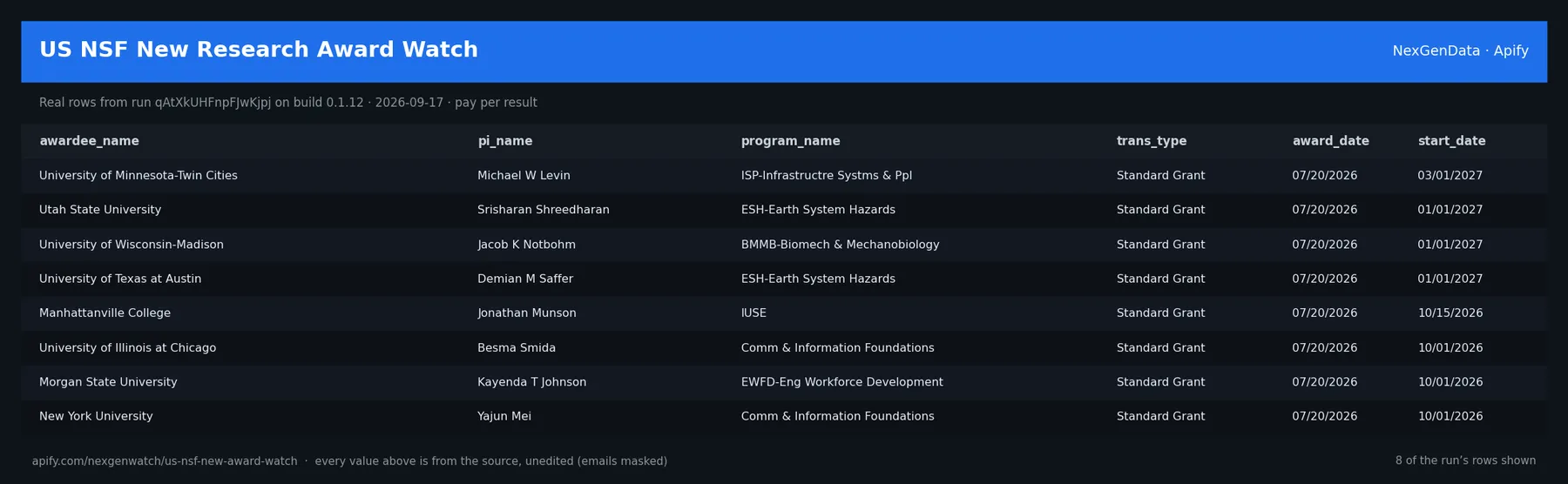
Real rows from run qAtXkUHFnpFJwKjpj on build 0.1.12 (2026-09-17), the same input as the Quick start below — every value is as the source published it (emails masked, long text shortened):
| awardee_name | pi_name | program_name | trans_type | award_date | start_date |
|---|---|---|---|---|---|
| University of Minnesota-Twin Cities | Michael W Levin | ISP-Infrastructre Systms & Ppl | Standard Grant | 07/20/2026 | 03/01/2027 |
| Utah State University | Srisharan Shreedharan | ESH-Earth System Hazards | Standard Grant | 07/20/2026 | 01/01/2027 |
| University of Wisconsin-Madison | Jacob K Notbohm | BMMB-Biomech & Mechanobiology | Standard Grant | 07/20/2026 | 01/01/2027 |
| University of Texas at Austin | Demian M Saffer | ESH-Earth System Hazards | Standard Grant | 07/20/2026 | 01/01/2027 |
| Manhattanville College | Jonathan Munson | IUSE | Standard Grant | 07/20/2026 | 10/15/2026 |
| University of Illinois at Chicago | Besma Smida | Comm & Information Foundations | Standard Grant | 07/20/2026 | 10/01/2026 |
| Morgan State University | Kayenda T Johnson | EWFD-Eng Workforce Development | Standard Grant | 07/20/2026 | 10/01/2026 |
| New York University | Yajun Mei | Comm & Information Foundations | Standard Grant | 07/20/2026 | 10/01/2026 |
The run finished with the status message: PARTIAL: emitted 25 item(s); ITEM CAP REACHED: max_items (10) stopped the walk at 07/21/2026, so award dates from there to 07/24/2026 were not read. Raise max_items or narrow the date window.; INCOMPLETE DAYS: 1 day(s) r
✅ What you get
Each row is flat JSON with these fields (from the dataset schema and the sample run; a field the source does not publish for a given row is null):
record_key(string/null) — e.g.nsf:2609977record_kind— e.g.awardaward_id— e.g.2609977title— e.g.Fast Optimization Methods for Transportation Network Design under User Equilibriawardee_name— e.g.University of Minnesota-Twin Citiesawardee_state— e.g.MNawardee_city— e.g.MINNEAPOLISpi_name— e.g.Michael W Levinprogram_name— e.g.ISP-Infrastructre Systms & Ppltrans_type— e.g.Standard Grantaward_date— e.g.07/20/2026start_date— e.g.03/01/2027end_date— e.g.02/28/2030estimated_total_amt— e.g.350000funds_obligated_amt— e.g.350000cfda_number— e.g.47.041award_url— e.g.https://www.nsf.gov/awardsearch/showAward?AWD_ID=2609977matched_awardee— e.g.Falsematched_pi— e.g.Falserecord_type(string) — e.g.nsf_award_recorddelta_type(string/null) — null in every sample rowdelta_kinds(array/null) — null in every sample row
⚙️ Sample inputs
1. Quick start — the Store example (this is what the sample above came from)
The sample run charged exactly: 1 × $0.02 apify-actor-start + 1 × $0.10 source-check + 0 × $0.03 nsf-award-delta = $0.12 on the Free tier — snapshot preview rows are delivered unbilled; only the source check and the start fee were charged.
2. A smaller, narrowed run
Caps the run at 5 rows; same billing shape as the sample run above. date_from narrows what the source is asked for.
3. Watch mode on a schedule
The first run seeds a private baseline and emits zero deltas; every later run emits one row per change, billed at $0.03 each plus the $0.10 source check; billed deltas are capped at 500 per run.
🧾 JSON sample record
One real record from run qAtXkUHFnpFJwKjpj, exactly as it lands in the dataset (emails masked, long text shortened):
🔧 How it works
Transport. Plain HTTPS from the Apify platform, no proxy. Every request carries an identified contact User-Agent.
Charging. Each nsf award delta is charged at the moment it is pushed (nsf-award-delta); a row that fails to charge is not delivered, so the dataset count always equals the charged count. One source-check is charged per run that actually read the source.
Source
NSF public Awards API (public, logged-out)
Public, logged-out only — no API key, login, cookie or CAPTCHA.
The eight delta types
| value | fires when |
|---|---|
new-award | an award appears in the window |
award-obligation-change | obligated or estimated funding moves |
award-end-date-change | the award start or end date moves |
recipient-award-win | a new award matches awardee_contains |
small-business-award | a new award's programme is SBIR or STTR |
investigator-new-award | a new award matches pi_contains |
program-funding-momentum | a programme's award count or obligated total moves |
geography-funding-shift | a state's award count or obligated total moves |
Leave delta_types empty for all eight. Every delta carries delta_kinds naming
which ones it satisfied — one new SBIR award to a watched recipient can satisfy four.
The two rollup types need an explicit date_from and date_to. A rolling window
would report movement on every run purely because the window moved, so they are
refused without one, and the window is part of the baseline identity.
How the window is read
The source has no sort parameter and its default order is not by date, so recency
comes from the date window, walked day by day. Each day is read to completion and
checked against the API's own totalCount; a day that comes back short is reported
as a named PARTIAL rather than left as a silent hole in the baseline.
Snapshot mode is a PREVIEW
watch_mode: false returns at most 25 records, hard-capped in code, labeled
output_mode: "preview". This actor sells change detection, not bulk export.
Watch semantics
The first watch run stores a private baseline and emits zero deltas. Billed
deltas are capped at 500 per run; the overflow is a named PARTIAL withholding, never
billed, re-detected next run. When a read is truncated, REMOVED is suppressed.
Terminal states
NORMAL · SUCCEEDED-0: GENUINE_EMPTY · SUCCEEDED-0 (no change) · PARTIAL · BLOCKED.
A zero with no evidence FAILS loud rather than exiting 0 quietly.
One delta type per Actor
This Actor watches new-award and nothing else. The other delta types in this family are separate Actors, each with its own price and its own baseline — so you pay for the feed you want and no other.
What is not done. No login, no cookie or CAPTCHA bypass, no private or personal-account data, no browser automation.
⏰ Set it on a schedule
A single run is a snapshot. The value is the feed: open the actor in Apify Console → Schedules → Create new, add this actor with input 3 above (watch_mode: true), and pick a cadence:
- Daily —
0 7 * * *(07:00 UTC): catch changes within a day. - Weekly —
0 7 * * 1: a Monday digest.
The baseline persists in a named key-value store between runs, so every scheduled run compares against the last one; use a different baseline_id for independent watches. Schedules can also POST results to a webhook (Console → Integrations).
💰 Pricing example
| Event | Free | Bronze | Silver | Gold |
|---|---|---|---|---|
Actor Start (apify-actor-start) | $0.02 | $0.02 | $0.02 | $0.02 |
Source check (source-check) | $0.10 | $0.09 | $0.08 | $0.07 |
NSF Award Delta (nsf-award-delta) | $0.03 | $0.03 | $0.02 | $0.02 |
Worked at the live Free-tier price (watch mode, one delta per change):
- 8 nsf award deltas: $0.02 start + $0.10 source check + 8 × $0.03 = $0.36
- 25 nsf award deltas: $0.02 start + $0.10 source check + 25 × $0.03 = $0.87
- 1500 nsf award deltas: $0.02 start + $0.10 source check + 1500 × $0.03 = $45.12
A run that delivers zero rows charges the $0.02 start fee plus the $0.10 source check (the source was read and reported empty). A BLOCKED run (source refused) fails loud and charges no value event. The start fee is charged once per GB of run memory; the default run memory is 1024 MB.
Yield on the sample run: PARTIAL: emitted 25 item(s); ITEM CAP REACHED: max_items (10) stopped the walk at 07/21/2026, so award dates from there to 07/24/2026 were not read. Raise max_items or narrow the date window.; INCOMPL. max_items is a hard ceiling on what is delivered and billed, never a target. Snapshot output is capped at 25 records regardless of the cap you set; watch mode is the full feed.
⚖️ Legal & ToS
This actor reads public, logged-out pages and feeds published by api.nsf.gov, www.nsf.gov. It collects only what the source publishes to any visitor, identifies itself with a contact User-Agent, and does not access accounts, private data or anything behind authentication. Use the output in line with the source's terms and your local law; the intended use is B2B research and monitoring.
❓ FAQ
Q: Do I need an API key or a login?
A: No. The source (api.nsf.gov, www.nsf.gov) is read logged-out; the input schema has no key field and the actor carries no secrets.
Q: Why did my run return 0 rows?
A: Read the run's status message. GENUINE_EMPTY means the source was read and had nothing in scope for your input (in watch mode the first run always seeds the baseline and returns zero deltas); BLOCKED means the source refused and the run failed without billing a value event — retry later or narrow the input. A zero-row run bills the start fee plus one source check.
Q: How many rows can one run return?
A: Up to max_items (default 1500); snapshot previews stop at 25. Raise the cap for a bigger run; you pay per delivered row.
Q: What does watch mode remember between runs?
A: A private baseline of source-native record ids in a named key-value store (baseline_id names it, so several independent watches can coexist). Each later run diffs the live source against it and emits only changes.
Q: How fresh is the data?
A: Every run reads the source live at run time; nothing is cached between runs except the watch baseline. Put it on a schedule for a continuous feed.
Q: What formats can I export?
A: The dataset downloads as JSON, CSV, Excel, XML or RSS from the run's Dataset tab or the Apify API, and any run can push to a webhook or integration.
Q: How is this different from the other grant and research-funding watches actors?
A: Same output shape and billing model; this one covers api.nsf.gov, www.nsf.gov. The siblings under Related Actors cover the other sources or slices — run several on one schedule for a combined feed.
🆘 Troubleshooting
- Run FAILED with BLOCKED → the source refused the request or changed its page shape → nothing was billed beyond the start fee; retry after a while, and if it persists open an Issue with the run id.
- Status says CAPPED → your cap (
max_items) was reached → raise it for a bigger run. - Input validation error on start → a field is outside the schema's allowed values → start from the Quick start block and change one field at a time.
- Run TIMED-OUT → a very wide request on a slow day → raise the run timeout in Run options or narrow the input; what was delivered before the timeout is still in the dataset.
- First watch run shows no deltas → expected: it seeds the baseline; changes appear from the second run.
🔗 Related Actors
- US NSF Award Obligation Change Watch — US NSF Award Obligation Change Watch — one structured record per entity from the official public source, deduplicated, pay-per-record
- US NSF Geographic Funding Shift Watch — Rolled-up NSF funding movement by state — a trend feed, not an award feed. Sourced from the public NSF Awards API, logged-out, no key
- US NSF Principal Investigator Award Watch — New NSF awards to the principal investigators you name. Sourced from the public NSF Awards API, logged-out, no key
- US NSF Program Funding Momentum Watch — Rolled-up funding movement by NSF program — a trend feed, not an award feed. Sourced from the public NSF Awards API, logged-out, no key
- US NSF Recipient Award Win Watch — New NSF awards to the institutions you name. Sourced from the public NSF Awards API, logged-out, no key
- US NSF SBIR/STTR Small Business Award Watch — NSF small-business (SBIR/STTR) awards as they are announced. Sourced from the public NSF Awards API, logged-out, no key
- 🏢 About NexGenData — NexGen Watch is NexGenData's fleet of 256 public monitoring and lookup actors built on official sources, pay-per-result. Browse the catalog at apify.com/nexgenwatch.
⭐ Found this useful?
If this actor saved you a manual check, a quick review on the Apify Store helps other teams find it. Feature request or a source that changed? Open it from the Issues tab — every one is read.


