

UK Planning Data Extractor (applications, listed buildings)
Pricing
from $0.50 / 1,000 record extracteds
UK Planning Data Extractor (applications, listed buildings)
Extract UK planning applications, conservation areas, listed buildings, tree preservation orders and 40+ other datasets from the official planning.data.gov.uk open-data API. No key, Open Government Licence.
Pricing
from $0.50 / 1,000 record extracteds
Rating
0.0
(0)
Developer

Plotbench Studio
Maintained by CommunityActor stats
0
Bookmarked
2
Total users
1
Monthly active users
a month ago
Last modified
Categories
Share
UK Planning Data Extractor (planning applications, listed buildings, TPOs)
Extract structured records from the UK government's official planning open-data platform — planning.data.gov.uk — as a clean Apify dataset: planning applications, conservation areas, listed buildings, tree preservation orders, Article 4 directions, brownfield land, green belt, flood risk zones and 40+ other datasets, national in scope, one schema.
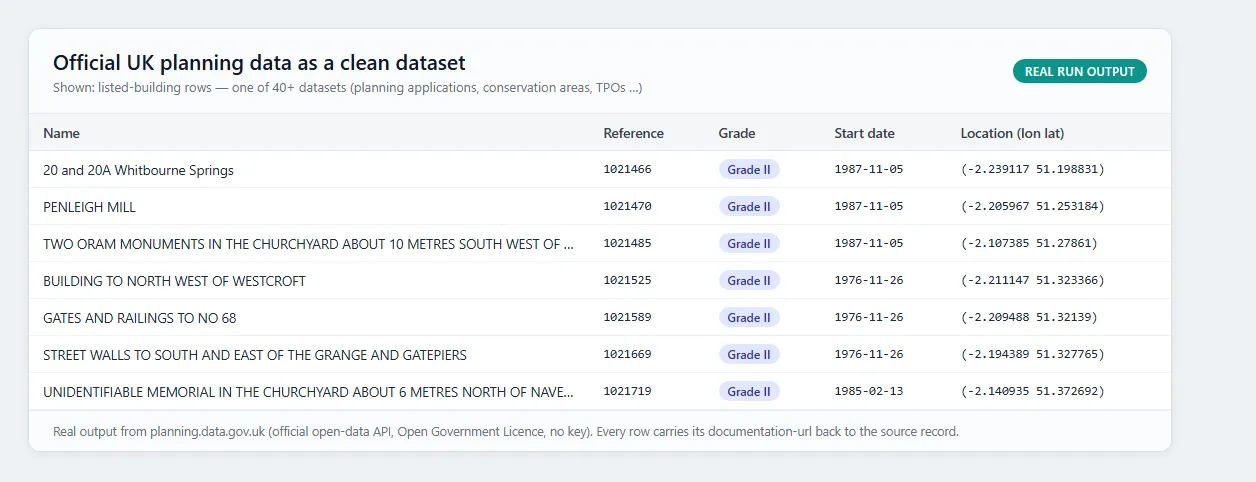
Built for people who need planning context in bulk:
- Property developers & land promoters — pull every planning application or constraint layer for a local planning authority in one run.
- Planning consultants — evidence bases and constraint reports without portal-by-portal clicking.
- PropTech products — a reliable national feed of planning records, refreshed on your schedule.
- Conveyancers / due-diligence teams — listed-building, conservation-area and TPO checks as data, not PDFs.
Why this source matters
UK planning data has historically lived in ~300 separate council portals. The government's planning.data.gov.uk programme aggregates it into one official API under the Open Government Licence — no key, no scraping, no per-council selectors that break. This actor is a thin, robust, paginating client over that official API: when councils publish, you get it.
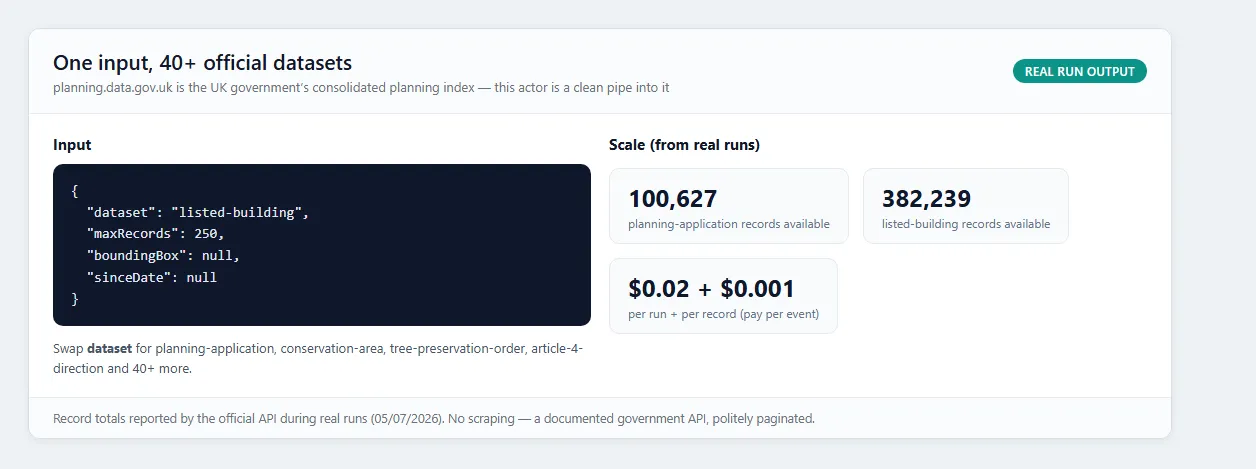
At the time of writing the platform holds 100,000+ planning applications and 380,000+ listed buildings, growing as more authorities onboard.
Input
dataset— any dataset slug from the platform (common ones offered as a dropdown; the full catalogue is at planning.data.gov.uk/dataset/).filters— optional raw API filters (local planning authority, reference, etc.).maxRecords— pagination is automatic (links.next), with polite delays and retry/backoff.
Output (one dataset row per record)
Fields vary by dataset (geometry/point included where published). Records are passed through faithfully with provenance fields added.
Pricing (pay per event)
| Event | Price |
|---|---|
| Actor start | $0.02 per run |
| Record extracted | $0.0005 per record |
A 1,000-record extract costs about $0.52. A full listed-building sweep (~382k records) about $191 — price your own usage accordingly.
Scheduling & integrations
Schedule weekly per authority and diff entry-date to catch new applications. Pipe the dataset to Google Sheets, webhooks, Make/Zapier via Apify integrations.
Fair use & data sources
This actor consumes the official, documented, keyless public API of planning.data.gov.uk, run by the Ministry of Housing, Communities and Local Government. Data is published under the Open Government Licence v3.0 (attribution: contains public sector information licensed under OGL v3.0). The actor paginates politely (250 ms delay, exponential backoff on 429/5xx). No council portals are scraped.
Limitations (told straight)
- Coverage is authority-by-authority: not every council publishes every dataset yet (the platform is expanding under a statutory programme). For planning applications specifically, coverage is strong and growing but not yet fully national — check your target authority first with a small run.
- This is the national aggregation layer, not a live mirror of each council's portal; publication lags the council source by the council's own publishing cadence.


