
Google Trends Scraper: Interest, Rising Searches ($2.50/1K)
Pricing
from $2.00 / 1,000 keyword trends
Google Trends Scraper: Interest, Rising Searches ($2.50/1K)
$2.50 per 1,000 keywords, failed inputs free. Google Trends by keyword: interest over time, peak, rising or falling, top regions, and rising and top related searches.
Pricing
from $2.00 / 1,000 keyword trends
Rating
0.0
(0)
Developer

Plumbline
Maintained by CommunityActor stats
0
Bookmarked
7
Total users
6
Monthly active users
2 days ago
Last modified
Categories
Features
Share
Google Trends by keyword: interest over time, peak, rising or falling, top regions, and rising and top related searches. For SEO teams, marketers, product researchers, and analysts who need demand data they can sort and chart.
Last verified working: 2026-11-21 (automatic live test run passed).
- Price: $2.50 per 1,000 keyword trends. No subscription; you pay only for keyword trends saved. Failed inputs are free. Try it on Apify's free plan (up to 20 keyword trends per run).
- Export: JSON, CSV, Excel, Google Sheets, or the API. Works with Make, Zapier, n8n, and AI agents (MCP).
Every run tells you plainly what worked and what did not: no silent empty runs.
What can Google Trends Scraper do?
- Trend spotting: sort by
trendDirectionandchangePercentto see which keywords are growing. - Keyword research:
risingQueriesshows breakout searches before they are crowded;topQueriesshows the steady ones. - Seasonality: chart
timelineover 5 years to plan launches, stock, and ad spend. - Market sizing by place:
topRegionsshows where interest is highest, by country or by state.
What data does Google Trends Scraper extract?
| Field | What it is | Example |
|---|---|---|
keyword | The keyword you submitted. | electric car |
type | trend or error. | trend |
geo | Country code, or Worldwide. | US |
timeRange | The time range used. | past_12_months |
dateFrom | First date of the series (YYYY-MM-DD). | 2025-10-26 |
dateTo | Last date of the series (YYYY-MM-DD). | 2026-10-25 |
searchType | web, youtube, news, images, or shopping. | web |
averageInterest | Average interest over the period (0–100). | 37.9 |
peakInterest | Highest interest value (100 unless the period is very flat). | 100 |
peakDate | Start date of the period with the peak. | 2026-04-12 |
latestInterest | Most recent value. The last period may still be in progress. | 18 |
trendDirection | rising, falling, or flat: the last quarter of the series vs the first quarter (±15%). | flat |
changePercent | Percent change from the first quarter of the series to the last quarter. | 11.8 |
timeline | Interest over time: date (YYYY-MM-DD start of the period), Google's label, and value 0–100. | [{"date": "2025-10-26", "label": "Oct 26 – Nov 1, …, …] |
topRegions | Regions with interest, highest first (code, name, value 0–100). | [{"code": "US-WY", "name": "Wyoming", "value": 100}, …] |
risingQueries | Related searches that grew the most: growth as shown ("Breakout" or "+850%") and growthPercent. | [{"query": "healthy meals", "growth": "+1,350%", "…, …] |
topQueries | Most popular related searches with a 0–100 score. | [{"query": "best electric car", "score": 100}, …] |
relatedTopics | Related topics when Google shows them. Often empty. | |
trendsUrl | Opens the same view on trends.google.com. | https://trends.google.com/trends/explore?q=electric+car&geo=US |
Examples come from a real run. Every row has every field; a value the page did not show is null, never guessed.
One row per keyword with the full timeline, regions, and related searches inside.
How to use Google Trends Scraper
- Click Try for free (or Start) on this page.
- Enter one keyword per line in the first field. The form is prefilled with a working example.
- Optional: set Max results and the other options.
- Click Start. Open the Output tab, or export JSON, CSV, Excel, or HTML.
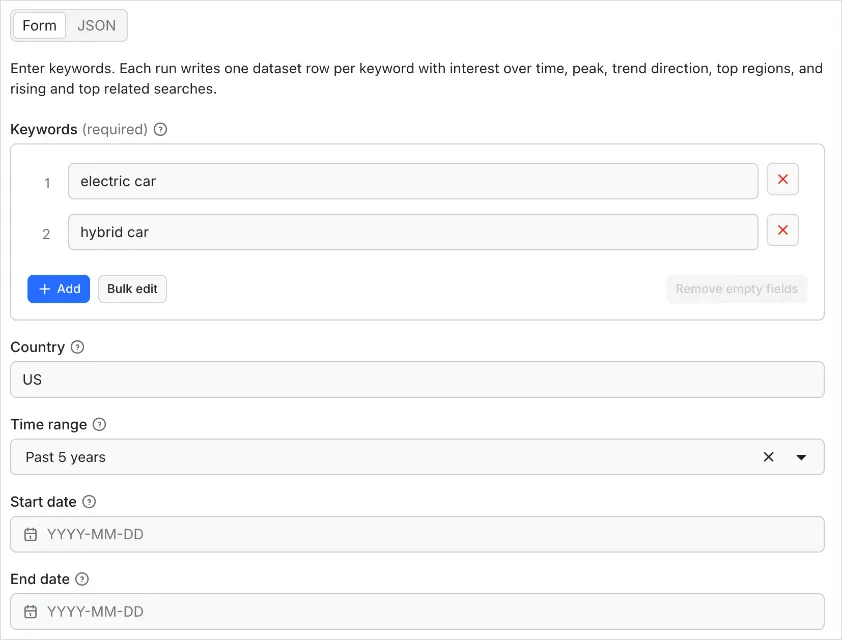
Example input
Example output
One real row from a run on 27 October 2026 (long values shortened here):
How much does Google Trends Scraper cost?
Pay per result: $2.50 per 1,000 keyword trends, plus $0.001 per run start. No subscription. With Apify's Store discounts: $2.25 per 1,000 on the Silver tier, $2.00 on Gold and above.
| Event | When | Price |
|---|---|---|
| Actor start | Once per run (per GB of memory; the default 256 MB counts as one) | $0.001 |
| Keyword trend | Each keyword trend saved to the dataset | $0.0025 |
| Example | Rows | Cost |
|---|---|---|
| 10 keywords | 10 | $0.001 + $0.025 = $0.026 |
| 100 keywords | 100 | $0.001 + $0.25 = $0.251 |
| 1,000 keywords | 1,000 | $0.001 + $2.50 = $2.501 |
- Retries after a bot check or a temporary error cost you nothing. You pay only for rows saved.
- An input that fails after all retries saves one error row so you can see what failed and why. Error rows are free.
- On Apify's free plan a run stops at 20 rows. Any paid Apify plan removes this limit.
- Set Max total charge per run in the run options. The Actor stops cleanly at that limit and keeps every row saved so far.
What you can count on
- Same columns on every row. Missing values are
null, so spreadsheets and databases never break. - No silent failures. An input that fails gets an error row with
errorCodeand a plain-languageerrorMessage. The other inputs keep running. - A clear run summary. The run status says how many results were saved, how many inputs failed, and why. The same numbers are saved as the
RUN_SUMMARYrecord in the run's key-value store, for automations. - Automatic retries. Bot checks and temporary errors are retried with a fresh request before an input counts as failed.
- Limits respected. Max results and your spending limit stop the run cleanly.
Google Trends Scraper API for code, automations, and AI agents
API (returns the rows when the run finishes):
Python (pip install apify-client):
JavaScript (npm install apify-client):
No-code: connect the Actor in Make, Zapier, n8n, or Google Sheets through Apify's integrations, or add a webhook to get notified when a run finishes.
AI agents (MCP): add https://mcp.apify.com?tools=plumblinedata/google-trends-scraper to Claude, Cursor, or any MCP client. The agent can call this Actor as a tool with the same input as above.
Limitations
- Values are 0–100, relative to the keyword's own peak in the chosen place and time. They are not search counts.
- Each keyword is measured on its own, so values of two keywords are not on the same scale.
- Keywords with very little search volume get an error row with
no_trend_data. trendDirectioncompares the last quarter of the series with the first quarter. The latest period can still be in progress.- Related topics are often empty; related searches are almost always filled.
FAQ
Which countries work?
Any two-letter country code, such as US, GB, IN, DE, or BR. Leave Country empty for worldwide.
Can I measure YouTube or Google Shopping searches?
Yes. Set Search type to YouTube, News, Images, or Google Shopping.
How do I open the same chart on Google?
Each row has trendsUrl, which opens the same keyword, place, and dates on trends.google.com.
What does an error row mean?
It marks an input that failed after retries. errorCode is short (blocked, empty_result, not_available, http_404, or invalid_... for a bad ID or URL) and errorMessage says what to do. Remove error rows with a filter on type.
Can I run it on a schedule?
Yes. Create a task with your input in Apify Console, then add a schedule (for example every day at 8:00).
Is it legal to collect this data?
The Actor reads public pages that anyone can open without logging in. You are responsible for how you use the data, including copyright, personal data rules such as GDPR, and the site's terms. If you are not sure, ask a lawyer.
How do I scrape Google Trends data?
Put your keywords in Keywords (keywords) and pick a Time range (timeRange). Each keyword returns interest over time, peak, top regions, and related searches.
How to find rising searches on Google Trends
Run your topic in Keywords (keywords). risingQueries lists the breakout searches and topQueries the steady ones.
How to export Google Trends data for several keywords to CSV
Add each keyword to Keywords (keywords), run, and download the dataset as CSV or JSON. timeline holds each keyword's full series.
Related Actors
| Actor | What it does |
|---|---|
| Google Search Scraper | Google search results with AI Overview and People Also Ask |
| Google News Scraper | Google News results by keyword |
| YouTube Search Scraper | YouTube search results by keyword |
Support
Found a problem or need a field? Open an issue on the Issues tab. Include the run ID and one input that shows the problem. We read every issue.


