Same Product Image Matcher
Pricing
from $2.00 / 1,000 candidate scoreds
Same Product Image Matcher
Pricing
from $2.00 / 1,000 candidate scoreds
Rating
0.0
(0)
Developer

QuarryLane
Maintained by CommunityActor stats
0
Bookmarked
2
Total users
1
Monthly active users
16 days ago
Last modified
Categories
Features
Share
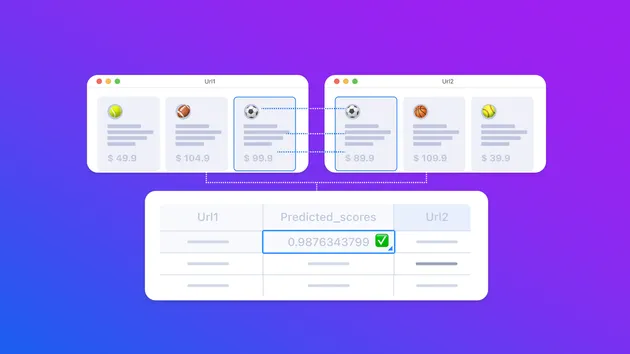
Is this the same product? Give the photos of your product and a list of candidate listings (for example the results of a 1688, AliExpress, Alibaba or Amazon scraper run). The Actor compares every photo of your product with every photo of each candidate, scores them, ranks the candidates and flags the likely matches.
Built for sourcing (finding the supplier of a product), price monitoring (matching your products to other shops' listings when titles differ) and spotting copies.
What you get
One row per candidate:
| Field | Meaning |
|---|---|
queryId, candidateId | Your product and the candidate (your IDs, or the dataset's url) |
rank | 1 = the candidate most like your product |
score | Similarity of the best-matching pair of photos, 0 to 1 |
verdict | likely_same (score ≥ 0.90), possible (0.80–0.90), different (below 0.80), or no_usable_photos |
queryImage, candidateImage | The two photos that matched best, to check by eye |
imageErrors | Photos that couldn't be downloaded or read |
candidate | The candidate exactly as you gave it (every field of the dataset item) |
Embed mode instead returns a 768-number vector for each image, to build your own product search.
How well it works
Measured on 300 products from Amazon Berkeley Objects, comparing two sets of photos of the same product that share no photo:
- among lookalike products of the same type from other brands, the right product ranks first 89% of the time;
- at a score of 0.90, it finds 60% of true matches while under 2% of other-brand lookalikes pass.
On real eBay sellers' photos (Stanford Online Products, 119 products in 12 categories), the right product ranks first among its category 97% of the time, and at 0.90 it finds 69% of true matches with 0.5% false matches.
Limits, plainly:
- It compares photos only. The same model in another colour, size or pack size usually looks the same and scores like a match: check titles or prices for those.
- Two different sellers photographing the same product in different styles (a 1688 studio shot against an Amazon listing) is untested and likely scores lower than the figures above. The eBay test is easier: both photo sets of a product come from the same seller, and the rivals are random products of the category rather than lookalikes.
- More photos per listing (different angles) match much better than one photo each.
- It is for product photos. Don't use it to match people's faces.
This is the off-the-shelf version of the model; a version trained for product matching may follow.
Input
Option 1, JSON: queries, a list of your products, each with images (up to 8 photo
URLs) and candidates (each with id and images). Up to 200 candidates per product.
Option 2, a dataset: datasetId (for example a scraper run's default dataset) plus
queryImages (your product's photos). The Actor reads the photo URLs from the fields named
in imageFields (default: images, imageUrls, imageUrl, image, thumbnail,
mainImage; dots for nested fields).
Pricing
Pay per event: one candidate scored, or one image embedded. Candidates with no usable photo are not charged. When you reach your spending limit, the Actor stops working on the rest (it doesn't score candidates it can't charge for) and says how many it skipped.
Credits
Accuracy figures use Amazon Berkeley Objects (CC BY 4.0, © Amazon.com) and Stanford Online
Products (Song et al., "Deep Metric Learning via Lifted Structured Feature Embedding",
CVPR 2016; eBay sellers' photos, used for evaluation only). The model is
Google's SigLIP 2 (google/siglip2-base-patch16-224, Apache-2.0).