
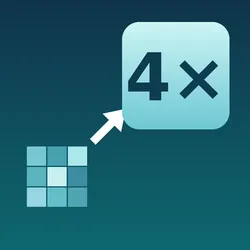
Image Upscaler 2x / 4x (CPU, clean-licence model)
Pricing
Pay per usage
Image Upscaler 2x / 4x (CPU, clean-licence model)
Upscale photos and graphics 2x, 3x or 4x from image URLs on CPU. Runs our own model, trained from scratch only on public-domain and CC0 photos, with the source of every training image listed. Batch input, PNG/JPEG/WebP output, transparency kept. No GPU, no external AI service.
Pricing
Pay per usage
Rating
0.0
(0)
Developer

Quiet Crane
Maintained by CommunityActor stats
0
Bookmarked
2
Total users
1
Monthly active users
3 days ago
Last modified
Categories
Features
Share
Make small or blurry images bigger and sharper. Give a list of image URLs and get 2x, 3x or 4x versions as PNG, JPEG or WebP. The Actor runs clean-x4, our own model trained from scratch only on public-domain and CC0 photos. The source of every training image is listed. It runs on CPU, so it needs no GPU and no external AI service. Your images are not sent anywhere else.
What it is good for
- Product photos and catalogue images that are too small for today's screens.
- Old web graphics, logos and screenshots.
- Thumbnails that need a larger version for print or a hero banner.
The model works best on photos and graphics with soft or compressed edges: it sharpens edges and removes JPEG blocks and noise. It is a restoration model, not a generative one: it does not invent new details such as faces, fine texture or text. Very small text may stay unreadable.
Input
| Field | Default | Notes |
|---|---|---|
| Image URLs | — | Direct links to JPEG, PNG or WebP files, up to 200 per run and 20 MB each. Only use images you have the right to process. |
| Scale | 4 | 2, 3 or 4. The model works at 4x; 2x and 3x are high-quality resizes of the 4x result, so they take the same time. |
| Output format | PNG | PNG (lossless, keeps transparency), JPEG (smallest, no transparency) or WebP (keeps transparency, max 16383 px per side). |
| JPEG/WebP quality | 92 | 50–100. |
| Max input size | 2 MP | Larger images are rejected from their header before decoding, with an error row, so one huge file cannot block the batch. |
Transparency is kept for PNG and WebP output, including palette PNGs. Photos are rotated according to their EXIF orientation, and colour profiles (ICC) are kept. Accepted inputs: JPEG, PNG, WebP.
Output
- Each upscaled image is saved in the run's key-value store, and its public link is in
outputUrl. - One dataset row per input:
A failed input (not an image, 404, too large) gets a row with error and does not stop the run.
Speed and cost
Measured on one CPU core, which is what a run with the default 4 GB of memory gets on Apify. Times include saving the PNG:
| Input | Output (4x) | Time |
|---|---|---|
| 512 × 512 | 2048 × 2048 | ~14 s |
| 1000 × 1000 | 4000 × 4000 | ~56 s |
| 1414 × 1414 (2 MP) | 5656 × 5656 | ~114 s |
Peak memory stayed under 0.7 GB at 2 MP. Platform usage is about 4 GB × time. For a 512 × 512 image that is about 0.018 compute units. Giving the run more memory adds CPU cores and makes it faster.
Pricing
Free during the testing period. You pay only the Apify platform usage of your runs.
Model and licence
- Weights:
clean-x4was trained from scratch for this Actor. No pretrained weights, no ImageNet/VGG features and no research-only datasets (DIV2K, LSDIR, Flickr2K and similar) were used. - Training images: 1,052 photos:
- 900 from the NASA Image and Video Library (US Government works, public domain in the US);
- 152 from Wikimedia Commons marked CC0 or Public domain.
- Provenance:
model/DATA-MANIFEST.csv, which ships inside the Actor, lists the source page, licence, credit line and SHA-256 of every image.model/NOTICE.mddescribes the architecture, training and test results. Ask on the Issues tab for a copy of either file. - Test: on 30 photos that were not used in training, after a 4x downscale, the mean PSNR is 0.52 dB above Lanczos. With blur, noise and JPEG added it is 1.65 dB above Lanczos.
- Known limits:
- Commons licence tags are set by uploaders. If a listed image is not CC0 or public domain, tell us on the Issues tab: it is removed and the model retrained without it.
- NASA's public-domain status is a US rule.
- This is a description, not legal advice.
Feedback
Open an issue on the Actor's Issues tab if an image fails or the result looks wrong. Please attach the source link.


