
Guardian Rss Scraper
Pricing
from $2.99 / 1,000 results
Guardian Rss Scraper
Guardian RSS Scraper is a Python tool designed to parse RSS feeds from The Guardian. It automatically extracts article titles, publication dates, section categories, authors, and full article links into clean CSV or JSON formats for media monitoring and news analysis.
Pricing
from $2.99 / 1,000 results
Rating
0.0
(0)
Developer

real-estate-api
Maintained by CommunityActor stats
0
Bookmarked
2
Total users
1
Monthly active users
3 days ago
Last modified
Categories
Share
The Guardian RSS Scraper: World and Technology Headlines
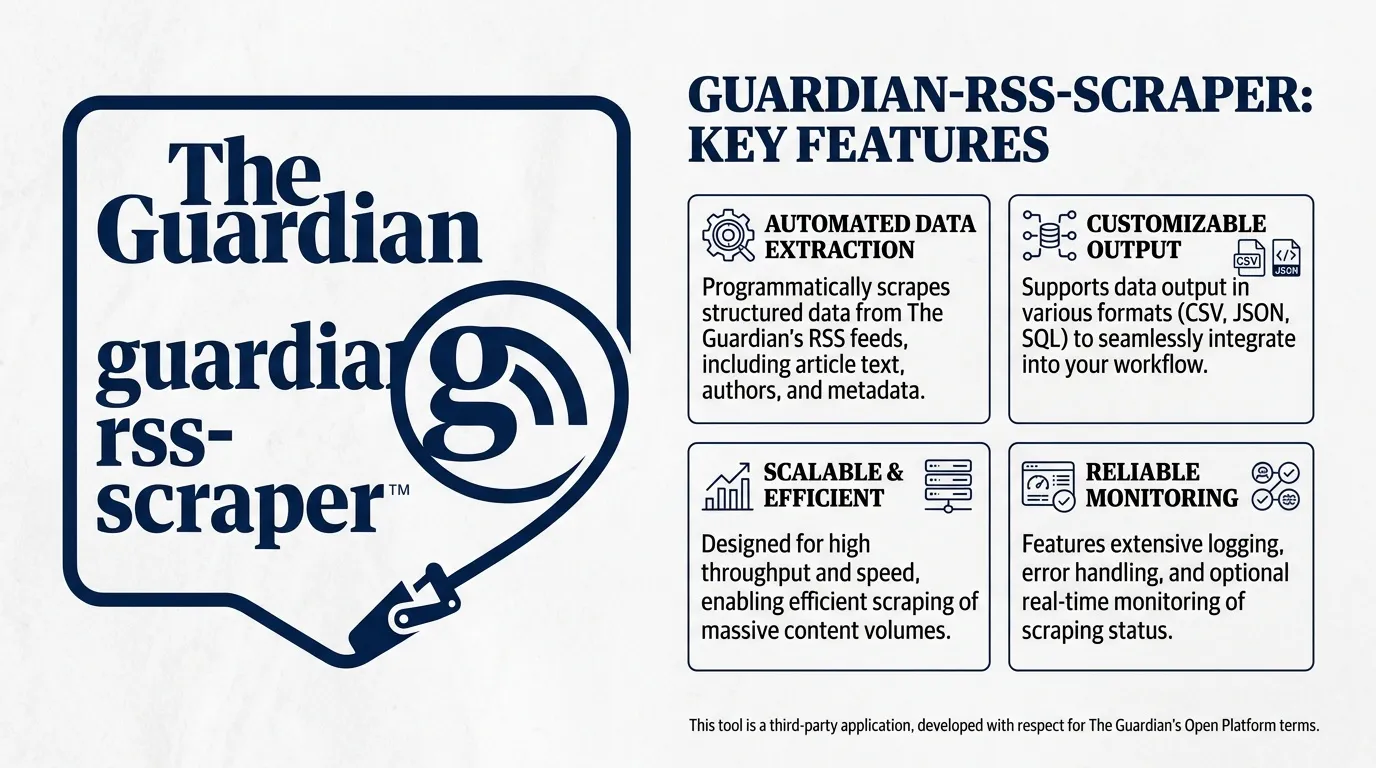
The Guardian RSS Scraper collects headlines from The Guardian's public World and Technology feeds. Each dataset row includes the headline, short summary, article link, publication date, categories, author, and image URL when available.
Export results to JSON, CSV, or Excel for news monitoring, research, and scheduled reporting. The feeds contain recent stories rather than a complete archive, so schedule recurring runs and use the guid field to identify duplicate stories.
Use Cases
- News monitoring: Track the latest World and Technology headlines on a schedule.
- Keyword tracking: Filter stories by words in their headlines or summaries.
- Research exports: Collect headlines, links, and publication dates in structured formats.
- Briefing preparation: Organize short summaries and article links for news digests.
- Duplicate detection: Compare
guidvalues across runs to identify previously collected stories.
Input Parameters
| Parameter | Type | Default | Description |
|---|---|---|---|
feedUrls | Array | World and Technology feeds | Accepted Guardian RSS feed URLs. Only the two verified feeds are processed. |
keyword | String | Empty | Optional case-insensitive filter for headlines and short summaries. |
maxItems | Integer | 100 | Maximum number of headline rows per run, from 1 to 1000. |
timeoutSecs | Integer | 300 | Overall run time limit in seconds. |
requestTimeoutSecs | Integer | 30 | Timeout for an individual feed request in seconds. |
Example Input
What Data Does This Actor Extract?
Each headline becomes one dataset row. HTML in headlines and summaries is converted to plain text. The actor collects feed metadata and short summaries, not full article bodies.
Example Output
Output Fields
| Field | Type | Description |
|---|---|---|
itemTitle | String | Headline in plain text. |
itemDescription | String or null | Short summary in plain text. |
link | String | Article URL supplied by the feed. |
categories | Array | Category labels provided by the feed. Empty when none are available. |
pubDate | String or null | Publication date from the feed. |
guid | String | Story identifier used for deduplication. |
image | String or null | Image URL when available. |
author | String or null | Author or byline when available. |
scrapedAt | String | UTC timestamp when the row was collected. |
error | String | Error description for a failed feed or invalid input. |
input | String | Value associated with the error. |
Error Handling
Invalid feed URLs, HTTP errors, and non-XML responses produce error rows. The actor continues processing the remaining feeds when possible, so one failed feed does not necessarily stop the entire run.
How It Works
- Reads the configured feed list, optional keyword, item limit, and timeout settings.
- Validates the feed URLs against the two supported Guardian sections.
- Requests each feed using a descriptive User-Agent.
- Retries HTTP 429 responses, server errors (5xx), and timeouts up to three times, with delays of 2, 4, and 8 seconds. A suitable
Retry-Aftervalue is respected when provided. - Extracts headlines, summaries, links, dates, categories, authors, and available images.
- Removes duplicate
guidvalues, applies the optional keyword filter, and stops when the configured item limit is reached. - Waits one second between feeds in the same run.
Limits and Terms
- Supported feeds: Only the verified World and Technology feeds are processed.
- Recent stories only: Each feed is a single document and does not provide backward pagination through the archive.
- Item limit: The default is 100 rows, with a maximum of 1000.
- Request frequency: Schedule each feed approximately 5–15 minutes apart.
- Request handling: The actor limits simultaneous requests and retries temporary failures.
The Guardian's terms may restrict commercial use, republication, and certain AI or machine-learning uses. Review the applicable terms before using exported content, especially for commercial applications or model training.
This actor collects headlines, links, dates, categories, bylines, image URLs, and short summaries rather than full article bodies. You are responsible for complying with applicable source terms, copyright requirements, attribution rules, and other relevant restrictions.
Pricing: The actor is free to run. Normal Apify platform usage charges may apply.
FAQ
Can I use any Guardian section feed?
No. Only the verified World and Technology feeds are supported. Other feed URLs are recorded as error rows.
How many headlines can one run save?
The default is 100, and the maximum is 1000.
What happens if a feed fails?
The actor saves an error row containing the failed input and continues with the remaining feeds when possible.
Why are the fields named itemTitle and itemDescription?
These are the dataset field names used by the actor. They contain the headline and short description supplied by the RSS feed.
Does the actor collect the full article?
No. It collects feed metadata and short summaries, not full article text.
How can I avoid duplicate stories?
Store the guid values from each run and compare them with later results before processing new stories.
Trademark Notice
The Guardian and related names, logos, and trademarks belong to their respective owners. Their use in this documentation is solely to identify the source of the data and does not imply affiliation, sponsorship, endorsement, or partnership.
Disclaimer
This actor is an independent tool and is not affiliated with, endorsed by, sponsored by, or officially associated with The Guardian or its owners. Users are responsible for complying with applicable source terms, rate limits, attribution requirements, and licensing restrictions.
Is Web Scraping Legal?
Collecting information that is already public is generally legal. Scraping is not the same thing as hacking, and there is no single law that bans it. The limits are the usual ones: do not break into accounts, do not take private or confidential data, and be careful with personal data and copyrighted works. A site's terms can also restrict how you access it. Facts such as a public name, price, or rating are not the same thing as republishing someone's article or photo.
This actor collects information from public pages. It does not log in and it does not bypass access controls.
For a longer explanation, see Apify's article Is web scraping legal?.


