Openaire Research Products Scraper
Pricing
from $1.99 / 1,000 results
Openaire Research Products Scraper
OpenAIRE Research Products Scraper is a Python tool designed to query the OpenAIRE Graph API. It extracts metadata for publications, datasets, software, and other research outputs—including author details, access rights, and funding info—into structured formats for scientific analysis.
Pricing
from $1.99 / 1,000 results
Rating
0.0
(0)
Developer

real-estate-api
Maintained by CommunityActor stats
0
Bookmarked
2
Total users
1
Monthly active users
2 days ago
Last modified
Categories
Share
OpenAIRE Research Products Scraper: EU Research Outputs & Projects
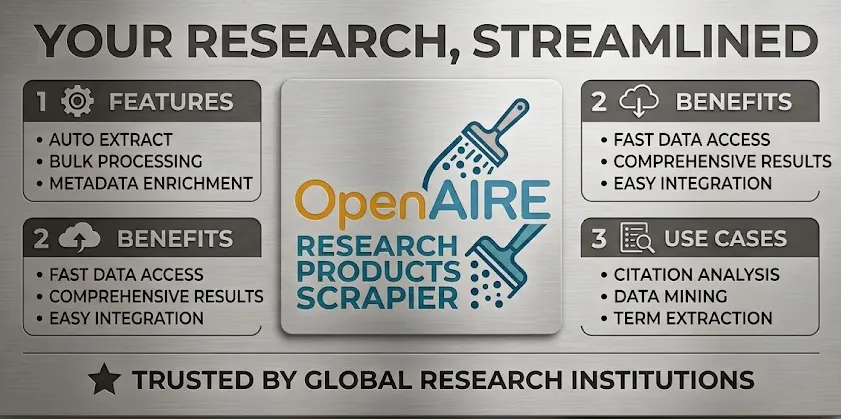
Extract research publications, datasets, software records, and funded projects from the public OpenAIRE Graph API. Collect structured research metadata using keyword-based searches without an API key or login.
Export results as JSON, CSV, or Excel through the Apify run interface.
Features
- Search research records using keywords.
- Retrieve research products or funded projects.
- Extract publication metadata, authors, subjects, funding information, and access rights.
- Convert HTML descriptions and project summaries into plain text.
- Skip duplicate records using OpenAIRE identifiers.
- Handle pagination, request timeouts, retries, and empty results.
- Save request errors and search information in structured dataset rows.
- Support scheduled runs for monitoring research outputs.
What Data Does It Extract?
Each successful row represents a research product or project. The productType field identifies the record category, while project titles are stored in mainTitle.
| Field | Description |
|---|---|
recordId | OpenAIRE record identifier used for deduplication. |
authors | Author objects associated with a research product. |
openAccessColor | Open-access color classification, when available. |
publiclyFunded | Public funding indicator, when available. |
productType | Record type, such as publication, dataset, software, or project. |
language | Language code and label. |
countries | Associated countries, when available. |
subjects | Subject classification objects. |
mainTitle | Research product title or project title. |
subTitle | Subtitle, when available. |
descriptions | Plain-text research product descriptions. |
publicationDate | Publication date. |
publisher | Publisher name. |
embargoEndDate | End date of an access embargo. |
sources | Source information. |
formats | Available format information. |
contributors | Contributor information. |
coverages | Coverage information. |
bestAccessRight | Access-right code, label, and scheme. |
container | Container or publication venue information. |
documentationUrls | Documentation references. |
codeRepositoryUrl | Software repository reference. |
programmingLanguage | Programming language information. |
contactPeople | Associated contact people. |
contactGroups | Associated contact groups. |
tools | Related tools. |
projectCode | Grant or project identifier. |
acronym | Project acronym. |
websiteUrl | Project website reference. |
startDate | Project start date. |
endDate | Project end date. |
callIdentifier | Funding call identifier. |
keywords | Project keywords. |
openAccessMandateForPublications | Open-access mandate for publications. |
openAccessMandateForDataset | Open-access mandate for datasets. |
fundings | Funding objects. |
summaryText | Plain-text project summary. |
sourceUrl | API request reference associated with the row. |
scrapedAt | UTC timestamp when the row was saved. |
error | Error details, present on failed requests or empty matches when applicable. |
input | Search and entity information associated with an error row. |
Optional fields may be absent when the source does not provide their values. Most returned values are preserved as supplied by OpenAIRE, except HTML descriptions and project summaries, which are converted to plain text.
Use Cases
- Literature and software discovery: Build searchable spreadsheets of publications, datasets, and software matching a keyword.
- EU-funded project research: Collect project codes, acronyms, funding details, dates, and open-access mandates.
- Open-access analysis: Review access-right classifications alongside research titles.
- Research monitoring: Schedule recurring searches and compare record identifiers to identify new results.
- Research data management: Export structured records for literature reviews, lab notebooks, and funding research.
Input Parameters
| Parameter | Type | Default | Description |
|---|---|---|---|
search | String | python | Keyword sent to the API search parameter. |
entity | String | researchProducts | Record category: researchProducts or projects. |
maxItems | Integer | 100 | Maximum number of successful records to save. Hard cap: 1,000. |
timeoutSecs | Integer | 300 | Maximum run duration in seconds for starting new requests. |
requestTimeoutSecs | Integer | 30 | Timeout for each individual request, in seconds. |
Example Input
To collect funded projects, change entity to projects. Adjust the keyword and limits to match your research task.
Example Output
The example uses placeholders for URL values. Actual output may contain additional fields depending on the record and the information returned by OpenAIRE.
Pagination, Rate Limits, and Error Handling
The scraper queries the OpenAIRE Graph API for research products or projects. It starts at page 1 and follows subsequent pages until the reported result count is covered, a page returns no records, or maxItems is reached.
- Batch size: Requests up to 50 records per page, adjusted when fewer records are needed.
- Sequential requests: Requests run one at a time, with a 60-second wait before the next page.
- Anonymous request pacing: The scraper is configured for approximately one request per minute.
- Retries: HTTP 429 and 5xx responses, as well as request timeouts, are retried up to three additional times with waits of 2, 4, and 8 seconds.
- Retry-After: A longer
Retry-Afterresponse value takes precedence over the standard retry wait. - Other failures: A 4xx response or a successful HTTP response containing invalid JSON produces an error row.
- Empty results: An informational row is saved when a search returns no matches.
- Duplicate handling: Previously encountered record identifiers are skipped.
The maximum maxItems value is 1,000. Larger values are reduced to this limit.
Because pagination includes a 60-second interval, the default 300-second timeout may only allow the first page and a few subsequent pages. Increase timeoutSecs when collecting larger datasets. A request timeout applies to individual requests, while the run timeout limits how long the scraper continues initiating new requests.
OpenAIRE publishes different request allowances for anonymous and authenticated access. This scraper does not send an authentication token, so its request pacing is designed for anonymous use.
Data Source and Licensing
The scraper retrieves records from the public OpenAIRE Graph API, using its research products and projects endpoints. No API key or login is required.
OpenAIRE data is published under a Creative Commons Attribution (CC BY) licence, according to the source information provided for this scraper. Verify the applicable terms and attribution requirements before redistributing or commercially reusing records.
The scraper respects its configured request pacing. Do not use proxies to circumvent source-imposed rate limits or access restrictions.
Frequently Asked Questions
Does this scraper require an API key?
No. It uses public OpenAIRE Graph API endpoints without requiring a key or login.
Can I export the results to CSV, JSON, or Excel?
Yes. The Apify dataset can be downloaded in JSON, CSV, or Excel format.
How many records can one run collect?
The default is 100 records, and the maximum is 1,000 successful records per run. Larger searches may require a longer timeoutSecs value because requests are paced to avoid excessive traffic.
What happens if a search fails or returns no results?
The scraper records an error or informational row and completes the run instead of stopping unexpectedly.
Why is the record type field named productType?
The field stores the OpenAIRE record type. The name productType avoids using the generic field name type in the dataset schema. Funded project records are identified as projects.
Are all fields available for every record?
No. The fields returned depend on the type of record and the metadata supplied by OpenAIRE. Optional values may be missing.
Changelog
Version 1.0
- Added support for research products and funded projects.
- Implemented pagination and record deduplication.
- Added structured error and informational rows.
- Added request timeout handling and retry logic.
Trademark Notice
OpenAIRE and related names, logos, and trademarks belong to their respective owners. Their use in this documentation identifies the source of the data and does not imply affiliation, sponsorship, endorsement, or partnership.
Disclaimer
This is an independent tool and is not affiliated with, endorsed by, sponsored by, or officially associated with OpenAIRE or its owners.
Data is collected from publicly available sources. Users are responsible for complying with applicable source terms, rate limits, attribution requirements, licensing conditions, and privacy laws.
Is Web Scraping Legal?
Collecting publicly available information does not automatically make every subsequent use lawful. The legal requirements depend on the data collected, how it is used, and the terms that apply to the source.
- Personal data: Research records may contain names or other personal information. Applicable privacy laws, including the GDPR or CCPA where relevant, may impose requirements on collection, storage, and use.
- Copyright: Research descriptions and other content may be protected by copyright. Check the relevant licence before reproducing or redistributing content.
- Terms and attribution: Follow the source's usage terms, request limits, and attribution or licensing requirements.
- Legal advice: This section provides general information, not legal advice. Consult a qualified legal professional if you are unsure about your intended use.