Google Images Scraper
Pricing
$19.99/month + usage
Google Images Scraper
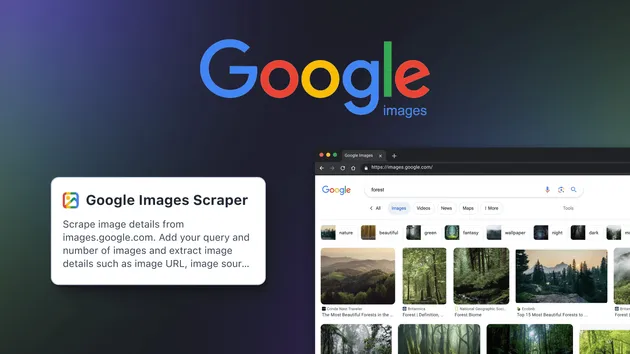
Scrape Google Images search results in seconds 🖼️🔎 Extract image URLs, titles, sources, thumbnails, and more from any keyword search. Perfect for content research, SEO analysis, dataset building, and trend discovery. Turn image data into valuable insights fast 🚀
Pricing
$19.99/month + usage
Rating
0.0
(0)
Developer

ScrapeEngine
Maintained by CommunityActor stats
0
Bookmarked
3
Total users
0
Monthly active users
3 months ago
Last modified
Categories
Share
Google Images Scraper
Google Images Scraper is a fast, Playwright-powered Google image search scraper that turns keyword queries into clean datasets of image URLs, thumbnails, dimensions, titles, source pages, and origin domains. It eliminates the manual, error-prone process of trying to download images from Google search by delivering structured data you can export and analyze. Built for marketers, developers, data analysts, and researchers, this Google image scraper helps you scrape Google image results by keyword at scale for SEO analysis, dataset building, and trend discovery. 🚀
What data / output can you get?
Below are the exact fields this Google Images scraping bot outputs to the Apify dataset for each image result.
| Data type | Description | Example value |
|---|---|---|
| query | Search query that produced the result | “technology” |
| imageUrl | Direct URL to the image | “https://miro.medium.com/v2/resize:fit:1400/1*6-dNFz13P5prRz_kYaInXg.jpeg” |
| title | Title text associated with the result | “Is Technology Ruining Your Experience ...” |
| imageWidth | Image width in pixels (if detected) | 1400 |
| imageHeight | Image height in pixels (if detected) | 1025 |
| thumbnailUrl | Thumbnail URL (falls back to imageUrl if needed) | “https://encrypted-tbn0.gstatic.com/images?q=tbn:7XZB0ElBde-RCM” |
| thumbnailWidth | Thumbnail width in pixels (default 300 if unknown) | 300 |
| thumbnailHeight | Thumbnail height in pixels (default 200 if unknown) | 200 |
| contentUrl | Source page URL where the image appears | “https://medium.com/.../is-technology-ruining-your-experience-at-work-...” |
| origin | Origin domain extracted from the source page URL | “medium.com” |
Notes:
- Results are saved to the Apify dataset, which you can export to JSON, CSV, or Excel from the Apify platform.
- Some fields (e.g., imageWidth/imageHeight) may be null if not detected; thumbnailWidth/thumbnailHeight default to 300×200 when exact dimensions aren’t available.
Key features
-
🔄 Robust proxy fallback
Starts direct, then falls back to datacenter proxy, and finally residential proxy with retries — with automatic “lock” to residential after success. This improves reliability for a SERP image scraper for Google. -
🧠 Smart block and consent handling
Detects CAPTCHA/unusual traffic pages and best-effort accepts Google consent dialogs to keep the crawl flowing. -
🖱️ Click-based extraction for accuracy
Opens image thumbnails and extracts high-quality image URLs, dimensions, titles, and source pages from live results — a dependable Google image search scraper approach. -
⚡ Real-time dataset updates
With pushToDatasetRealtime enabled, each record is saved immediately to the Output table so you can monitor progress live and automate downstream steps. -
🧹 Duplicate and noise reduction
Skips data URLs and common non-usable hosts (e.g., gstatic, googleusercontent) and de-duplicates repeated image URLs for cleaner outputs — ideal for a Google image URLs extractor. -
🧩 Memory-optimized architecture
Creates a fresh browser context per query and blocks non-essential resources (fonts, some scripts, media) to keep runs stable at scale. -
🖼️ Structured image metadata
Outputs consistent fields for image URL, thumbnail, dimensions, title, source URL, and origin domain — perfect for a Google Images dataset scraper. -
💻 Developer-friendly, Python-based
Implemented in Python with Playwright and Apify SDK — easy to integrate into automation pipelines (e.g., Google Images scraper Python workflows or via the Google Images scraper API on Apify).
How to use Google Images Scraper - step by step
-
Sign in to Apify
Create a free Apify account or log in. -
Open the actor
Find “Google Images Scraper” in the Apify Store and click Try for free. -
Add your input
In the Input tab, paste your list of keywords into queries. You can submit one or many. -
Set limits
Use maxImages to control how many images per query are collected (default 10). -
Configure proxy and mode
Optionally set proxyConfiguration to route traffic through Apify Proxy. Leave headless enabled for production stability. -
Enable live output (optional)
Keep pushToDatasetRealtime on to see each image appear instantly in the Output table. -
Start the run
Click Start. The Google image crawler will scroll, click, and extract images automatically. -
Export results
Go to the Dataset tab for your run to download results. Export to JSON, CSV, or Excel from the Apify UI or via API.
Pro tip: Chain this run in an automation (e.g., Make, Zapier, n8n) or call it from your code to orchestrate bulk download Google images workflows by using these URLs with your preferred Google image downloader.
Use cases
| Use case name | Description |
|---|---|
| SEO & marketing research | Analyze SERP image compositions by keyword, source domains, and visual trends to optimize content strategy. |
| Brand monitoring | Track how and where brand visuals appear by extracting origin and contentUrl fields from results. |
| Content sourcing | Quickly collect image URLs and titles to review and curate assets (then use a separate downloader if needed). |
| AI/ML dataset building | Scrape Google image results by keyword and export structured metadata for labeling and model training. |
| Competitive analysis | Compare which publishers and visuals dominate Google Images for your target terms. |
| Academic research | Gather image samples with traceable source pages for studies and citations. |
| API pipelines | Run as a Google Images scraper tool via Apify API and push structured results into data lakes or ETL workflows. |
Why choose Google Images Scraper?
This Google Images Scraper focuses on precision, resilience, and automation, offering a production-ready way to download images from Google search as structured metadata.
- ✅ Accurate, structured output: Clean fields for imageUrl, thumbnailUrl, dimensions, titles, contentUrl, and origin.
- ✅ Scalable by design: Per-query browser contexts and resource blocking keep large runs stable.
- ✅ Developer-ready: Python + Playwright + Apify SDK make it easy to integrate into pipelines and scripts.
- ✅ Real-time visibility: Optional live pushes to the dataset for instant monitoring and triggers.
- ✅ Safer operations: Smart block detection with proxy fallback (none → datacenter → residential).
- ✅ Better than extensions: Avoid brittle browser add-ons; use a maintained, server-side Google Images scraper alternative to a Chrome extension.
In short, it’s a reliable Google Images scraping bot for automated, repeatable workflows.
Is it legal / ethical to use Google Images Scraper?
Yes — when used responsibly. This tool extracts publicly available information from Google Images results and does not bypass authentication. As with any web data collection:
- Only use public data and respect website terms of service.
- Comply with applicable regulations (e.g., GDPR/CCPA) in your jurisdiction.
- Do not republish or commercially exploit copyrighted images without permission.
- Use proxies and automation responsibly, and consult your legal team for edge cases.
Input parameters & output format
Example input JSON
Input parameters
-
queries (array)
Description: List of search queries or keywords to scrape images for. Can be single query or multiple queries.
Default: not set (UI prefill: ["nature"])
Required: Yes -
maxImages (integer)
Description: Maximum number of images to scrape per query (1-100).
Default: 10
Required: No -
proxyConfiguration (object)
Description: Choose which proxies to use. If Google rejects the proxy, a residential proxy will be used as a fallback.
Default: not set (UI prefill: {"useApifyProxy": false})
Required: No -
headless (boolean)
Description: Run browser in headless mode (recommended for production)
Default: true
Required: No -
pushToDatasetRealtime (boolean)
Description: If enabled, each scraped image is saved to the actor Output table immediately (recommended). If disabled, all results are saved at the end.
Default: true
Required: No
Example output (dataset items)
Notes:
- The actor pushes each record with keys: query, imageUrl, title, imageWidth, imageHeight, thumbnailUrl, thumbnailWidth, thumbnailHeight, contentUrl, origin.
- Some fields may be null if not detected; thumbnailWidth/thumbnailHeight default to 300×200 if unknown; origin may be “unknown” when a source cannot be determined.
FAQ
Does this Google Images Scraper download actual image files?
No. It extracts imageUrl and metadata, saving records to the dataset. You can then use a separate Google image downloader or script to fetch the files in bulk.
How many images can I collect per keyword?
Use maxImages to control per-query limits. The default is 10, and you can increase it within the allowed range to automate and download images from Google search at scale using the extracted URLs.
Can I run it as a Google Images scraper Python workflow?
Yes. The actor is built with Python and Playwright, and you can trigger it via the Apify API from your own Python scripts for end-to-end automation.
How does it handle blocks and CAPTCHAs?
It checks for block indicators (e.g., consent/CAPTCHA pages) and automatically falls back from direct → datacenter → residential proxies with retries. Enabling proxyConfiguration is recommended for stability.
What data fields are returned?
Each result includes query, imageUrl, title, imageWidth, imageHeight, thumbnailUrl, thumbnailWidth, thumbnailHeight, contentUrl, and origin — ideal for a Google image URLs extractor and Google Images dataset scraper use cases.
Can I get results in CSV or Excel?
Yes. Results are saved to the Apify dataset. From the Apify UI or API, you can export the dataset to JSON, CSV, or Excel for analysis and reporting.
Is it safe and compliant to scrape images from Google?
Yes, when done responsibly. The actor collects public metadata from Google Images results. Always respect terms of service and intellectual property rights before reusing images.
Does it work without a browser window?
Yes. headless is enabled by default for production stability. You can keep it headless for server-side automation or disable it for debugging.
Closing CTA
Google Images Scraper is built to extract structured image metadata from Google Images reliably and at scale. It delivers clean fields for URLs, thumbnails, dimensions, titles, and sources — ready for SEO analysis, dataset building, and research.
Whether you’re a marketer validating SERP visuals, a developer building a Google Images scraper API or Python workflow, or a researcher assembling training data, this Google Images scraper tool fits seamlessly into your pipeline. Use the Apify API to automate runs, integrate with your stack, and export results in the format you need.
Start turning Google image searches into actionable datasets today.